Last Updated on January 22, 2026 by Angel Melanson
The delirious, divisive ending of Danny Boyle’s 28 Years Later left audiences with a number of curiosities to chew on. What’s next for Spike as he leaves behind the relative safety of the Holy Island? Does Dr. Kelson's Bone Temple, an oasis dedicated to the fragility of mortality, survive the onslaught of ambushes from the behemothic “Alpha” Infected, Samson?
But mainly, how is Candyman director Nia DaCosta going to follow up a film that ended with a cult of Jimmy Savile-dressed ruffians doing ninja parkour off the walls of Cheddar Gorge to a soundtrack of Teletubby metal? The good news is that, with 28 Years Later: The Bone Temple, DaCosta has delivered a thrilling follow-up that not only retains both the thematic meat and visual extravagance of its predecessor, but one that also steers the tale into wild new frontiers, as tender as they are terrifying.
It’s a daunting task, taking the reins over from an auteur as established as Boyle, but DaCosta’s directorial voice is confident and clean. Along with her frequent collaborator DoP Sean Bobbitt, the Hedda director has crafted a film that – thankfully – never tries to mimic Boyle and Anthony Dod Mantle’s distinctive guerilla style, and is all the more secure in its own identity for it.
It’s clear that DaCosta’s vision of the 28 Years Later world values the same aesthetics however, chiefly, reminding us that emerging from the bleached bones and bloodshed of this rage-ravaged hellscape, like a flower through ash, is a world where flora and fauna can finally thrive again, untouched by human hands. Nature is, as the kids say, healing, and DaCosta and Bobbitt perfectly capture the immense, awe-inspiring organic beauty that reminds us of humanity's place as just another link in the food chain.

This existential sentimentality doesn’t mean The Bone Temple goes easy on us when it comes to brutality, though – far from it. If 28 Years Later evoked Boyle’s punk spirit, The Bone Temple is, as its title suggests, metal AF. The gore is grislier, the kills more vicious and the stakes more sinister than ever before. Those who cut their teeth in horror on the “torture porn” boom of the 2000s will find a lot to love in one particular barn-set bloodbath, while the final showdown culminates in a fiery theatrical set-piece that has to be seen to be believed, turning things up to eleven in more ways than one.
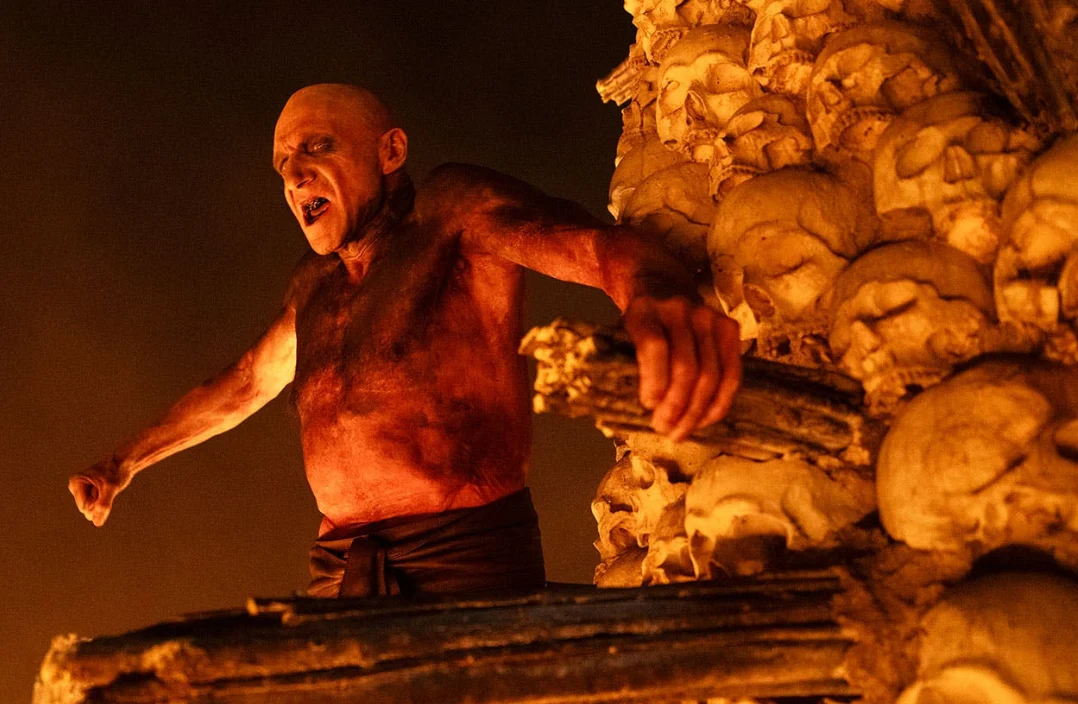
Reflecting the evolution of both the in-universe world and its cinematic journey, The Bone Temple is far more concerned with its human characters than their Infected antagonists. A boy forced into manhood far before his time, as Spike, Alfie Williams provides another heartwrenching performance, but this time around his time in the spotlight is more sidelined in favor of Ralph Fiennes, whose halcyonic Kelson, and his evolving relationship with Samson (Chi Lewis-Parry), takes center stage in an incredibly surprising, genre-defying way. Fiennes’ Shakespearean mastery of the craft remains one of the 28 series resurrection’s strongest points and now more than ever, the iodine-soaked pariah feels like a painfully necessary voice of compassion and reason in a world that has forgotten its soul.

Fiennes is also perhaps the only actor of our times who could feasibly hold his own against Jack O’Connell here, whose Sir Lord Jimmy Crystal chews up every single scene and leaves nothing but crumbs. Part Remmick from Sinners, part Cook from Skins, the maniacal cult leader rules over the Jimmies like a mad, syphilitic king, each of his lines delivered with a sadistic, foppish glee that marks Jimmy as a horror villain for the ages (although it would be wise to avoid the Saville tracksuits come Halloween season…!) Despite it all, O’Connell manages, somehow, to imbue Crystal with enough off-kilter charm to elicit empathy for a young man who lost his way in a world in which all paths had been burned before him.

Among the Jimmies themselves, Erin Kellyman, who was only seen briefly at the end of 28 Years Later’s Teletubby ninja Cheddar Gorge showdown, moves into a central role for The Bone Temple, delivering an incredible performance as Jimmy Ink, the morally questioning heart of the motley crew. As Jimmy Crystal’s own personal jester/bodyguard, Emma Laird’s cutesy but cutthroat Jimmima provides some of the biggest laughs and gasps, while newcomer Maura Bird as Jimmy Jones is a name you won’t soon forget.

The Bone Temple certainly feels like the second film in a trilogy, but that needn’t necessarily be a pejorative. In fact, in keeping with 28 Years Later’s Arthurian structure, The Bone Temple reads like a splintered-off chapter in the overall journey of any great legendary hero, the bedtime story of nightmares, and almost Tolkienistic in how it operates like a coming-of-age side quest in Spike’s evolutionary arc. There’s an argument to be made that The Bone Temple is in fact folk horror at its purest. While you won’t find any witches, forest gods or talking billy goats within, this is a film of folklore, a story within a story destined to be passed down in-universe to each new generation of survivors, mythologizing Spike in a (hopefully) healed future.
While 28 Years Later was unapologetic in its Britishness, both the good and bad of it, The Bone Temple reckons with far more universal themes – the battle of good and evil, the importance of strong, compassionate leadership, and the dire necessity of retaining one’s humanity in a world gone totally insane. This gentle diversion may well be a point of contention for viewers who were hoping to further explore the Anglocentric themes of post-colonial crisis that the first film so deftly touched upon, but that’s not to say the film is completely removed from its Brit-specific roots.
An opening set piece that sees a roving gang of aimless youths committing violence out of boredom and frustration in a dilapidated, deserted leisure center certainly feels evocative of an era of Britain marred by Tory budget cuts and classist cruelty, and while the name ‘Savile’ is never (thankfully) directly mentioned by any of his doppelgänger clan, the visual of such a culturally infamous predator leading a pack of vulnerable youths, Pied Piper-style, certainly leaves a sour pit in the stomach.
And while 28 Years Later established Kelson as a Merlinesque figure, Sir Jimmy’s religious psychosis tarnishes him with a far less flattering archetype, refering to the doctor as “Old Nick” throughout, an alternative name for the Devil that was first recorded in usage in the England of the 17th century. As demonstrated by the Holy Island in the first film, the bruised Britain of 28 Years Later faces a choice not unlike its real-world counterpart – learn from the mistakes of the past and heal to evolve, or regress into archaism. It is painfully clear that Sir Jimmy has chosen the latter.

While Boyle already let the cat out of the bag that Cillian Murphy is returning to the trilogy, far be it from us to ruin the big reveal, so all we’ll say is; yes, Jim from 28 Days Later is back, and yes, you are going to want to see his return on the biggest screen possible. Thanks to The Bone Temple’s early positive reactions, Sony has officially given the once-box office dependent third film in the 28 Years Later trilogy the greenlight, but that doesn’t let you off the hook from showing up in droves to support the film in theaters, not least because The Bone Temple is a movie that deserves, nay, needs to be seen big, loud and distraction-free. Miss it at your peril.
28 Years Later: The Bone Temple releases in theaters on January 16 via Sony Pictures. For more, make sure to grab the latest issue of FANGORIA to read our exclusive interview with director Nia DaCosta, and for more 2026 horror news, here's all the releases we're looking forward to coming this year.