Last Updated on January 29, 2026 by Angel Melanson
This article contains spoilers for 28 Years Later and 28 Years Later: The Bone Temple.
Regular Fango readers may remember that following Danny Boyle’s 28 Years Later last summer, I was filled with dread at the prospect of explaining to my American friends who Jimmy Savile was. Thankfully, I knew that upon the release of 28 Years Later: The Bone Temple, now in theaters, I had no such worry – Stateside horror fans are now plenty clued up on why they shouldn’t be donning a blond wig and ratty tracksuit for cosplay purposes, even if some of them already are.
However, there was another, more pressing concern at the forefront of my mind as I emerged bleary-eyed from the darkness of my screening and onto the busy streets of London – how exactly am I meant to explain to concerned onlookers that a Duran Duran needledrop in the fourth film of a zombie movie franchise has me in floods of tears about the state of the country I call home, and more widely, the world itself?
The Bone Temple Is As British As It Gets
Among the – admittedly very little – negative chatter surrounding 28 Years Later: The Bone Temple, a more common complaint seems to perpetuate that the hotly-anticipated sequel has less to say about Britain than its predecessor, or indeed the franchise starter 28 Days Later, due to having an American director at the helm in Candyman’s Nia DaCosta.
Not only does this assertion diminish DaCosta’s ties to this country – her father was born and raised in the UK, not to mention her extended stints living, studying and shooting here, starting with 2019’s Top Boy and most recently with the sapphic Ibsen adaptation Hedda – it’s also not true. While the Brexit analogy is certainly less on the nose, sure, this is still a film with plenty to say about Britain; the good, the bad and the ugly of it all.

Described by DaCosta as an examination of “the nature of evil”, The Bone Temple demands from us what every film in the 28 series has so far, and that is that we reassess our ideas of “good” and “bad”, particularly in relation to context, and reckon with the uncomfortable truth that human beings, in all their nuanced complexity, can never be defined as a pure example of either. Let us not forget that in 28 Days Later, series hero Jim didn’t just kill would-be rapists; he also killed an Infected child.
28 Years Later: The Bone Temple applies this same logic to its setting, reminding us that despite all of Britain’s evils both past and present, there is still a human heartbeat in the country worth saving. While 28 Years Later shot an arrow through post-colonial RETVRN fantasies, The Bone Temple urges us to consider the present, to examine the social decay left behind when a country abandons its own people, and to remember how the inhabitants of this strange, rage-ravaged world are damaged, a damage that is not, as former Tory PM and traitor David Cameron suggested when he coined the phrase “Broken Britain” back in 2011, the fault of the individual, but of circumstance.
Sympathy For The Fingers
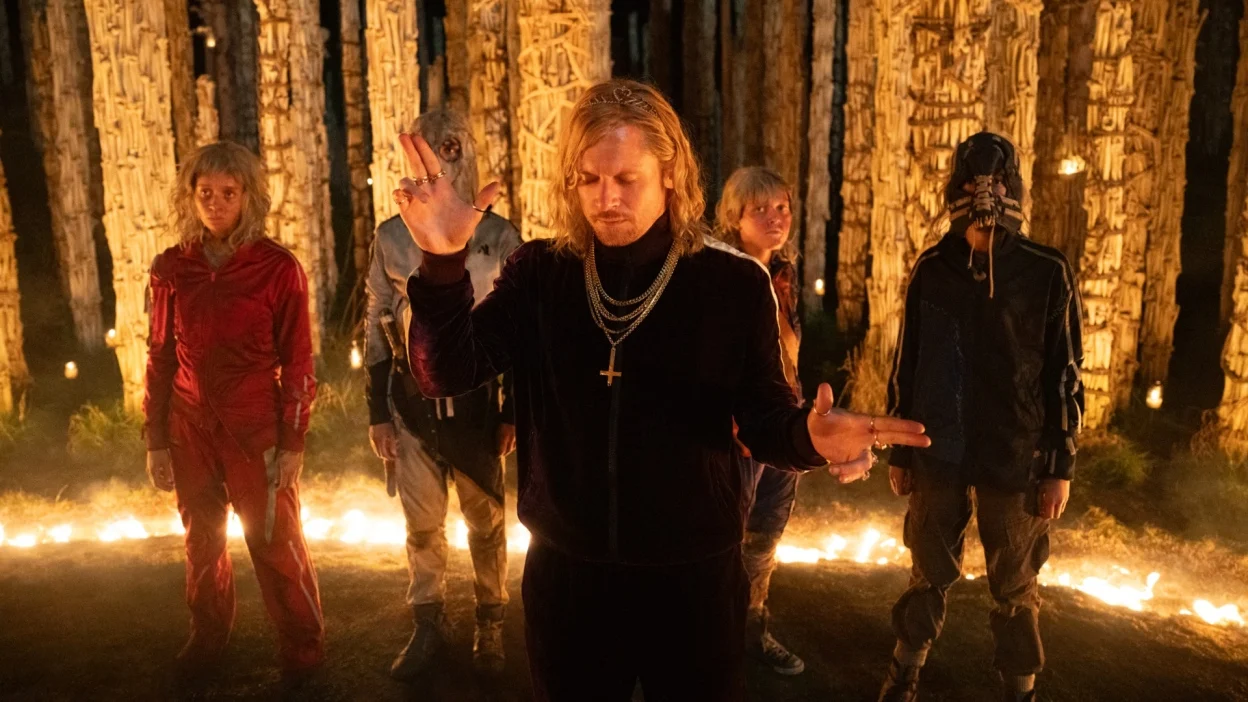
Off the bat, The Bone Temple challenges our pre-conceived notions of good and bad by introducing us in proper to the Cult of Jimmy Crystal. Initially it may seem impossible to sympathize with a roving gang of ruffians who delight in nothing more than delivering sadistic acts of “charity”, especially when said gang is dressed in the garb of one of Britain’s most notorious sexual predators. But The Bone Temple pleads with us to look beyond the velour tracksuits and into the scarred, scared faces of some of Britain’s most vulnerable.
It is no coincidence that Spike’s violent initiation to become a Jimmy takes place in an abandoned leisure center, a setting clearly representative of Conservative cuts that have gutted much-needed third spaces. Fittingly, these scenes were shot in Bradford, one of the UK’s most deprived areas, and a city painfully affected by the more than £42 million that has been axed from councils' sports and leisure budgets since 2010.
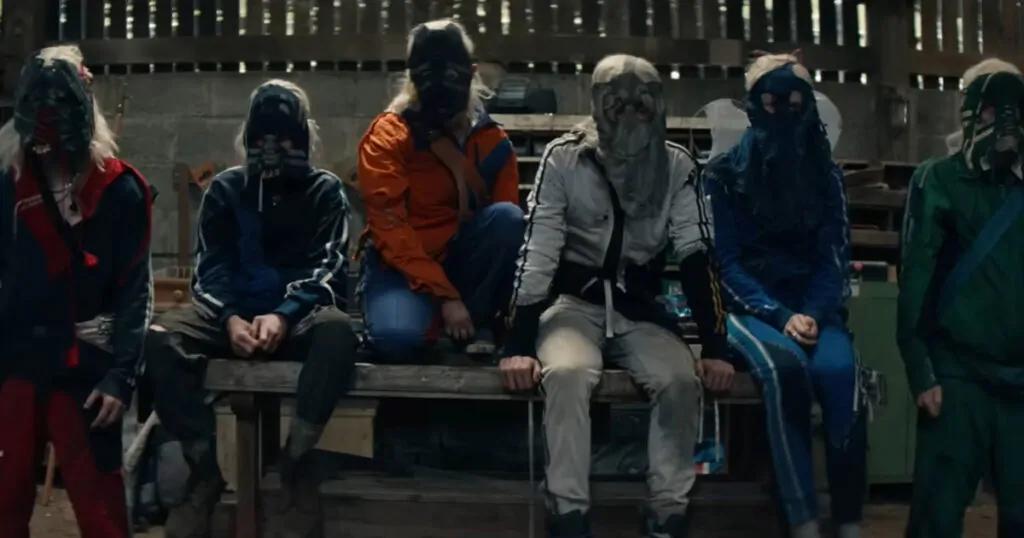
Misled crusaders spreading a gospel they don’t fully understand, the Jimmies were left to rot by the institutions that were supposed to protect them as lost and broken young people – with an emphasis on young, as charmed by recollections of children’s television as they are by flaying. With most of them scarcely out of their teens, it is clear that the Jimmies have never known a life free of violence, the tragedy of their lost youth made explicit from the first sweeping aerial shot of the leisure center, where a dusty warning sign plainly states there are to be “no children beyond this point”.
And yet, children they still are. When Jimima is killed she weeps for her lost cat, a fleeting memory of innocence quickly shattered by bloody blunt force trauma to the brain. As Jimmy Shite bleeds out from his femoral artery, he cries for God and Jesus, his plea for salvation quickly admonished and mocked for calling on those “shite cunts”.
Throughout his filmography, series scribe Alex Garland has made no bones (pardon the pun) when it comes to expressing concerns about the indoctrination of young people into violent institutions, from Warfare’s reminder that battle renders the bodies of young men as disposable, to the uncanny chills of Men’s baby-faced Rory Kinnear labelling Jessie Buckley a “fucking bitch”.
While it may seem tasteless to point out, the Jimmies’ preferred killing method of stabbing should not be overlooked as a sad indictment of a key issue faced by British youth, especially those embroiled in gang culture. There is no shortage of data correlating a rise in violent knife crime and austerity measures that decimate services and charities designed to help young people, and that equally as much to prove that without strong, empathetic leadership, young people are easily lost to worlds of violence.

We Need to Talk About Jimmy
The Jimmies may have a leader, but Sir Lord Jimmy Crystal is far from the positive role model this motley crew so requires, with the sadistic scoundrel undoubtedly representing a dark side of Britain both new and old. Like the British Empire personified, Jimmy does not ask, nor wait for permission, to lay claim to a land he sees as his and his alone. He forces himself in, claims resources as his own, and when challenged with righteous indignation, affixes a sneering plea for manners and civility.
Furthermore, with his misunderstanding of the Petrine cross (not a symbol of Satanism), Jimmy represents Britain’s worst habit of bastardizing iconography. Just as the cross of Saint George has become shorthand for anti-immigration, white supremacist sentiment when its martyr was of Turkish descent with a Palestinian mother, Jimmy’s gold chain and tracksuit combo that once represented an eccentric philanthropist beloved by a nation has become synonymous with unspeakable abuse. Furthermore, his use of the word “charity” as a precursor to violence feels grimly suggestive of Savile’s extensive charity work – which in hindsight we now know was more often than not a sick ruse to acquire access to children and vulnerable people.
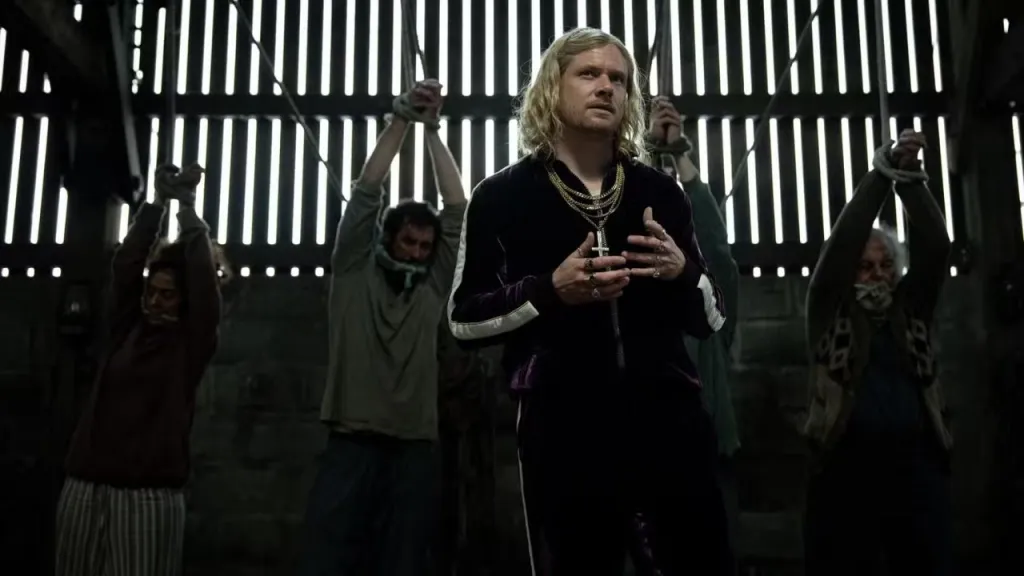
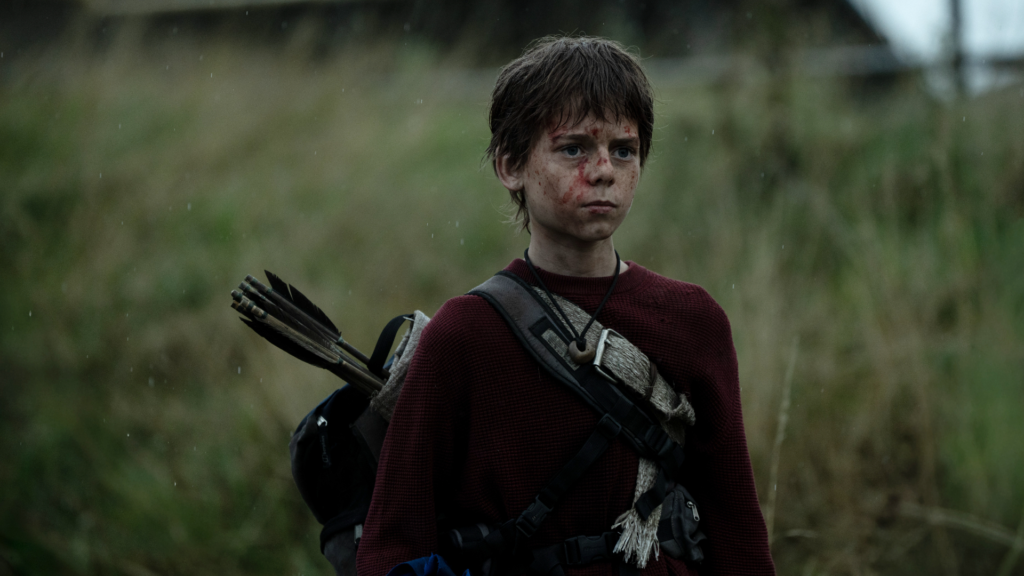
The Bone Temple challenges us to consider the notion, however, that Jimmy is as much a victim as he is a villain. In our first introduction to his character, we meet not a man ripping flesh from bone, but a child, terrified as the safety of the world he has known for only a few short years comes crashing down in blood and chaos.
After fleeing the rectory at the start of 28 Years Later, little Jimmy begs for his father to protect him, only to be abandoned in favor of the same religious ecstasy he now so desperately craves. Jimmy’s life is also one marred by ruin and ravage, a young man forged in flame who has also never been shown how to move through the world without treading on the faces of others.
There is also the implication that Jimmy is suffering from schizophrenia, an admission that quietly inspires Dr. Kelson’s revelation about the psychiatric nature of the infection. Only after the Iron Maiden showdown does Jimmy stop hearing the voices of his “father”, and it is not just the realization that his faith is a lie that leads to such clarity, but also the drugs that he inhaled during Kelson’s liturgical dance. As Jimmy bleeds out, Saint Peter style, he is finally medicated.

Kelson And Samson: Friends ‘Til The End
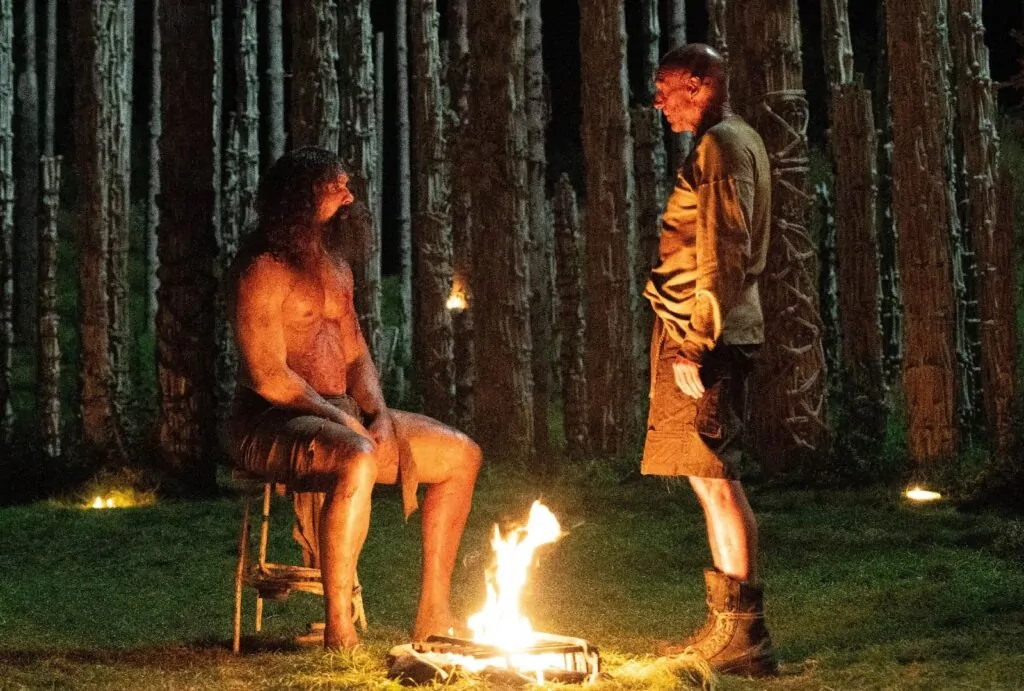
Delivering, in his words, peace and respite is Kelson’s MO, after all. An important distinction that may have been missed by audiences outside of Britain is that not only is Kelson a doctor, he’s an NHS doctor, jokingly assuring Samson that there will be “no charge” for tenderly treating his wounds.
The last time we saw this pair interact, Samson was trying to rip Kelson’s head clean from his shoulders. But there is no bad blood here. Kelson harbours no ill will towards Samson. He does not refer to Samson as a monster, a brute, or a zombie but rather, a friend, a friend who is sick, a friend who is not in his right mind, a friend whose judgement is clouded by a virus that is also itself merely trying to survive.
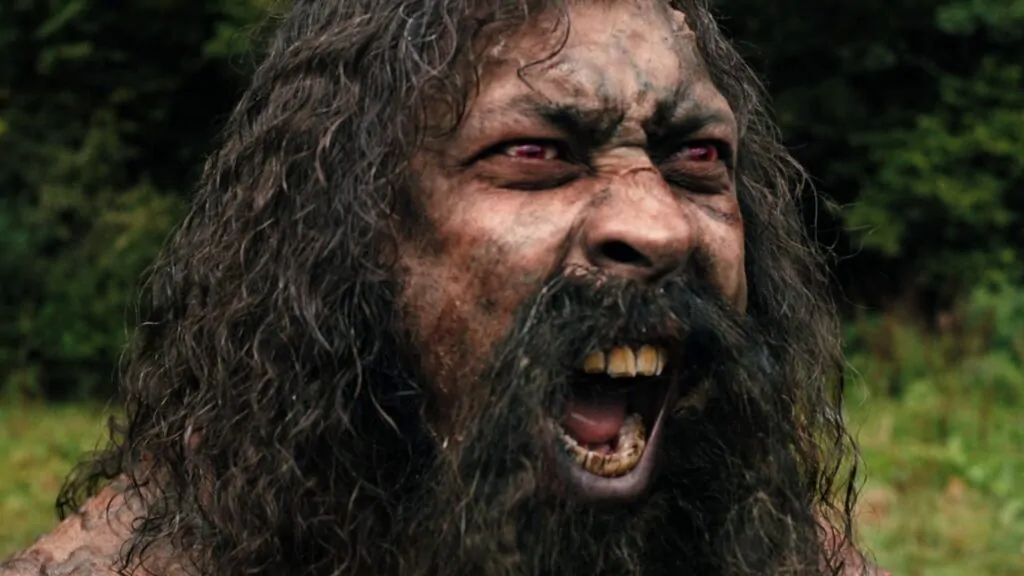
The formation of the National Health Service and its mantra that healthcare should be available to all, regardless of wealth, class or social standing, is without a doubt one of Britain’s proudest cultural achievements, and one that Kelson represents throughout both films. However, as it stands, the NHS is a system tarnished by funding cuts and staff shortages exacerbated by anti-immigration policies that have deported hundreds of healthcare workers under the guise of barely-veiled xenophobia.
What brings Samson back from infection is not thoughts or prayers, but medication – mental health medication, to be precise. In a country where mentally ill people in crisis are seen as burdens both culturally and institutionally, Kelson’s refusal to abandon his friend in his darkest hour serves as an impassioned reminder of the dire importance of having healthcare systems that see patients as people, and not pockets full of cash.
America Is Cars, But Britain Is Trains
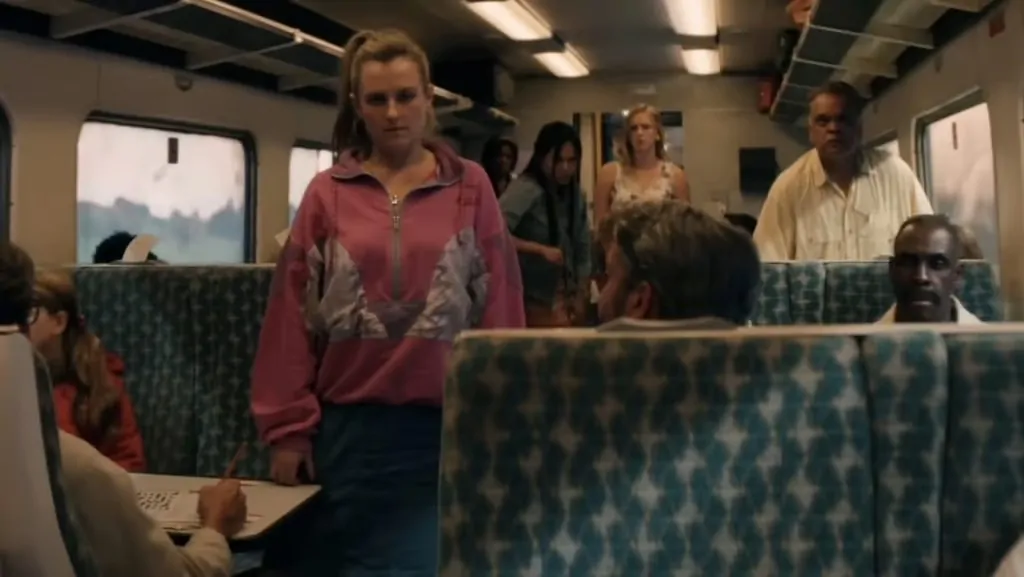
Another inherently British symbol that serves as a pivotal thematic centerpoint of The Bone Temple is the train car, a rotting vestige which becomes an instinctual point of return for Samson as he drifts back towards humanity. A flashback hints that the train may be the last memory Samson has of a pre-fall Britain (or at least a deeply treasured one), and it’s a memory of a world that no longer exists.
Just like the NHS, the once great British rail network is but a shell of its former self, decimated for profit by privatization and serving nobody except those who are rich enough to not even need public transport. In the words of Boyle himself when explaining why trains are featured so frequently throughout his filmography, “America is the land of the car, but Britain is trains.”
If Britain is trains, then what better representation of a land in which communication and connection have fallen prey to corruption, a land in which we’re further removed from each other than ever before, than a train car, left to disintegrate alone in the woods.
Nostalgic Needledrops Done Right
But just like 28 Days Later and 28 Years Later before it, The Bone Temple does not delight in cynical nihilism aimed at Britain, instead using these contrasts to highlight the importance of remembering what truly makes a country great. The Bone Temple’s instantly iconic Duran Duran, Radiohead and Iron Maiden needledrops serve not as nostalgia for nostalgia’s sake (looking at you, Stranger Things) but as songs that Kelson, a man who lived in, worked in and remembers the Britain of the ‘80s and ‘90s, would hold dear.
More critically, the bands of The Bone Temple are all British, reminding us that even with our dark and tarnished history we still have much to offer the world in terms of music, culture, art and film – just like the one you’re reading about.

Jim's Return And Future Redemption
Like its predecessor, The Bone Temple features an ending for the ages, with the epic return of 28 Days Later’s Jim (Cillian Murphy) and the reveal that he’s survived the last almost-30 years in peaceful isolation, along with his daughter, Sam. Jim owes nothing to Kelly and Spike as he watches the young pair flee across the Cumbrian hills, a pack of Infected hot on their tail, yet the crux of his poignant history lesson just a few minutes prior rings in both his and our ears: “Those who forget history are doomed to repeat it.”
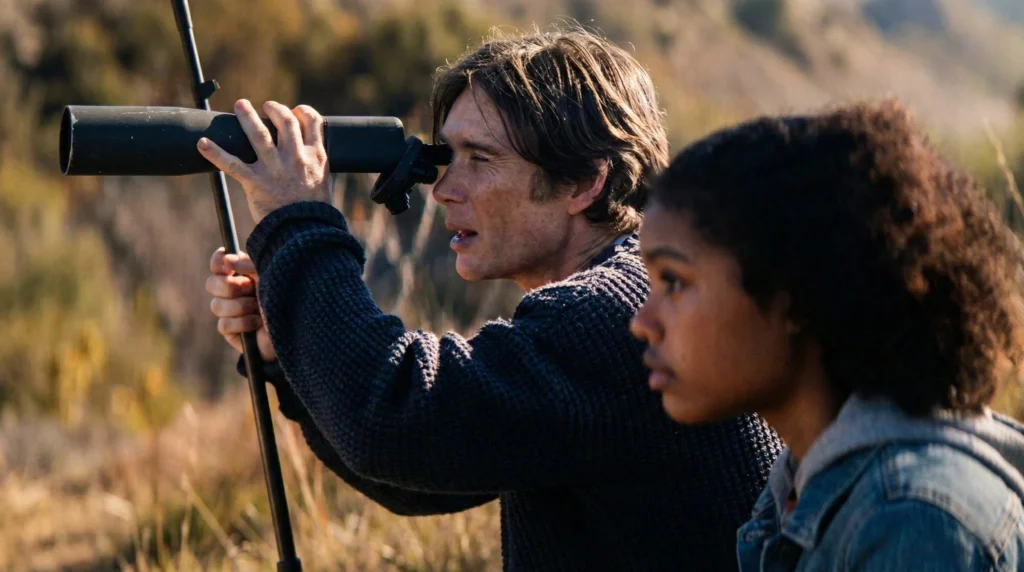
What does the ending of The Bone Temple say for the future of not just Britain, but every nation? According to DaCosta, with a cure on the horizon, the third film will be a film about “redemption”, themes already put in motion by this infernal requiem to a broken world. There has to be a hope that the Infected can come back, just as there has to be hope that we can come back from this dark era of enabling state-funded genocide, constant attacks on our most vulnerable populations, and rising hate crimes.
The only way to do this is to see each other as Kelson sees Samson, as Jim sees Kelly and Spike – as human beings. When faced with the question of “do we help them?”, no matter who it refers to, The Bone Temple makes it clear that there is only ever one answer – of course we do.