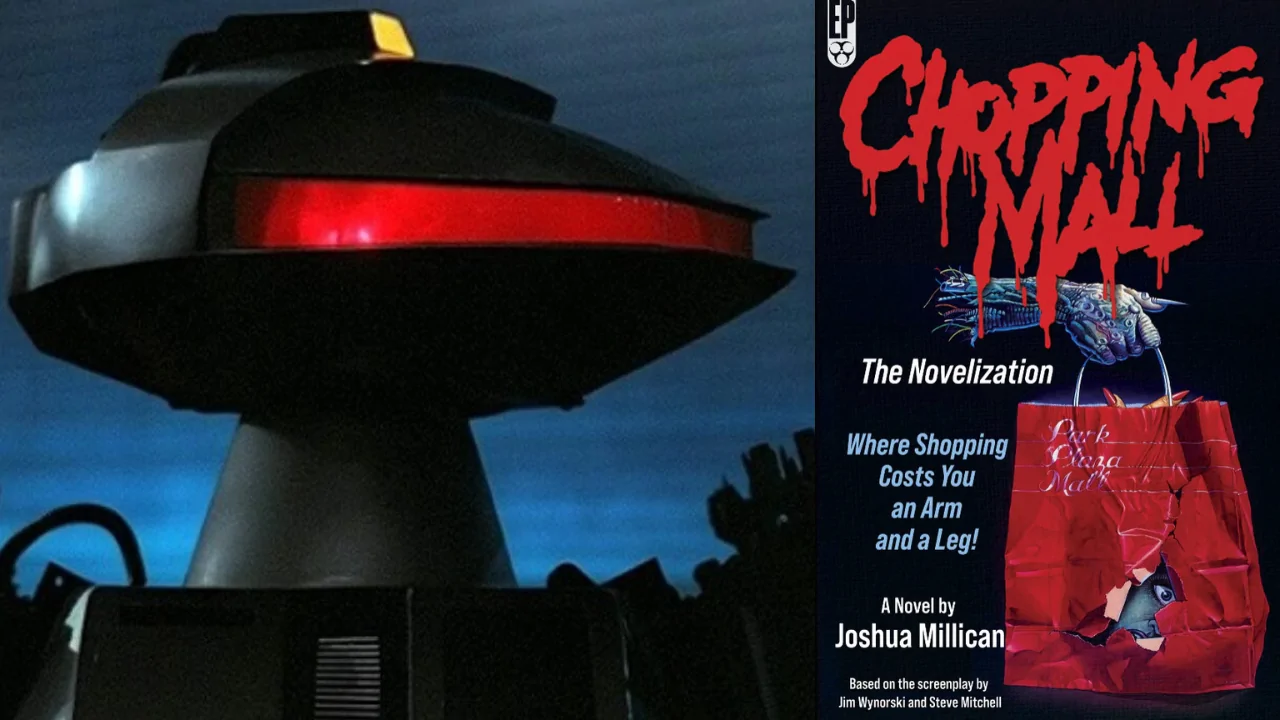
Let’s just get one thing out of the way immediately: no, the novelization of Chopping Mall does not find a way to recreate what was happening on the film’s poster. As die-hard fans know, the movie was originally released as Killbots, and featured one of the film’s murderous security robots – completely honest advertising.
Alas, that version flopped, and so after a few snips to make the movie even shorter and a title change, the film was re-released in the hopes that this time around it would find an audience. But that meant a new poster as well, and so the familiar image of the robotic hand holding a shopping bag full of body parts was born.
Only problem is: no one in the movie got dismembered! (Unless you count the girl whose head was blown apart entirely.) The robots rack up an impressive body count, but it’s all pretty basic: electrocution, stabbing, and laser fire serve as their MO. More than once, I’ve heard someone say they were disappointed that there wasn’t actually any “chopping” in the film, which is crazy because what it DOES have is still pretty fun.
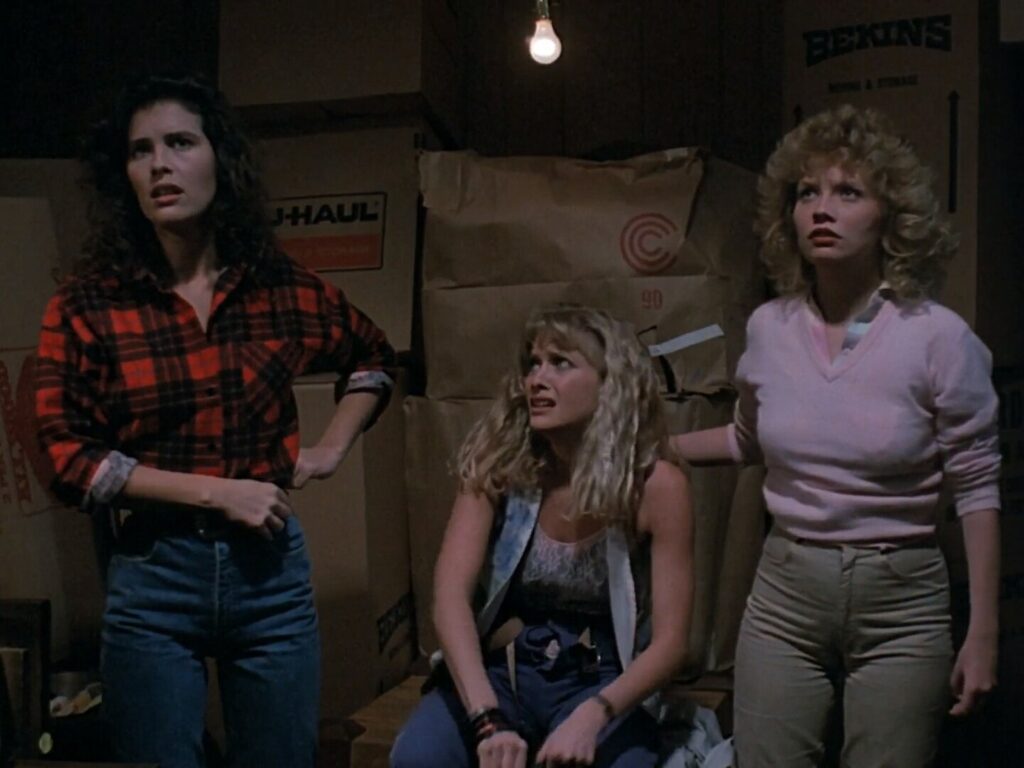
That said, the novelization by Joshua Millican does find a few spots to divert from the finished film and give fans a little more to chew on. I mean, I assume he kind of HAD to, since the movie runs a mere 72 minutes with credits, so even with his additions, it’s still the shortest book I’ve covered for this column (150 pages). Not to be read as a complaint, I should stress, it was actually kind of a refreshing change of pace to read one of these things in two sittings.
Millican offers four key additions that would stick out to even a casual fan of the movie, with the first hitting immediately. While the movie opens with a commercial of the robots attacking a jewelry thief in the mall, the author offers a different prologue. Here we check in with some scientists and military types who are developing the machines and dreaming of bigger and better things for them to do than protect malls (i.e. participate in actual warfare).
It’s an odd inclusion in retrospect since we never again see these characters (including one named after Barbara Crampton, who plays Suzie in the movie), and a later scene invokes something even sillier, but at least it tells you right up front that this won’t be a glorified transcript of the finished film.
The author also offers up a pair of additional action scenes to up the overall body count. In the first, the characters of Paul and Mary Bland (played by Paul Bartel and Mary Woronov, reprising their characters from Eating Raoul) return to the mall with a horse, intending to use him for the meat at their restaurant the next day. Unfortunately, they cross paths with one of the robots, which instantly vaporizes all three of them with its laser fire.

The other one is the culmination of a strange new subplot about the “Mall Mole.” Throughout the story, characters refer to and think about an urban legend of a man-sized mole that stalks the back corridors of the three-story shopping center. It’s an odd thing that finally pays off with the introduction of Jamal, a character who is referenced but not seen in the film.

Turns out Jamal was on the run from some drug runners and inadvertently found a secret chunk of the corridor that he was able to fashion into a makeshift studio apartment. He’s now been there for years and – thanks to a big fur coat he stole from one of the stores – is the supposed “Mall Mole” folks claimed to have seen. He survives an encounter with one of the robots, but then, at the end, runs into a fourth robot as a bit of a fun surprise for fans (who know that there are, in fact, only three in the movie).
This little addition leads directly into the fourth and weirdest major addition: aliens! Paying off a line that the best sci-fi stories involve robots *or* aliens, we are given a little epilogue in which overseeing intergalactic beings take responsibility for the malfunction that caused the robots to go haywire. Then, having had their fun, they fly off to cause havoc somewhere else. It’s a bizarre interlude that honestly doesn’t seem too far out of the realm of possibly being an actual idea that producer Roger Corman and/or director Jim Wynorski actually had at one point, given their love of such silliness.
The remaining changes are minor. There’s a little more to the robot demonstration, with one character actually asking about Asimov’s laws of robotics, and some more stuff with the otherwise unseen military backers. And Millican peppers the dialogue and internal monologue with references to ‘80s mainstays, including one about Fast Times at Ridgemont High directed at Alison, who was played by Ridgemont co-star Kelli Mulroney.
I was also tickled that he chalks up Suzie’s air duct freakout to claustrophobia, because she thinks about what caused her condition in the first place: being trapped inside an old refrigerator. Any 1980s kid worth their salt will instantly recognize the story from a memorable (and terrifying) episode of Punky Brewster, and I couldn’t help but wonder if any of the other minor bits of biographical detail about the characters were also inspired by other ‘80s shows or movies, and I just didn’t pick up on them (I haven’t seen EVERYTHING, folks!).
Otherwise, he sticks to the movie, which makes sense: the main appeal of Chopping Mall is how straightforward and fun it is, so dragging it down with subplots and lengthy conversations wouldn’t be the right call. And it gave me a good excuse to revisit the now 40-year-old film, adding a little extra value to the proceedings.
You can get it on Kindle for a mere six bucks, but there are paperback and mass market versions available as well for those (like me) who like to have everything proudly displayed on the shelf. Plus, it’s a movie about a mall – buying the physical version just seems more fitting, right?