
Last Updated on March 16, 2024 by Michael Gingold
Editor's Note: This was originally published for FANGORIA on April 30, 2010, and we're proud to share it as part of The Gingold Files.
—
The Human Centipede (First Sequence) is one of the bigger shams to appear on the horror scene in recent years. This isn’t a movie, it’s a 93-minute stunt, one that takes a single idea that could have sufficed as the punchline for a 10-minute short and wraps it in a feature’s worth of ineffective genre tropes and clichés.
That idea, as you’ve likely heard, involves three people surgically attached at their mouths and anuses, creating a “human centipede” with one long digestive system. It’s the brainchild of one Dr. Heiter, who lives in a big house in the German woods and is played by Dieter Laser, who resembles Christopher Walken with a glandular disorder. Apparently his looks and low, sonorous voice are supposed to do all the work as far as building a sense of menace around Dr. Heiter, since Laser’s English-language line readings are rather less than persuasive. He’s also not very scary because he tends to explain himself and his actions in the most on-the-nose way possible. “I don’t like human beings,” he announces to two visitors/victims moments after letting them in, and once he’s got his trio of subjects strapped to hospital beds in his basement, he spends several minutes explaining the “human centipede” operation in such exacting detail that it kills any sense of dread.

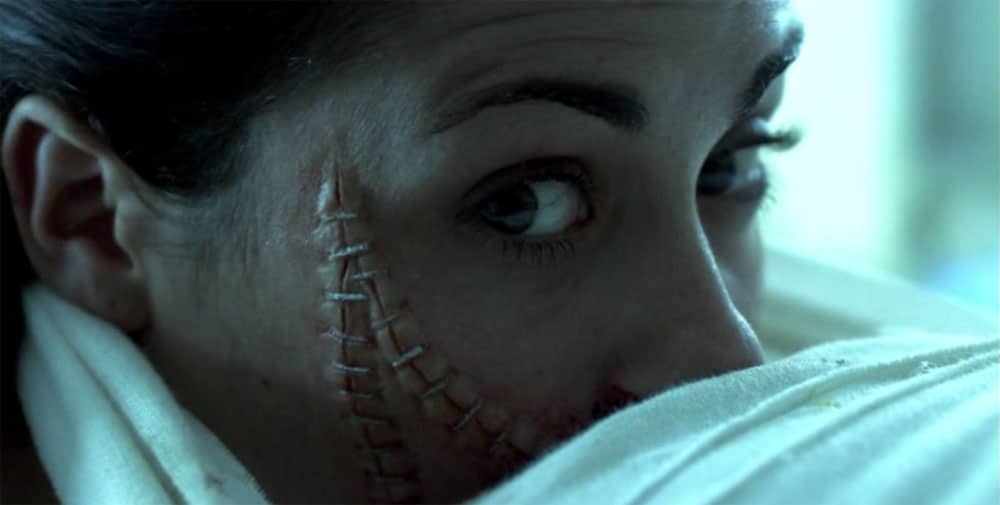
And then, having established his twisted premise with lip-smacking enthusiasm, writer/director Tom Six becomes paradoxically coy about following through with the gory details. We only see brief glimpses of Dr. Heiter’s surgical process, as if Six, who clearly made this movie in order to get a gross-out rise out of his audience, has suddenly become a convert to the power of suggestion. He also hasn’t done much to explain why Dr. Heiter goes to all this trouble; there’s little sense of any purpose or pleasure the mad medico derives from his self-made hybrid.
His victims don’t fare much better. Two-thirds of the centipede are visiting Americans Lindsay (Ashley C. Williams) and Jenny (Ashlynn Yennie), who are ostensibly hip New Yorkers but, after they develop car trouble in the middle of nowhere in pouring rain, decide to go traipsing through the woods instead of following the road to find help, and ignore the glaringly obvious signs that Dr. Heiter means them no good once they’ve taken shelter in his home. When one of them (please don’t ask me to distinguish between the two) manages to free herself from his bondage—occasioning the one honest shock in the whole movie—she makes a series of head-slappingly stupid moves while attempting to escape from Dr. Heiter’s house, in a lengthy sequence that feels like padding in the absence of any actual plot. There’s no way to be engaged with or sympathetic for these idiots, yet if Six is attempting to push their genre-foolish behavior into the realm of satire, he isn’t pushing nearly hard enough.
In any case, the girls are silenced once the operation is complete, since the “head” of the centipede is tourist Katsuro (Akihiro Kitamura), who is given nothing to say but rants and threats in Japanese, instead of expressing a personality. Lacking much idea of how Dr. Heiter and his creation might interact, Six devotes a good chunk of the third act to a couple of nosy cops, who, in the time-honored tradition of dumb B-movies, are as inept at investigation as that briefly freed girl was at survival. Indeed, too much of The Human Centipede is numbingly familiar: The sleazy motorist who crudely propositions the stranded Lindsay and Jenny, the coldly sterile surfaces of Dr. Heiter’s dwelling—you’ve seen them all before, no doubt in movies that didn’t expect you to be distracted by how mind-blowingly bizarre the central concept supposedly was.

And perhaps this one would be, in a film that bothered to provide a story with a sense of purpose. The Human Centipede isn’t scary because there’s no point of audience identification, and it isn’t truly shocking because there’s no way to emotionally engage with what’s happening on screen. (How sad that recent movies like Martyrs and Inside, which pushed boundaries to the extreme while paying equal attention to their human interest, couldn’t parlay their notoriety into the kind of U.S. theatrical release The Human Centipede is receiving.) Some have suggested that the film is really intended as black comedy—but absent true wit or satirical twists on the conventions it indulges in, what’s left to be amused by—the spectacle of its principals’ suffering? The movie’s true desperation becomes clear in the final minutes, which attempt to generate irony via a confession that comes completely out of nowhere, and pathos on behalf of a person who has long since ceased to exist as a character.
All that said, I’ll admit I’m in the minority here; I could provide links to a dozen fawning reviews proclaiming this to be some kind of great achievement in confrontational horror, many of them comparing the film to the works of David Cronenberg. But there’s really no comparison at all. The genius of Cronenberg’s body-horror fantasies is that they always stand in for genuine real-world anxieties: fear of venereal disease, fear of hereditary madness and violence, fear of cancer or AIDS. There’s no such subtext anywhere in The Human Centipede, whose only conceivable metaphor could be for a group of people lining up to kiss ass—which, come to think of it, suits this film just fine.
