
Last Updated on March 16, 2024 by Michael Gingold
Editor's Note: This was originally published for FANGORIA on May 25, 2012, and we're proud to share it as part of The Gingold Files.
—
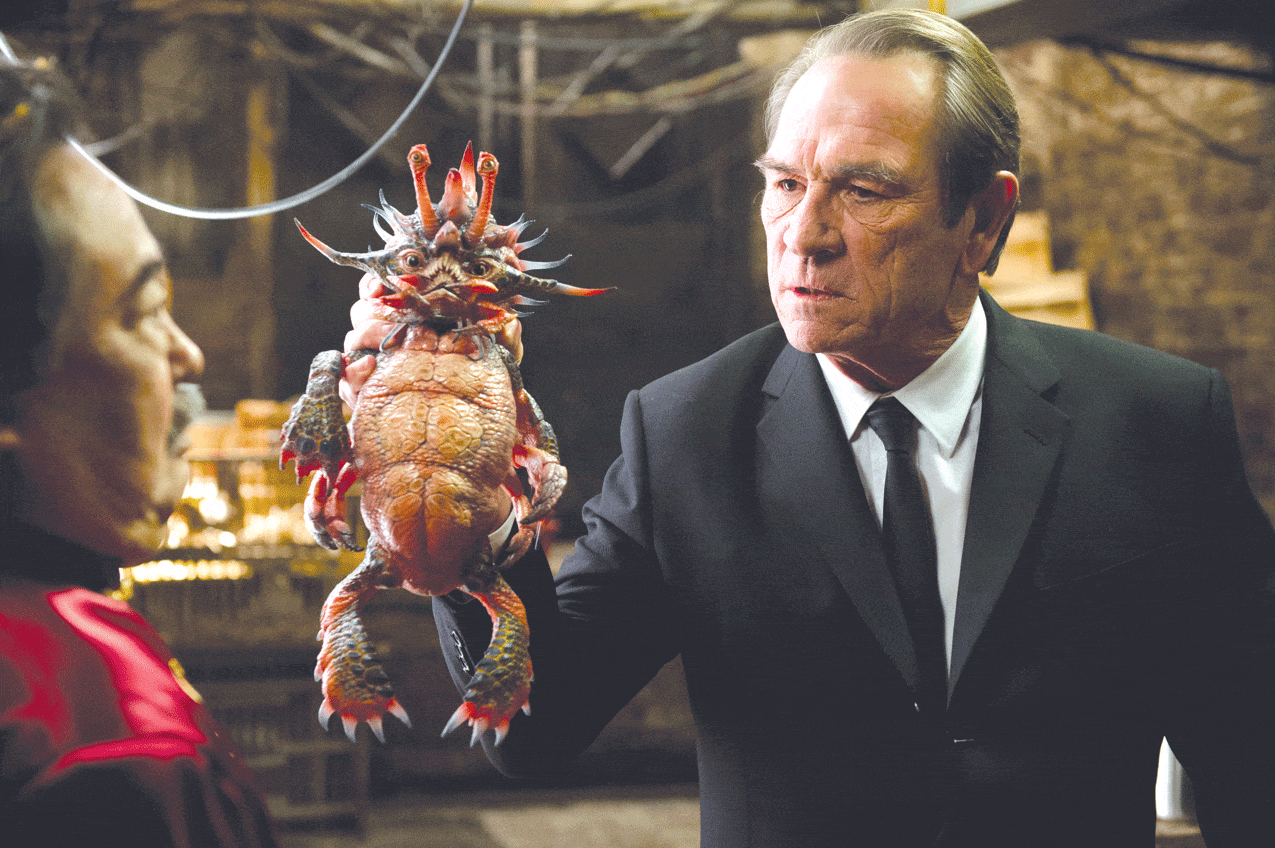
Fourteen years after winning one of his many Best Makeup Oscars for the first Men in Black, monster master Rick Baker is back with a whole new menagerie in Men in Black 3. And as he told Fango over the course of our interview, some of his ideas for the original film wound up in the new sequel.
The storyline of Men in Black 3 (directed by series regular Barry Sonnenfeld from a script by Etan Cohen) sees Agent J (Will Smith) traveling back to 1969 to prevent a vicious, time-traveling extraterrestrial villain named Boris “The Animal” (played by Flight of the Conchords’ Jemaine Clement) from killing Agent K (Tommy Lee Jones in the present, Josh Brolin in ’69) and altering Earth’s history for the very worse. Fango spoke to Baker at a special screening event tied to “Aliens, Gadgets, and Guns: Designing the World of Men in Black 3,” an exhibition of his (and other artists’) special makeup and props at New York City’s Museum of the Moving Image.
Having done two Men in Black films before, was it difficult coming up with a bunch of new aliens for the third one?
Actually, I came up with a bunch of old aliens [laughs]. On the first film, they said, “We want to see aliens unlike anything we’ve ever seen before.” And I said, “Well, that’s gonna be hard,” because when I did the aliens for the first Star Wars, it was a lot easier, you know? But since then, there have been a million cantina scenes, a million Star Trek shows. So I said, “Let’s make aliens like we’ve seen before, as if the aliens everyone’s seen in movies are based on something that really does exist. We’ll do [gestures at a photo of SpaceBoy] something like Invasion of the Saucer-Men, but cooler.” And they didn’t buy it.
So I tried to get that in on the second one, and they didn’t buy it. This one, when I saw that the script had the time-travel element, I thought, “This is the one. This is the time when it was supposed to happen.” So I said, “The 2012 aliens should look like Men in Black aliens, what we’ve known. In ’69, they should be retro aliens—big-brained, bug-eyed, with fishbowl helmets.” And they went, “That’s brilliant!” [Laughs] I was really excited; I got to make a bunch of aliens like the ones I grew up with. To me, those are what aliens look like.
When you create so much stuff for a film like this, how surprised are you when you view the final product, and see which of your creations are most prominent or have been digitally augmented?
Or how many are not even in the movie [laughs]! On this one, we counted 127 aliens that we made; I haven’t counted how many are in the film, but a lot of them didn’t make it. It’s a funny thing; I always say that I wish I could see the movie before I start making it, so I’d know where to concentrate my efforts, you know? So many times, there’s something you think is going to be a featured character, and you spend most of your time and effort on that, and then it turns out not to be featured, and then something you think was going to be a background character is. I wish there was time travel, so I could watch the movie and go, “OK, I know where to put the emphasis.”
Are there any examples you can cite in Men in Black 3?
Yes—we designed aliens for the Chinese-restaurant scene, like this red-and-black guy [gestures toward an impressive, arachnoid creature head mounted in a case], but you hardly see him in the movie; I don’t think you’d even know he’s in it. He’s behind an ornamentally carved wooden thing, and just as you start to see him, they shoot him and he blows up. And there was a black-and-gold guy we made for that scene, and they said, “We really like that guy, and we think he’s gonna get killed right away in this scene, and we should use him in something else.” And I went, “Well, what scene is he going to be in?” They said, “We don’t know,” so I said, “Let’s use him here.” “No, no, we’re going to save him for something else.” And they didn’t use him! [Laughs]
Do you find that the rushed nature of big-budget productions these days makes it difficult in general to determine where to put that emphasis?
Yeah. Now, people think because I do the rubber stuff that I’m against the digital stuff, which I’m not. It’s another trick in our bag of tricks, another way we can fool people and do cool things. What I don’t like about the whole digital revolution is that it has made for sloppy filmmaking—that “We’ll fix it in post” attitude. It’s like, “I don’t have to make that decision now, because we can fix it later.” And that doesn’t always work, you know? But in another way, it’s also great that you can do that; there are times when a prosthetic edge might be coming off and you have an actor you can’t go and touch up, or it’s a situation where the sun’s going down and you can’t reglue it; now it can be fixed digitally.
What were the specific inspirations behind the creation of Boris?
Well, first of all, Barry Sonnenfeld contacted me when this movie first started to happen, and said, “I know you’re retired, but I can’t imagine doing a Men in Black movie without you; will you come out of retirement?” And I was like, “First of all, I’m not retired [laughs], and second, you don’t have to beg me to do a Men in Black movie.” Anyway, they always had Boris as kind of a motorcycle guy; they described him as being like Dennis Hopper in Easy Rider. But I thought he should be more than that. So I kind of rethought what he was, and pitched a design and a concept for him.
There was this whole idea of him being made up of fingers—which wasn’t as developed as I had imagined—because Boris was originally going to eat people; I guess they decided that was too extreme. They were going to have him open his mouth really wide, and I went, “That was something I wanted to do in 1980, but it’s been done a lot of times since!” And it doesn’t usually look very good; you get a jaw that stretches down and it’s not too convincing. So I felt if anything, he should kind of unfold, and his whole body could consume people. Originally, his body was going to open up with all these fingers, and if you notice, on his neck there’s a weird thing that’s kind of like knuckles; it’s very subtle, but it started out being not as subtle.
I also didn’t think Dennis Hopper was the right kind of biker; if anything, I thought he should be more like Sonny Barger, the head of the Hells Angels in the ’60s, crossed with Charles Manson. I felt he should be much more intimidating-looking, and it would be cool for him to have these goggles shoved in his eyes. I knew they weren’t going to like that, to not see the actor’s eyes. It was a challenge to get them to buy that idea. They said, “Well, you can’t be too extreme, because he has to pass as human and walk around New York.” And I said, “First of all, if you see this guy walking toward you, you avoid eye contact with him. So he can be more extreme than you’d think.” When I did the illustration of Boris, and first showed it to them on the computer, I showed it to them as small, from a distance. If you see that guy, you can tell he’s kind of a biker, you’re not going to look at him that much. And the closer he gets, you’ll glance at him, but you’re not going to look right at him; you’re going to avoid eye contact with him, so you’re not going to see the details.
They said, “We like that idea, but we’ve got to see his eyes,” and I told them, “You know, I don’t think you do. It would be much cooler if you never do.” So they were like, “How about we just take the glass out, and we see his eyes inside there?” I actually did a makeup on myself to show them, and they were like, “Yeah, yeah, yeah, like that,” and I said, “No, it makes no sense,” and besides, I had widened [the space between] Boris’ eyes, so he’d end up looking cross-eyed if you were looking through these two tubes at [the actor’s] eyes. It’s so much more intimidating not to know what’s in there.
Jemaine Clement is an unusual choice for this role, but he really pulls it off. How was he to work with?
Well, I designed the makeup before Jemaine was involved, and at first I didn’t even know who he was. I looked him up, and he was kind of goofy-looking, with his glasses and stuff, you know? But I watched some YouTube videos and thought he was really funny, and had something he could bring to the part, which he did; he turned out to be great for it.
How did he take to the makeup? I believe this is his first time in heavy prosthetics.
Well, that’s the first thing I asked him: “Do you have any idea what you’re getting into, Jemaine?” He went, “What do you mean?” and I said, “Do you understand what your daily life is going to be when you’re this character? Probably three and a half to four hours in the makeup chair, an hour removal at the end of the day, and all during the day there’s going to be somebody like me looking at the corner of your mouth and coming up and poking you and looking at you as an object. Do you really want to do this?” [Laughs] And he was like, “Yeah, yeah, that’ll be fine.” He was really good about it.
Men in Black 3’s story hinges on Josh Brolin playing the younger Agent K; was there ever talk of putting him in prosthetics to make him look more like Tommy Lee Jones?
He does have prosthetics on! And they’re seamless. I can’t take credit for those; Josh has his own makeup guy, Christien Tinsley, who has worked with me a bunch on films, and I know him very well. In fact, Christien has made me up before, so I knew he was perfectly capable. When this thing first came up with Josh, Barry said, “I want you to design the makeup, but Josh has his own guy,” and I told him, “I know Josh has his own guy, and he’s really good. We’ve got plenty to do, and I’d be very happy with Christien doing this.”
I had already done a design, looking at Tommy and looking at Josh, and I said, “I think he’s close enough as it is, and it should just be a nose and earlobes.” Christien said, “Well, Josh wants to do a lot more”—Josh likes makeup—“he wants cheeks and a forehead.” I said, “I bet you’re just going to use a nose and earlobes.” I know they did cheeks and a forehead, several different versions, but sure enough, they ended up just using the nose and earlobes. And they did an incredible job with it. And Josh was just fucking amazing. It’s a scary thing—the whole Men in Black series is based on J and K’s relationship, and all of a sudden there’s a different actor playing K, but you totally buy it. My first day on the set, we had a bunch of our ’60s aliens working, and I was deep into making them all ready and the chaos of getting stuff done. Then it was time to film, and I heard Josh and was looking for Tommy. I thought Tommy was doing the voice off stage somewhere! Oh my God, he was so good! I closed my eyes, and then Barry said, “You’ve gotta listen to him on the headset!” Josh was great. A great guy, too.
