Editor's Note: This was originally published for FANGORIA on August 27, 2004, and we're proud to share it as part of The Gingold Files.
The triptych of lackluster major-studio August 2004 horror sequels is now complete, and if Anacondas: The Hunt for the Blood Orchid seems less disappointing than Alien vs. Predator or Exorcist: The Beginning, that’s only because it didn’t have nearly as far to fall. 1997’s Anaconda was no great snakes, though at least it offered the spectacle of up-and-coming stars (Jennifer Lopez, Ice Cube, Owen Wilson, etc.) ducking a giant CGI snake and Jon Voight’s outsized performance as the human bad guy. He also figured in that memorable moment in which his character is swallowed and then barfed up by an anaconda, whereupon he winks at J. Lo before expiring.
In Anacondas, sadly, only the plot gets regurgitated. It’s no surprise that not just “based on characters by” but an actual story credit is given to the original’s scripters Hans Bauer, Jim Cash (who died four years ago) and Jack Epps Jr., since the new movie is an almost verbatim duplication of the old, right down to one character incapacitating another with a poisonous bug bite. What’s startling is that it took four people to pen this film, and what’s even more startling is that two of them were Michael Miner and Ed Neumeier, whose RoboCop remains a model of genre screenwriting.
The story they’ve cooked up replaces the original’s documentary film crew with a GQ and Cosmo-ready scientific/pharmaceutical team seeking a rare orchid that grows only in a certain valley in a remote area of Borneo. Samples of the flower have proven to impede the aging process, but there’s a catch—there’s only a two-week window every seven years during which it blooms. When the group arrives in the jungle, they find that only gruff, tough Bill Johnson (Johnny Messner) is willing to take them upriver in his ramshackle boat; all the other pilots refuse to go, being that it’s “the rainy season.”

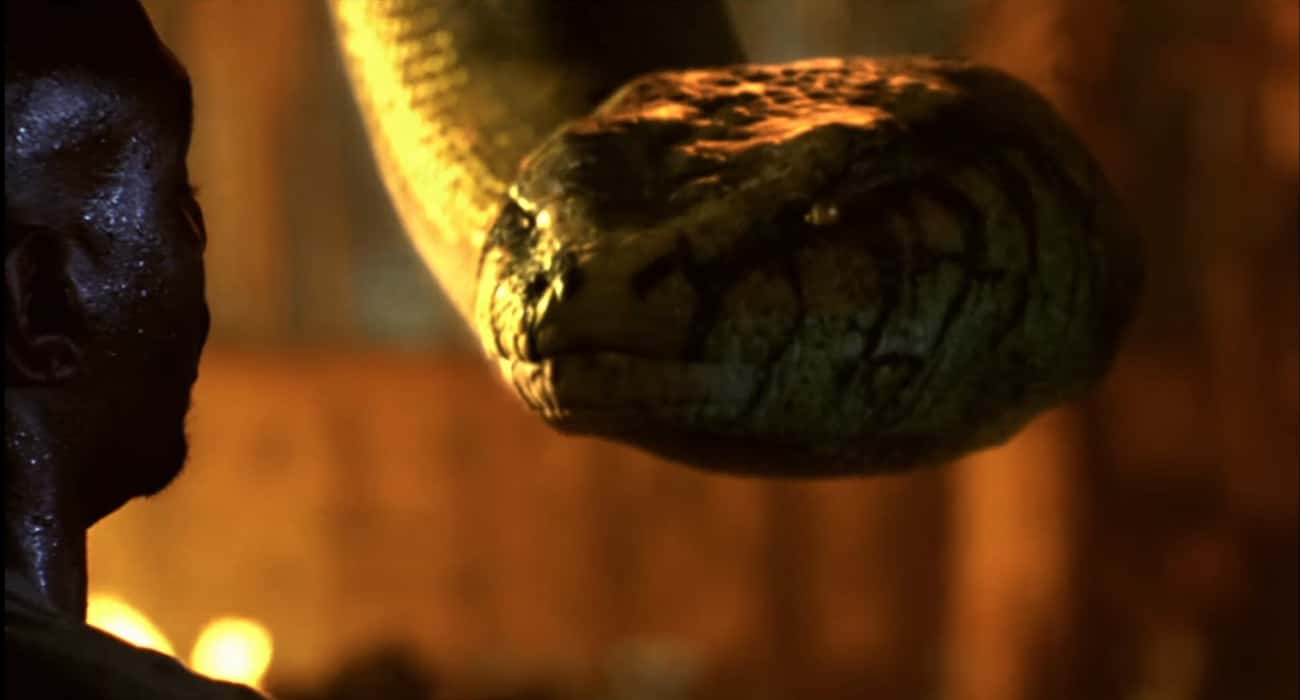
Nevertheless, once they do set out, they never run into any inclement weather that impedes their progress, but they’ve got bigger things to worry about. Namely, the local anacondas, which are bigger and hungrier than any seen before—the result, apparently, of that orchid being an intrinsic part of their food chain despite only blooming briefly every seven years, and allowing the snakes to live longer and grow larger than normal. (The characters are soon too busy running for their lives to consider the fact that introducing the flower to humans would presumably result in a lot of 10-foot-tall people running around.) And wouldn’t ya know it, the blooming season just happens to coincide with the anacondas’ “mating season,” meaning more male serpents then usual are out and about to get a crack at the sole female.
The dialogue provides a few good unintended laughs with this kind of scientific baloney, but the movie misses out on being so-awful-it’s-funny enough to recommend. Laughs, even bad ones, tend to be generated by surprise, and none of the stock characters (or the snakes, for that matter) say or do anything unexpected, as they trudge and slither through jungle-movie clichés so ancient it’s likely the target youth audience won’t recognize them. Attempts at intentional humor are provided by a young African-American computer wiz (Eugene Byrd), who serves the function of all young African-American men in movies like this: to deliver a string of wisecracks in the face of danger.
Dwight Little’s direction is vigorous enough even as he takes the creaky material far too seriously, and Stephen F. Windon’s sharp, colorful photography makes the film look better than it deserves. The CGI snake FX are technically proficient, though you won’t often be fooled into thinking you’re watching living, breathing reptiles. It’ll be interesting to see if Anacondas becomes the kind of surprise hit its predecessor was; apparently there’s talk of another sequel, and the one I’d like to see would involve the survivors of this expedition taking revenge on the people who brought back the original orchid samples, and neglected to mention that the flower could only be found on a cliff face overlooking a roiling mating pit of giant, people-eating snakes.