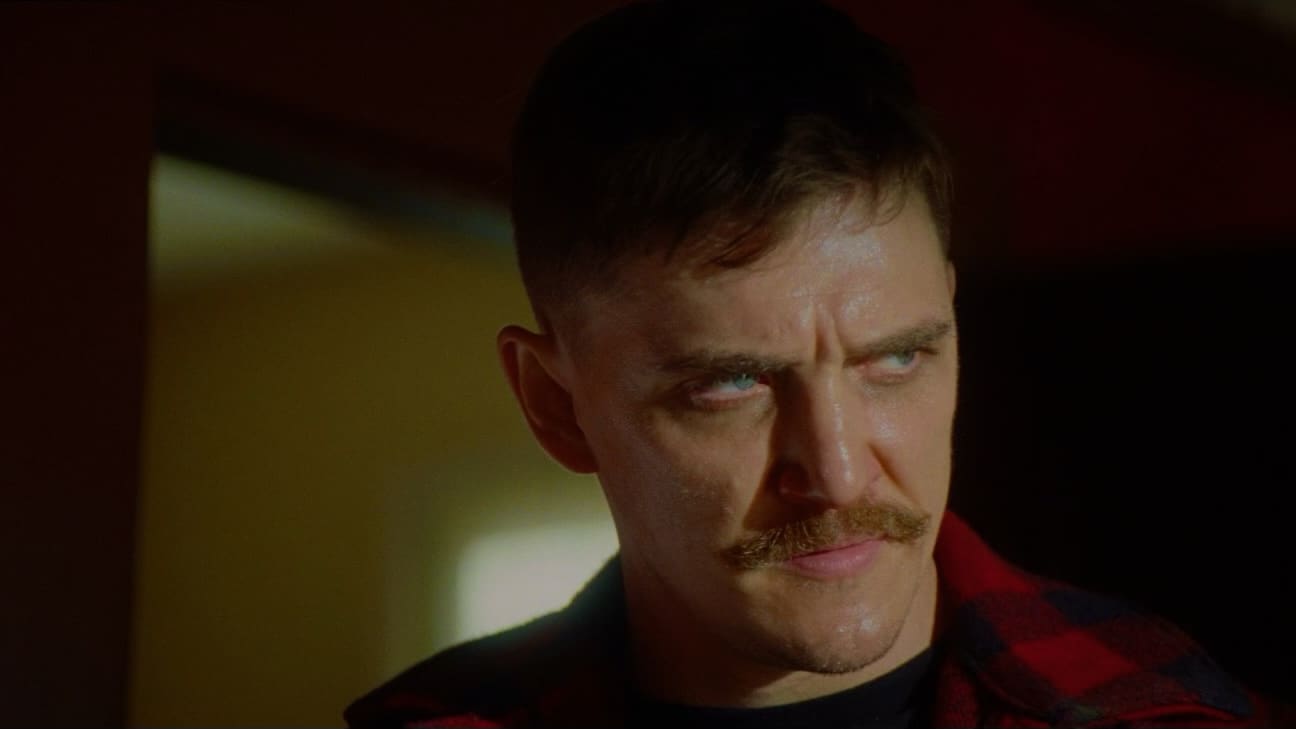
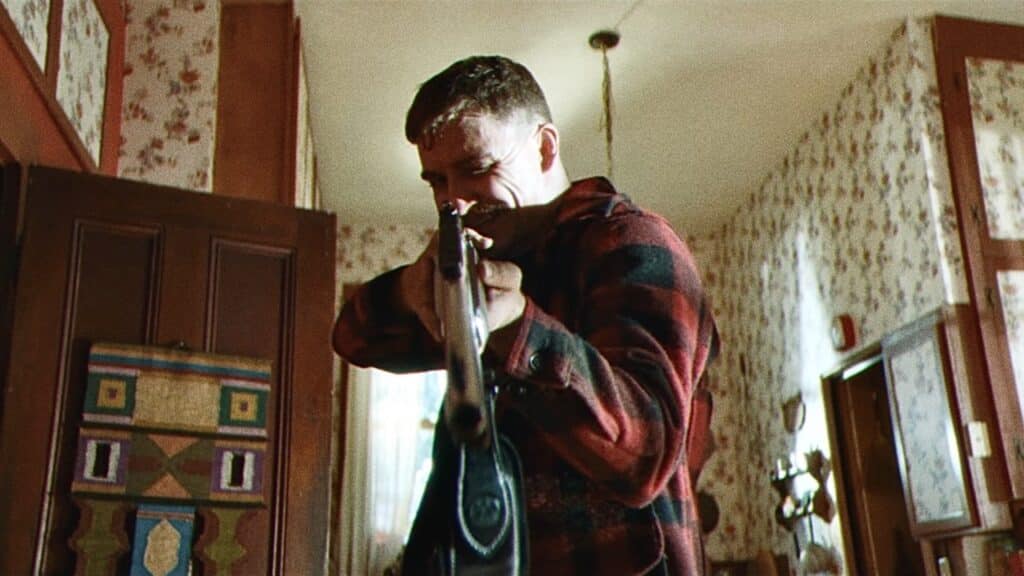
I missed Strange Darling when it played last year's Fantastic Fest, and I have lamented it ever since. FANGORIA EIC Phil Nobile Jr. has been singing its praises, and when I finally got to sit down with this strange fairy tale, I immediately understood why. Strange Darling writer/director JT Mollner has created such a wild and fun ride for audiences. DP Giovanni Ribisi shot the whole thing on 35mm, lensing it in such a way that the whole thing vacillates between dreamy and nightmarish.
Ribisi is well known for his work in front of the camera (Sneaky Pete, Avatar) spanning decades, and while he's been working as a DP behind the scenes on music videos and commercials, Strange Darling marks his feature debut as a cinematographer. Mollner and Ribisi were old friends well before they became Strange Darling collaborators, bonding over a shared love of good movies and cinematography.
Mollner admits, “I'm one of those directors who wishes I was a cinematographer.” As avid proponents of shooting on film, it's no wonder this was shot entirely on 35mm. Mollner attributes his instant friendship and decision to collaborate with Ribisi as: “We were just turned on by the same stuff. ” A no-brainer, really. And while making the leap to a feature film shot entirely on 35mm may have been a bit horrifying for Ribisi, it more than paid off.
The cast is small but absolutely stacked, starring Kyle Gallner (Scream, Smile, The Passenger), Willa Fitzgerald (The Goldfinch, Reacher), Ed Begley Jr. (Better Call Saul, A Mighty Wind), and Barbara Hershey (Black Swan, Insidious).

Mollner and Ribisi joined us to chat about their festival darling, internet spoilers, taking a ride, building a dark fairy-tale world, and the importance of being “prepared for luck.” Read our full interview below, and watch Strange Darling in theaters now.
We've been encouraging people to go into this one rather blindly. How have you been navigating that while promoting the movie? That balance of, we're going to entice and surprise?
JT Mollner: It's one of those things where there are surprises and different scenes, subverted expectations, and there's one surprise that's probably bigger than other surprises. Narratively, that was interesting for us to do, but also, the movie's just about archetypes, tropes, expectations, and these two characters. There's more than those two characters but really, it's about the dynamic between them. I think it's been easy for me to talk about those characters and the narrative without leaning on too much more. You have to dance around things, but we've gotten used to it, I think.
Can we talk about the choice to present this in a very specific way? This unfolds in a non-traditional narrative. Did you know that from the onset, that's how you wanted to present the story?
JM: Yeah, the story came in that order when I was conceptualizing the narrative early on, and it's the way it works. It's usually months of just coming up with an idea, then ideas building from there, and the narrative coming together. Sometimes, you think of things in a linear fashion, and here, it just comes in the order you see it.
When I got to the end, so to speak, I was equally surprised. I thought, “Oh, that could be a really interesting way to approach this final girl archetype and really flesh her out more,” or differently than I've seen in other films I love so much. It was about, “Is there a different angle here? Can we do something different with her?” And once I figured that out, it had to be in that order.
Giovanni, you're incredibly well-known in front of the camera, but you've been transitioning to behind the scenes as a cinematographer for some time now. This is your feature cinematography debut, and you decided to go all out, shooting 35 millimeter on your first feature. Did your experience translate pretty seamlessly to a larger-scale production?
Giovanni Ribisi: I think so, yeah. I have my own very small shop where I've been working and making visual content, for lack of a better term, for 15 years, including commercials and music videos. I wear several different hats on a lot of these jobs, but it was really informative and such an incredible learning experience over the last decade-and-a-half. A lot of it comes down to a logistical, economic thing. And I'm not talking about money, I'm just talking about the economics of taking something from beginning to end, and what are all the requirements or various aspects that they don't really teach you in film school, or I don't think they teach you in film school.
One of the things where JT and I really connected was you just have to prepare. Sometimes it depends on how much money you have, but I just always like to feel comfortable. I feel like that is truly the creative process there. Making the movie in production is executing all the creative decisions that you've made or trying to navigate and figure out how you can make those decisions. For five months, it was JT and myself, and then suddenly, there were 50 people that JT had to contend with, and there's politics, and all of these little things.
At the end of the day, you have tools and there's taste and there's, really, education that cultivates that taste. Watching movies and all that stuff, you can really nail all of that over a couple of years. But really getting the sociological ability to execute that stuff in the context of, sometimes, 200 people, is another art in and of itself. That was part of it.
Were you intimidated at all going into this?
GR: Oh, horrified. I'm horrified right now talking you. I'm a horrified person. I had to explain to my wife at one point. I said, “Look, you got to understand something about me. My house is always on fire. That's it. That's who I am.“ You just have to be ready for whatever comes at you. I say this over and over again, making a movie is a miracle. There's so much luck, but you could really be prepared for luck.
JT, you're a big proponent of shooting on film. How did you know that Giovanni was the one to shoot this?
JM: Vanni and I met because of film. We met because Steve Bellamy, the president of Kodak at the time, invited us both to the Kodak table at the ASC Awards. He knew I would like to go because I'm one of those directors who wishes I was a cinematographer. It's a visual medium, so that matters so much, and I just worship DPs. I usually have such a clear idea of the aesthetic that I'd like, even when I'm writing something, but I would never have any idea how to bring it to life. That's why I'm just amazed with DPs.
When I started making short films 15 or 16 years ago, nobody was shooting film for short films or for low-budget movies. Good cameras had come out, and people said that the technology was so advanced, so people were all shooting digitally.
I remember talking to my producing partner at the time and saying, “This is not what I signed up for.“ The films that I watched when I was a kid in the '90s, and the films I saw from the '70s when I was watching movies in the '90s looked a certain way, and there was a cinematic depth and softness to them, something rich. That's what I wanted to work in. That was the paint I was interested in painting with.
Everything I've done, except for one experimental short shot all in one take, was on film. I've shot digitally for commercials and stuff, but what I like to do, the aesthetic is reminiscent of films from a different time. It works well within the world that we like to create.

Vanni and I were totally connected on that when we met. He and I were watching all these movies when we met, years before we did a movie, and we were just turned on by the same stuff. That's part of the reason we became friends.
There were probably two years of our friendship where we would go back and forth via text late at night, talking about movies that we'd seen. I knew almost nothing about his family or anything personal, and he knew very little about mine because all we talked about were movies. Now we've gone deeper because I wanted to know him, because he's a great dude, and we became friends beyond that. But at first, that was just it. It was film, film, film.
I remember there was a whole period where I was so impressed with his cinematic knowledge. He suggested some films I hadn't seen, and I thought I'd seen everything. One of the movies where you were like, “You got to watch Onibaba.” That's the name of that film, right?
GR: Yeah.
JM: Yeah, it was so good. I was like, “How did I miss this movie?“ I think Kwaidan, I hadn't seen. He was recommending some movies, and I didn't want to be left out of it, so I would try to recommend movies that maybe he hadn't seen. I finally got him once with Shadows of Forgotten Ancestors. We both loved Cronenberg and David Lynch.
Once this movie was written, I was hoping he'd want to do it. I don't even think I sent it to him asking if he'd do it, because he's very picky. I just sent it to him saying, “Give me some feedback on this.“ And so the trap that I set worked.
GR: Then, in 15 minutes, I was begging to do anything to be a part of it.

Because you're such cinephiles, and that's your language as friends in general, were there any kind of touchstones that you discussed when you were talking about the look and the vibe of this?
GR: Yeah. I think the biggest thing for us was that there's so much content nowadays, and it has started to become this homogeneous.
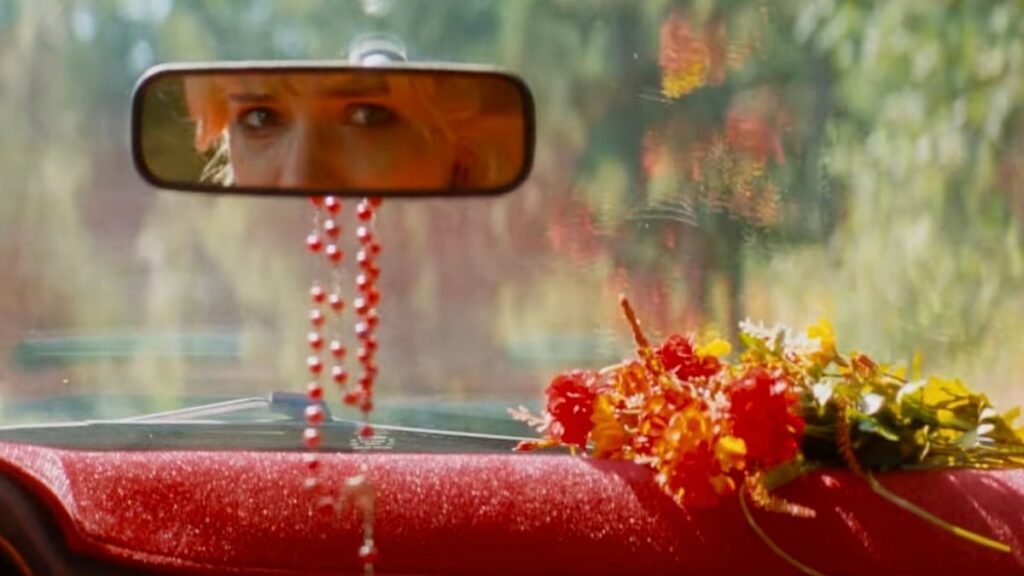
We wanted to do everything but that. We wanted to get out of the river and try to find our own path. You have to explore all the wrong choices and really work at it, I think that was our mission statement. We landed on the idea of trying to visually set this thing in a fairy tale. The other mission statement was Blood on the Flowerbed. Maybe that says it, but it just spoke to both of us. It was almost like we wrote that on the camera dolly and said that's what we want to do here.
I forgot about this, but we talked a lot about balancing something that could have been really dark with humor and humanity. Because it's funny, there are certain sequences; the gun goes off, the window breaks, I hope I'm not giving anything away, and suddenly we're turning this whole thing into absurdity. Watching it, I was like, “Oh, that's really smart. That's really great.“ It gets dark moments before that, and then suddenly, we have the music, we're outside, and everything is back to that fairy tale. Everything is lush and green. All of that was really important and concerted. It wasn't just, “Oh, that's where the chips fell.”
Do you guys expect the internet to spoil this movie?
GR: Yes.
JM: So far, people have been incredible. Actually, it's shocking how many people are burying this body with us. I can't believe the amount of people who've seen it now and it's being very tightly guarded and protected by the people who've become fans of it, which we're very, very grateful for. The critics who liked it, and the critics who didn't like it (there was somebody who didn't like it that much), no matter how people feel about it, when they write about it, everybody's protecting it. They all know that it makes it a little more enjoyable.
I would hope that if narrative stuff gets spoiled, the movie is still supposed to be a ride that does not rely on those things. You strap in, and you go. So little attention was paid to teaching lessons or having an opinion or a point of view about these characters. As I was writing, it was all very instinctual. It was like, “I'm fascinated by these two people. I'm fascinated by these archetypes, and I want to follow them through this craziness, take everybody with us, and just see where it goes.“
That's the goal, for it to be fun, uncomfortable, and crazy. We talked about The Pixies', Loud Quiet Loud, there are intimate moments, and there are explosive moments. I've had to watch this movie hundreds of times now and even if you're proud of what you've done, you don't always enjoy watching it over and over again. Sometimes you're just done with it. This has been more watchable for me than anything I've ever done before because the actors are so compelling, and it really is a ride, even for the filmmakers. I hope it works out that way for audiences.
Incredible. But let's all be on our best behavior. When you're in The Strange Darling Club, you protect the secret so other people can enjoy it the same way you did.
JM: I love that. The Strange Darling Club. You definitely seem like you're in the club. You're in the club.
Join the club, and go see Strange Darling in theaters now. Let the box office know we want more original, indie horror movies on the big screen.