When a cat scratches you, you walk it off. When a cat bites you, you call the doctor. A scratch draws blood. A bite can, too, but leaves behind nasty bacteria deep in your mitt's tissue; the punctures typically heal and seal pretty quickly, too, leaving all those germs to party under the skin. What harm can Garfield do with just a nip? Kitty cat fangs are potentially lethal instruments; an untreated wound site can become infected, leading to scarring (fine), tissue loss (not fine), or sepsis (oh no). In extreme circumstances, they can prompt unsightly hair growth, the primal urge to bat shot glasses off countertops, or a newfound fondness for Science Diet.
Anna (Grace Glowicki), the bereft protagonist in Mary Dauterman's Booger, is lucky to avoid hospitalization when the movie's furry namesake takes a chunk out of her thenar space. Booger, a jet black American bobtail, formally belongs to Izzy (Sofia Dobrushin), her late roommate, whose recent passing has Anna sunk like a foul anchor.
The cat has a bristlier bond with her than he did with Izzy, best demonstrated by an altercation over a houseplant. Anna catches Booger sneakily chomping on it and shoos him away; Booger takes offense to the admonishment, and acts on his feline pride with a retaliatory chomp on her hand. Here, it's clear as day that Anna isn't the primary cat custodian in this tiny apartment. Izzy probably would've called on the nearest hospital. Anna slaps a bandage on instead.
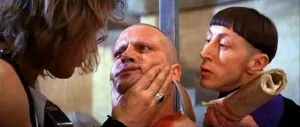
Meanwhile, Booger bugs out like a hairy bullet through an open window and down the fire escape, leading Anna on her movie-long search across New York City to recover the ungrateful little shit. At the same time, she notices some aftereffects from the bite, first a hairball here, a bizarre, nigh-incomprehensible nightmare there, then a sudden gain in light sensitivity. Eventually, she's ripping rodents' heads off outside her building, leaving their dismembered carcasses out in plain view as grisly warnings to other rats: Abandon all hope, ye who enter here, this sidewalk belongs to cat Anna. (As Matthew Inman concluded in an exhaustive study from the early 2010s: Cats are man's adorable little serial killers.)
Booger is filed under the body horror niche for the immediate surface value of its brief: Woman gets bit by cat, woman becomes cat (or cat-ish). But much like the cat bacteria (cat-teria) left festering in a bite wound, Dauterman's thoughtful, economical script digs beneath that surface, neatly dovetailing visual markers of Anna's metamorphosis with emotional ones. Anna is grieving. Her best friend is dead. Her world is a shambles, and Booger, her last living reminder of Izzy, just ditched her.
Because Americans do not have a healthy, compassionate relationship to grief, whether theirs or others', the significant figures in Anna's life, like her boyfriend, Max (Garrick Bernard), and her boss, Devon (Richard Perez), have notes and opinions about how she's supposed to cope with her loss. No one, not even Izzy's own mother, Joyce (Marcia DeBonis), bothers showing any curiosity about what she's feeling. It's a bleak sort of irony, given old adages regarding cats and curiosity (never mind that cats are themselves curious animals).


Joyce does the best work out of everybody as Anna's support system, a touching detail coming from the person reeling the most over Izzy's death. She treats Anna like a second daughter; her love and empathy are freely given, and she barks orders when Anna passes out in the wake.
Unlike Max and Devon, she isn't insistent, whether well-meaning but oblivious (like Max) or entitled and obnoxious (like Devon). But even Joyce's advice on how best to process Izzy's death is molded by the American notion that there are wrong and right ways to grieve. Joyce is going through the same thing as Anna. Losing Izzy has changed her, too, of course, just not the way it changes Anna, because no two people endure grief the same way.
Joyce compartmentalizes, marshaling resources for her daughter's funeral service while holding herself together for the rest of her family while also comforting Anna. Anna, on the other hand, goes feral. What Booger does with Anna's devolving humanity is nearly miraculous: The movie gives her deserved space to endure the profound, transformative sensation of loss, however unpleasant her grief may be.
On average, most humans don't mourn by horking up wads of hair, for example, or gorge themselves on canned cat food. They might initiate carnal hijinks with douchey strangers at bars, granted, or distance themselves from folks they care about, as Anna does with Max, who, ineffectual though his strategies for reaching Anna may be, genuinely wants to help. He just doesn't know how, and it isn't Anna's job to tell him; it's her job to feel what she must, and his to listen. (Devon's job is merely his job; he's a pushy asshole and a product of working in a corporate environment that compels middle management dweebs to be pushy assholes.)
The simpatico connection Booger's theme shares with its plot is remarkably clean in a comically bitter contrast to its messier contents. It's this quality that makes the film so extraordinary in body horror's canon: Anna's grief meshes with her Kafka problems to the point that they're inseparable from one another. Consider a body horror classic like The Fly, where Seth Brundle's mutation from man to man-fly (and not “fly-man,“ which is what would happen if the fly mutated into Jeff Goldblum) is a consequence of his mad scientific experiment rather than a representation of his inner turmoil.

Think about Julia Ducournau's Titane, where motor show dancer cum serial killer Alexis ends up pregnant after she fucks a car. Her mechanophilia is rooted in a childhood accident, sure, but the unexpected automotive bun in the oven is the result of unprotected bouncy-bouncy with a Cadillac and not a baked-in component of the film's overarching motifs. (This changes, admittedly, if the film is read through a transgender lens, which reframes Alexis' agony as a metaphor for transitioning pains.)
This isn't to take away from The Fly and Titane; neither need to justify themselves. (Try imagining body horror from the 1980s onward without The Fly.) But Booger exists in a distinguished class of body horror, where the grotesque remaking of the human form is experiential rather than simply depicted on screen. Dauterman so firmly embeds us in Anna's perspective that we quickly share in her visceral ordeal, as if we've hitched a ride within her psyche. Her confusion is ours, and if body horror cinema should convey anything, it's the bewildering effect of watching your body break, tear, and shape itself into something unrecognizable from the vessel you've occupied since birth.

It's minor kismet that Booger's release falls on the year of Shinya Tsukamoto's Tetsuo: The Iron Man's 35th anniversary. Like Booger, Tetsuo buries the audience in its dual protagonists' points of view; this makes the film's unconventional narrative, defined by a constitutional incoherence, a feature and not a bug. There is nothing coherent about the reconstruction of one's body.
Tetsuo pairs inscrutability with shocking violence. Booger is much easier to comprehend than Tetsuo, but a handful of surreal, disorienting dream sequences blur the world outside Anna's head; rather than violent, her transformation is disgusting, but the film's gross-out elements are linked, inextricably and stubbornly, to abiding sorrow. Booger will nauseate you. Cat barf will do that to a person. But as much as Dauterman churns stomachs, she breaks hearts at the same time.
Booger is in theaters and on VOD Friday, September 13th.