
Editor's Note: This was originally published for FANGORIA on October 10, 2003, and we're proud to share it as part of The Gingold Files.
It will be interesting to see how Kill Bill Vol. 1 is received by mainstream audiences not familiar with its influences—whether they can appreciate it if they don’t recognize that the Japanese swordmaker is played by Sonny Chiba, street-fighting darling of ’70s grindhouses, that a lascivious male nurse is quoting Robert Englund from Eaten Alive or that a certain piece of music is derived from Lucio Fulci’s Sette note in nero, a.k.a. The Psychic. (Since I picked up on all three, you know what side of the fence I’m on.) Kill Bill is the ne plus ultra of homagistic cinema, a movie whose every frame is designed to pay tribute to Quentin Tarantino’s favorite film fare, and to appeal to those who share his passions. Tarantino separates the faithful from the non- from the very beginning; listen for who laughs appreciatively and/or applauds at the opening pair of title cards, and you’ll know how many diehards you’re sharing the theater with.
Tarantino was one of the first to introduce Asian action standards to American movies, and 11 years after Reservoir Dogs, the whole trend has turned into a snake eating its own tail. We now have Hong Kong actioners imitating Hollywood features that were influenced by Hong Kong actioners (So Close, which seems inspired as much by the success of Charlie’s Angels as by homegrown predecessors like Naked Killer, is a good example); the appeal of martial arts, wirework and two-fisted gunplay is threatening to burn itself out. The difference is that Tarantino isn’t just riding a trend he helped create; he clearly loves this stuff, and incorporates a dizzying number of Asian subgenres, from heroic swordplay to anime, the latter of which is used to dramatize one character’s violent backstory.
The writer/director also went the extra mile and cast a number of Chinese and Japanese performers with varying levels of experience in genre films. In addition to Chiba, who still makes a strong impression decades after his heyday (if anyone gets the now-traditional Tarantino Career Boost from Kill Bill, it may well be him), martial arts veteran Gordon Liu appears as an underworld killer (and will take a second role in Vol. 2); Battle Royale and Ju-On (video version) starlet Chiaki Kuriyama plays a teen assassin who wields a mean ball and chain; Jun Kunimura (the protagonist’s best friend from Audition) is an ill-fated gang boss; and one of the anime voices is Gamera 3 and Battle Royale II star Ai Maeda. Tarantino gleefully pours on the visual quotes and drenches the soundtrack in music tracks from B-cinema past (to the point where one wonders where the “original score” credited to Wu-Tang Clan’s The RZA can be found), and sometimes mixes and matches the two: a sequence taking its cues from Asian cinema might be backed by scoring from an Italian Western.
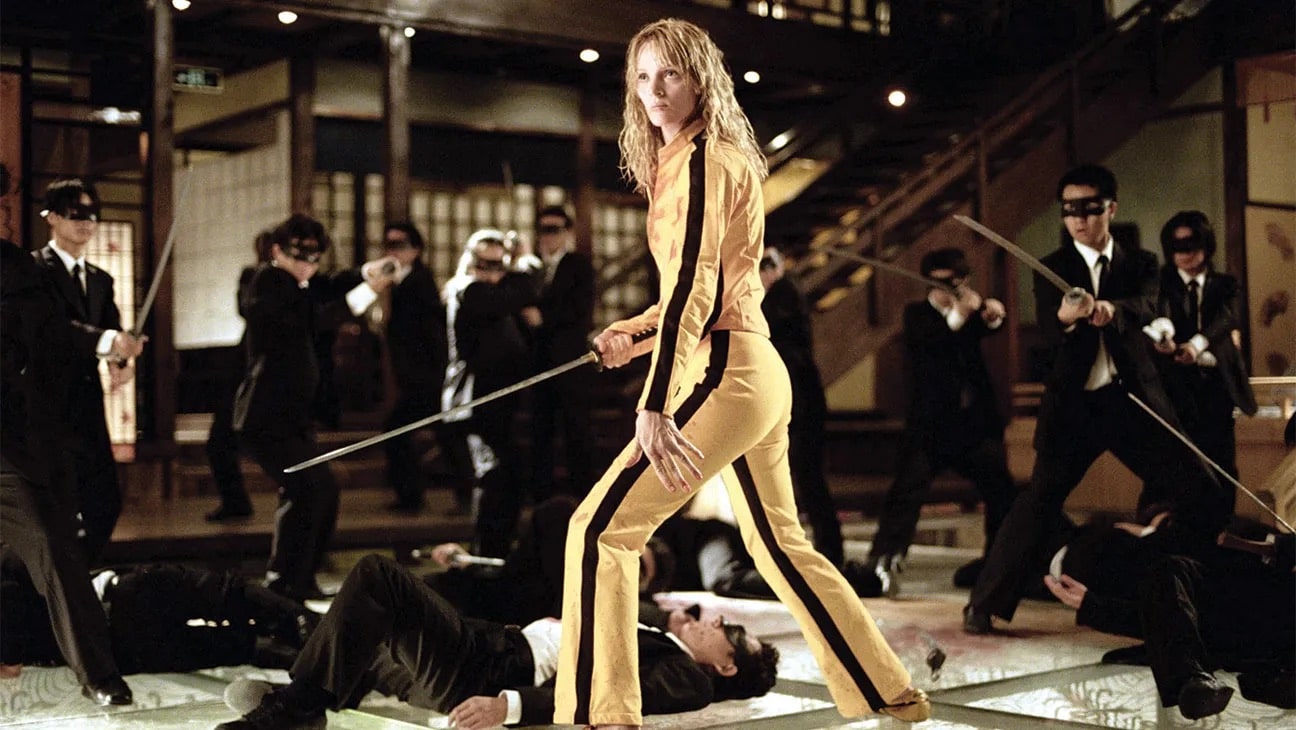
The downside to all this picture-and-sound quotation is that it crowds out much in the way of story and character. For all their mayhem and bloody spectacle, the best foreign revenge dramas that Tarantino takes his cues from were equally driven by compelling human drama, which is mostly absent here. Even given that Kill Bill has been neatly sliced into two halves, the plot of Vol. 1 is pretty thin: An assassin known only as The Bride (Uma Thurman) is almost killed in a massacre on her wedding day (while she’s pregnant, no less) by her former associates under the command of the mysterious Bill (David Carradine). Four years later, after waking from a coma, she sets out on the vengeance trail, knocking off her old cohorts and would-be killers one by one. That’s all there is to the narrative, really, as Tarantino uses it as a simple springboard to indulge in his one-movie retrospective, as well as his various other fetishes, from oddball breakfast cereals to women’s feet.
Of course, no one ever said that a popcorn action movie had to be very deep; it’s just that Tarantino set the bar so high with Reservoir Dogs and Pulp Fiction, in which the people had quirky heart and soul to go with their killer instincts, that the overall lack of these qualities here is something of a letdown. Bill himself, supposedly the story’s central figure (he is, after all, the title character), literally barely exists in this volume, and we never even find out why exactly the Bride was targeted for termination. The biggest disappointment is the lack of Tarantino’s trademark memorable dialogue; you could walk out of Dogs and Pulp humming the lines, and while the tough talk in Kill Bill is certainly persuasive, it lacks the alternately down-to-Earth and brutal poetry of the earlier films.
So Kill Bill is mostly a movie about surface effects—but what surfaces! If Tarantino is working more on the level of craftsman than storyteller here, he’s doing it at the top of his form. Robert Richardson’s camerawork defines dynamic, and the confrontations and battles are charged with energy and excitement; while the lengthy fight scenes are presented in the fast-cut manner more akin to recent Hollywood than vintage Hong Kong, they never lose coherence—you always know where the blows are coming from and where they’re going. And particularly in the final reels, when a massive battle unfolds in “The House of Blue Leaves,” they’re also drenched with blood. After Freddy vs. Jason, the many-times-greater volume of spraying crimson on view here continues to speak of a new permissiveness on the part of the MPAA, or perhaps to the fact that Tarantino seems to know how to work with them better than anyone else. He’s also got a few tricks up his sleeve in his depiction of the bloodshed, pulling a simple visual switch that lessens the gruesomeness of the mayhem without diluting its impact. (It is also, crucially, a gambit that would never work in a movie less self-aware of being a movie than this one.)
While the actors have pretty simple roles to play, they all attack them with gusto. Thurman rises to the challenge of her intensely physical part, transforming her tall and willowy self into a fighting machine with an appropriate-to-the-film sense of ironic detachment (though the moment when she first wakes from her coma, and her reaction when she realizes she has lost her unborn child, hints at greater depth the character might have achieved). Chiba brings both gruff humor and a sense of reverence to the swordmaker role, and the more prominent of the Bride’s targets (Lucy Liu and Vivica A. Fox, plus Julie Dreyfus in a smaller part) transcend simple fighting-female gimmicks. Kill Bill Vol. 1, in fact, is probably the most femme-centric American action movie since the grindhouse days, and isn’t at all self-conscious about it (in part, of course, because it didn’t start out that way; things will obviously change when the Bride goes after Michael Madsen’s Budd and Bill himself in Vol. 2).
I’m told by a couple of people who’ve read the full Kill Bill script that Vol. 2 will contain more dialogue and character material than the first half; if Tarantino keeps the action extravagance up, the concluding film promises to be even more satisfying than the first. (And of course, the whole saga, recombined into one feature, will eventually be available on DVD for the full dramatic experience.) As many devotees are likely to be, I’m quite anxious to see Vol. 2—not so much out of investment in the story just now, but simply to see what the heck Tarantino pulls off next.
