
Editor's Note: This was originally published for FANGORIA on October 22, 2004, and we're proud to share it as part of The Gingold Files.
When I reviewed Takashi Shimizu’s first theatrical Ju-On film (see it here), I questioned whether its U.S. remake The Grudge might benefit from imposing a traditional American narrative structure onto Shimizu’s fractured framework. It turns out that the answer is yes and no. Screenwriter Stephen Susco has streamlined the original plot, eliminating certain elements (the subplot involving a group of schoolgirls is completely gone) and expanding the heroine’s role. Yet for all that, and with Shimizu continuing his mastery of atmosphere from the previous incarnations, the overall approach of The Grudge still doesn’t quite work for me. This franchise continues to play like a series of vignettes that don’t entirely add up to a satisfying story; the new film generates a number of chilly sequences, yet the overall spell dissipates as soon as the end credits roll. Watching The Grudge is like reading only the first half of a good, scary book.
After a nice, startling intro that’s not as chronologically out of place as it first appears, The Grudge settles into the familiar (for Ju-On fans) story of a young social worker called in to the case of an elderly woman in a suburban Tokyo house who appears to be suffering from dementia. When Karen (Sarah Michelle Gellar) arrives at the home, she soon discovers that aged Emma (Grace Zabriskie) has a good reason to seem catatonic—the building is the breeding ground of a curse that soon embroils Emma’s son Matthew (William Mapother), his wife Jennifer (Clea DuVall) and his sister Susan (KaDee Strickland).
The biggest difference from Ju-On, obviously, is all the Caucasian faces on view, and Susco does a nice job of weaving his American characters’ unfamiliarity with Japan into the overall feeling of unease. He also injects some nice grace notes, such as Karen’s boyfriend Doug (Jason Behr) looking wistfully at a page of U.S. newspaper he’s used for padding as he unpacks. For his part, Shimizu manages the trick of visually presenting his own home country as an alien place, seeing sights and locations no doubt familiar to him through an outsider’s eyes.
He also demonstrates his customary knack for turning domestic settings that should be comforting and safe into literally haunted environments, as the curse spreads like a virus and follows anyone who becomes “infected” to their apartments and workplaces. The impeccable, naturalistic work by cinematographer Hideo Yamamoto and production designer Iwao Saito heightens the sense of the familiar being invaded by the supernatural, with strong assist from Christopher Young’s eerie music. Shimizu’s technique of building tension quietly, through careful camerawork and deliberate pacing, and paying it off with well-timed jolts is not quite so much groundbreaking as it is pleasingly old-fashioned; the old saw about expectation being more effective than explicitness certainly applies here.
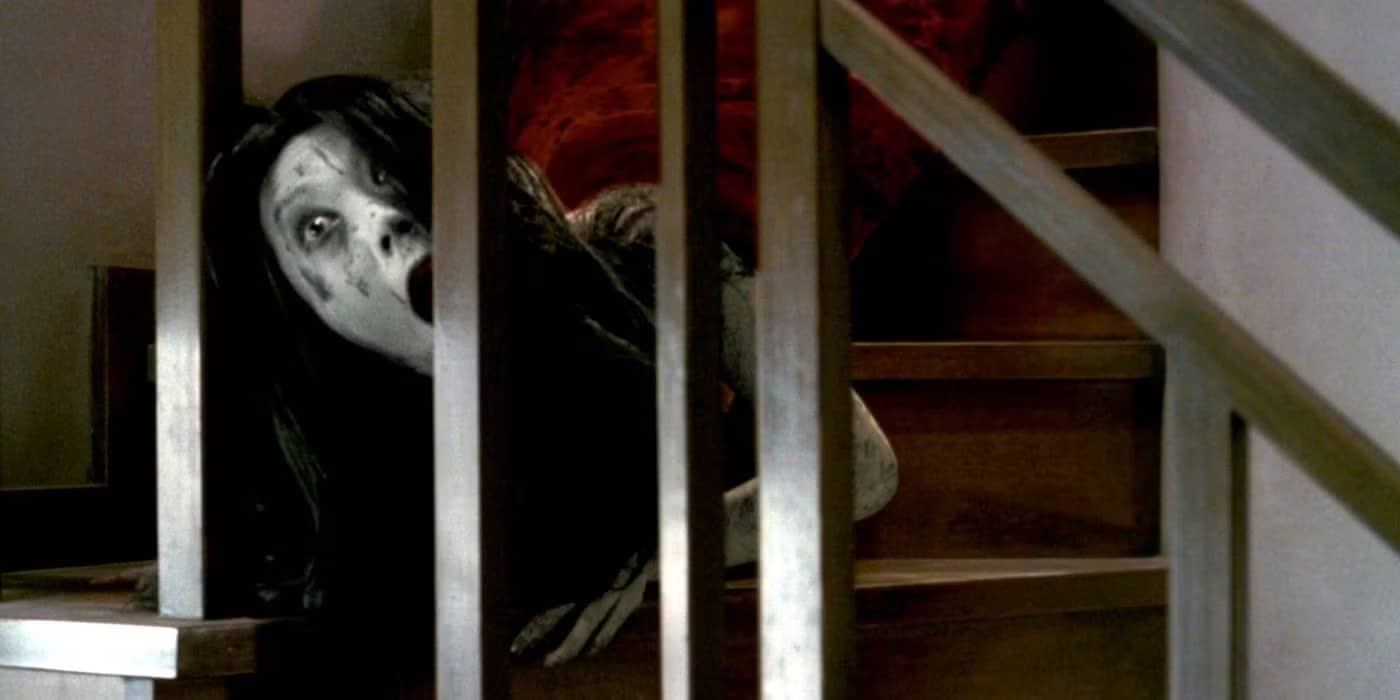
After a while, though, a certain sameness starts to hang over the proceedings; the scares repeat rather than build, and the movie adopts a stop-and-start rhythm instead of a sense of mounting dread. Disappointingly, the most chilling image from Ju-On—the ghost mother and child Kayako (Takako Fuji) and Toshio (Yuya Ozeki) perched over a terrified young woman as she cowers in bed—isn’t present here, and the second best frisson—Kayako slithering down a staircase like a reptile—loses some of its effectiveness in this iteration due to overcutting and too-tight framing.
Part of the feeling of repetition derives from the fact that the characters aren’t given much in the way of personality. The combination of bravery and vulnerability that Gellar perfected on Buffy the Vampire Slayer serves her well here, and DuVall does a lot with a little, but otherwise the curse’s victims aren’t given much to do before they become victims. Perhaps the strongest impression is made by Ryo Ishibashi, the hapless hero of Takashi Miike’s Audition, playing a detective investigating the bizarre events. Alternating between speaking English and Japanese, he brings a welcome center of gravity to the discontinuous proceedings, but he also figures in the most unfortunate addition to Shimizu’s original, a rooftop expository scene with Gellar that feels very much like a post-test-screening addition for the benefit of slower viewers.
It’ll be interesting to see how The Grudge plays to those U.S. audiences unfamiliar with the Ju-On franchise, given that it’s the most “Japanese” of the current crop of Asian remakes. It certainly announces that Shimizu can hold his own working with Hollywood producers and actors, and that he’s more than ready to move beyond the franchise that seems to have possessed his life almost as much as the onscreen curse. I await his next English-language project with anticipation as strong as my hope that that film isn’t The Grudge 2.
