Editor's Note: This was originally published for FANGORIA on October 22, 2004, and we're proud to share it as part of The Gingold Files.
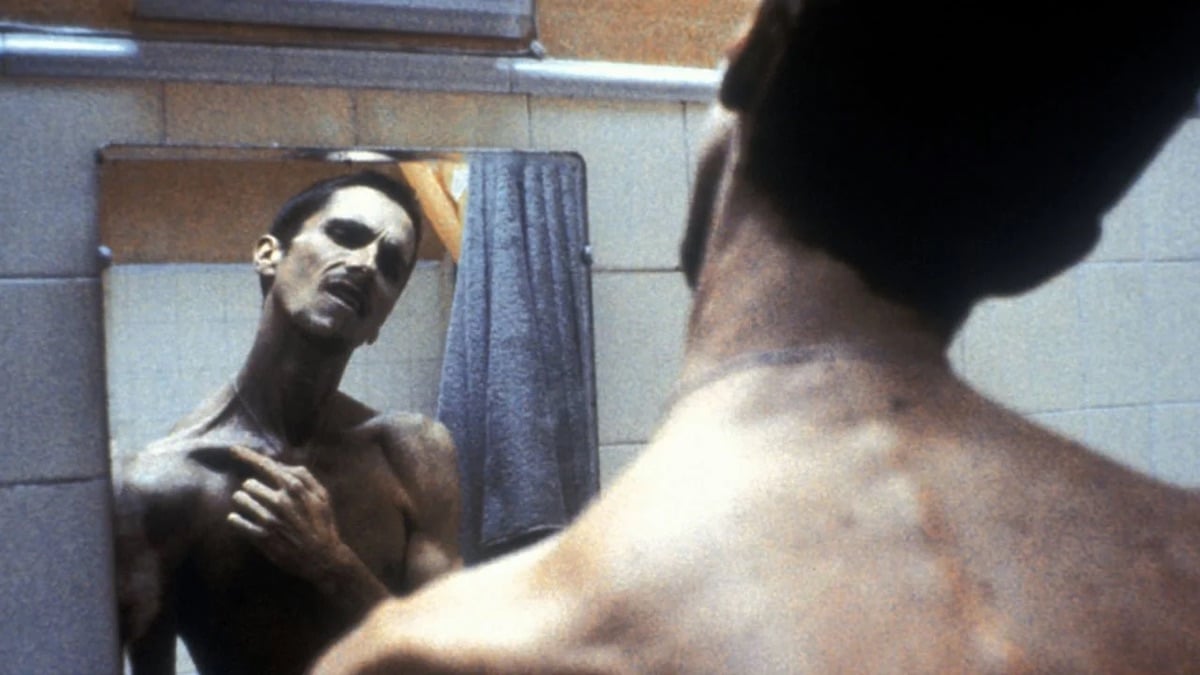
The first and most obviously striking thing about The Machinist is the gaunt appearance Christian Bale achieved to play the title role. Like Raging Bull’s Robert De Niro in reverse, Bale dropped over 60 pounds to portray troubled protagonist Trevor Reznik, and his physical state makes for instant sympathy—after your first glimpse of his emaciated body, you just want to give the guy a sandwich or something. But the actor’s weight loss is no mere stunt; rather, it reflects the psychological wasting away that Trevor is undergoing.
First seen disposing of a carpet-wrapped body before the story jumps back in time, Trevor is suffering from a very prolonged bout of insomnia, and finds his only comfort in the arms of sympathetic prostitute Stevie (Jennifer Jason Leigh), who lives down the hall from his drab apartment. In fact, everything about Trevor’s world seems colorless or otherwise drained of life; the film’s every setpiece speaks of physical or emotional decay. (It’s no wonder New Line felt that scripter Scott Kosar was the right man for their Texas Chainsaw Massacre remake.) At the factory where he holds down the title job, he’s looked down on as an oddball at best; he takes late-night coffee breaks at an airport cafe where the waitress (Aitana Sanchez-Gijon) just might provide an opportunity for romance if Trevor could only break out of his shell.
Things only take a turn for the worse, though, as Trevor begins finding strange notes around his apartment, and seeing a grinning, threatening stranger (John Sharian) following him around. This man, calling himself Ivan, claims to be a new co-worker, but nobody else at the factory has even heard of him. Soon Trevor is confronted with the questions—what is real, what isn’t, how much of what he’s experiencing is just in his head?—that have plagued many a protagonist in psychological thrillers.

The difference is in the details of the telling, and most crucially the fact that director Brad Anderson and Kosar don’t make the mind-tease the focal point of their storytelling. The Machinist is a creepy character study first and foremost in which the way Trevor responds to a world that seems to be spiraling out of control is just as important, if not more so, than the details of how that’s happening. Most gratifyingly, although there is a climactic plot twist that throws the movie’s prior events into new relief, the filmmakers underplay the revelation; its emotional ramifications are more important to them than giving the audience a “gotcha” moment.
Anderson’s visual approach perfectly complements his storytelling, as he teams with cinematographer Xavi Gimenez to present an environment that seems to have had the life leached out of it. This sort of monochromatic mise en scène has become a cliché in the years since Se7en, yet Anderson makes us forget how often we’ve seen it before by making the look all of a piece with his overall dramatic approach. Produced by the Spanish Filmax company, The Machinist was lensed in Barcelona, which the director and his team have transformed into a very convincing Everycity, unrecognizable as anyplace specifically in Spain (or in America) and very much appropriate to the film’s focus on Bale’s feelings of alienation. The icing on the cake is a superb score by Roque Baños, whose old-fashioned melodic contributions carry echoes of, but not outright lifts from, Bernard Herrmann.
Leigh and Gijon are both very good as two very different women whose only common factor is their growing concern for Trevor, while Sharian contributes palpable menace without reaching to be “scary,” and Michael Ironside, barely recognizable at first, has a vivid turn as a co-worker of Trevor’s. At the center of it all is Bale, enacting a remarkable portrayal of loneliness, guilt and paranoia that would be powerful even without his physically wasted look. Despite a few startling and/or grisly moments, The Machinist is not a horror film in the strictest sense, yet Anderson, Kosar and Bale make a compelling case that a person losing their grip on sanity and reality—and possibly hastening their own mental collapse—can be the most frightening fate of all.