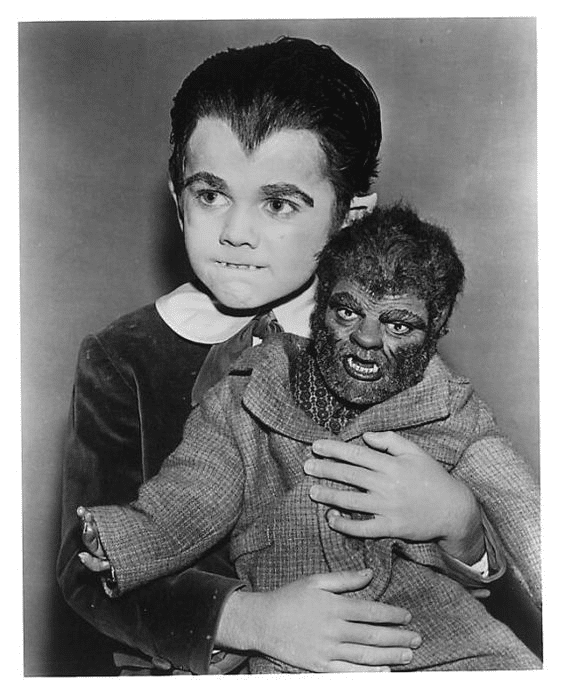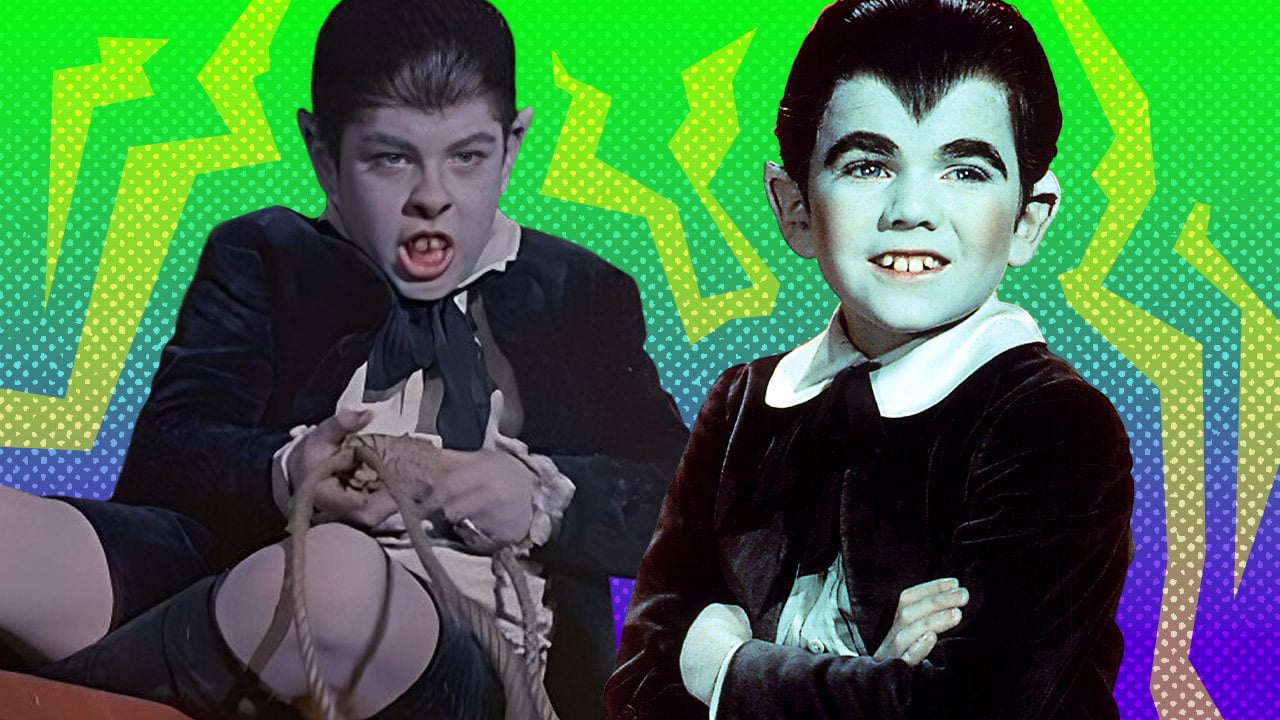
This fall marks the 60th anniversary of The Munsters, the classic television sitcom featuring a household of Universal-inspired monsters (and their black sheep/conventionally beautiful niece) that has endured various reboots and remakes – most recently as a Rob Zombie-helmed feature film). To mark the occasion, Fango spoke with Nate ‘Happy’ Derman and Butch Patrick, the two then-child actors who played the family’s lycanthropic grade-schooler, Eddie Munster.
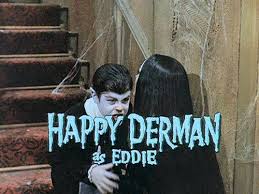
When Universal TV greenlit a color pilot film for The Munsters in 1964, 10-year-old child actor Nate ‘Happy’ Derman was cast as the wolf-boy Eddie.
Nate Derman: My father, may he rest in peace, was a comedy writer. We came out to California in ’55. His name was William Derman. His brother actually came out here first – my uncle, Lou Derman. He wrote for Mister Ed. They were both amateur magicians and members of the Magic Castle in Hollywood. So I performed at the Castle from… I guess I was 12 years old, and I worked there until I was 21. The only day they allowed minors in was on Sunday. So I worked every Sunday and went from being Happy Derman to ’Nate the Great’. So yeah, show business was in my blood.
How did you go from magic to The Munsters?
Nate: My mom was the typical stage mother. She took me to all these interviews. I was in a movie with Jerry Lewis called The Family Jewels, and another with Eddie Arnold called The Two Little Bears. The people I interviewed for on The Munsters were the producers, Norm Liebmann and Ed Haas. I went in and I did magic for them. The other thing I think appealed to them was that I used to build models. I had built the Frankenstein model, the Dracula model – those Aurora models. I meticulously painted them and they were on shelves above my bed. All that seemed to impress them enough, so they hired me.
Do you remember getting into character?
Nate: My makeup took almost three hours to put in. One of the first things they made was a mold of my teeth because I needed a mouthpiece so that they could rot out my teeth. When they transformed me with all that, the ears and the widow’s peak, it was really cool. I had Spock ears before Spock!
What do you recall about your co-stars?
Nate: I remember the first time I saw Fred [Gwynne] in makeup [playing Herman]. You know, it wasn’t Boris Karloff. It was more of a comedic take on Frankenstein, and the same with Al Lewis [playing Grandpa]. They were comedic versions of monsters of the ’40s – they weren’t actually scary. Of the four of us, I think Joan Marshall [playing the Munster mom, then named Phoebe] had the most subtle makeup. To see all of us on the set was a real thrill. We thought this was going to be a lot of fun to do on a weekly basis.
CBS bought the show but mandated some changes. Color filming was out, and they wanted to recast Eddie and the Phoebe character.
Nate: The pilot was shown to the bigwigs in New York. They were the ones who said, ‘Make these changes, and we’ll buy it.’ I had a contract for $750 a week – which, in 1964, was a lot of money. I think it was for 13 episodes.
The recast reworked Eddie into a more conventional good-hearted kid.
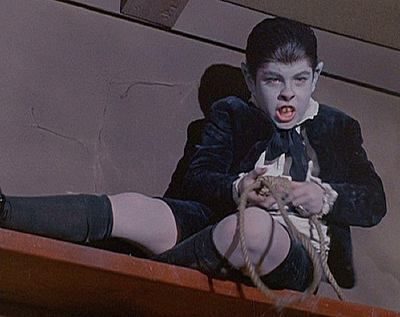
Nate: Exactly. Eddie in the original pilot was more of a dark character. When I portrayed him, I was 56 inches tall. Butch Patrick was 49 inches tall – smaller by seven inches. He had a bigger head and a smaller body, so he was enough of a difference, just in stature alone.
The unaired color pilot went unseen for decades before finally being released officially as a DVD extra.
Nate: For 20 years, I was told that this pilot was nowhere to be found or was destroyed. When I finally saw it, I have to tell you, it brought back such memories that I teared up. By this point, I had kids – my daughter and my son – who were in elementary school. As soon as they saw The Munsters words drip in the front they just looked at each other, and then they saw me at ten years old, playing Eddie Munster. My kids had heard about my first career but they’d never seen anything. It was so worth it, so worth it. The fact that this pilot exists and that it shows me as Eddie Munster is part of my legacy.
10-year-old Butch Patrick was cast in April 1964 as the new Eddie, ahead of Universal shooting a second Munsters pilot.
Butch Patrick: There was no audition process. Usually, you go to an interview, then a reading, then a screen test. I went straight to the screen test. I had just finished on a show called The Real McCoys, which was a fairly popular show featuring Walter Brennan and Richard Crenna. I did eight episodes of their final season.
Was your Munsters screen test done with makeup?
Butch: You’ve probably seen the early pictures of me without my widow’s peak and my bushy eyebrows. That was the look that I did the screen test with. And we actually went into a production like that.
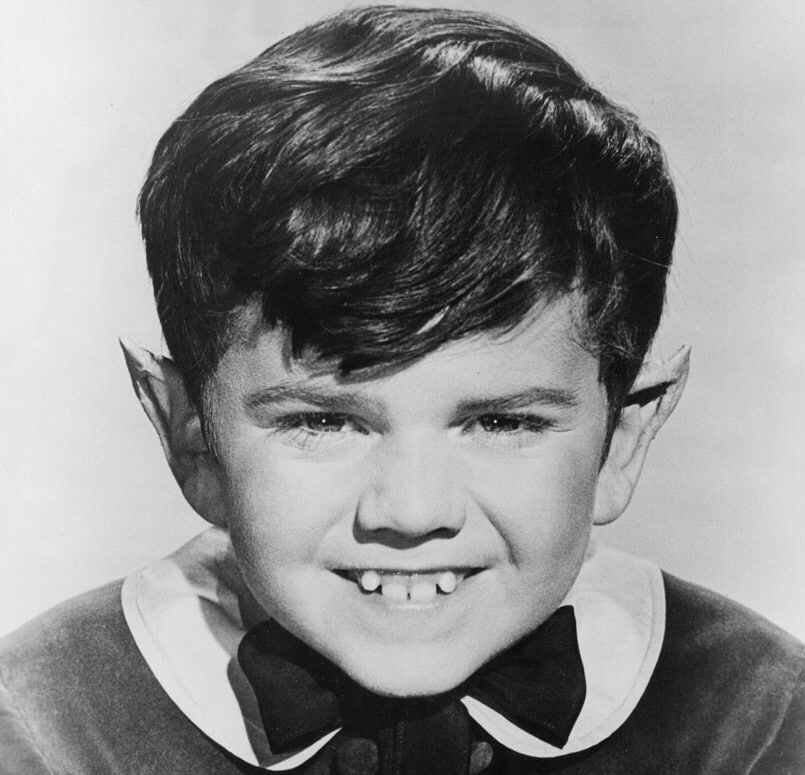
For the My Fair Munster pilot.
Butch: Right, with the love potion, where the postman falls for Lily and the neighbor falls for Herman. There’s a scene of me running down the street from school with a bunch of girls following me. That’s the only time you’ll ever see me without the widow’s peak.
What did you think of your final look for the show?
Butch: The hairpiece was very itchy, and then there was wax on my eyebrows, before putting on the fake eyebrows. I appreciated it and I thought that it worked better. I became more of an Eddie Munster and not Butch Patrick with pointed ears.
Eddie was recast along with the Munster mom, now played by Yvonne De Carlo…
Butch: Honestly, I think she was the last-minute drop-in surprise they needed to guarantee the show’s success. Yvonne came with a Star Power name. She was there to be the matriarch of the household and her presence was much needed. She could hold the household together and make it believable, so Fred and Al could do their slapstick comedy routines.
Your Eddie was a very different characterization from Happy Derman’s.
Butch: Happy was there in the early stages, where they’re trying to figure out what’s going to fly. He was being directed that way. They told him to make it scarier, make it more rabid-dog-like. All I know is, I’m glad they changed gears.
How was it adjusting to a weekly production?
Butch: For at least the first four or five episodes, there were a lot of technical issues that had to be hammered out. The makeup was changing on a week-to-week basis, with Fred’s headpiece and Grandpa’s nose. Our structure for the week was Monday, going in for an hour to read the script in the offices; then Tuesday blocking for the camera and the director, to facilitate a smooth shoot for Wednesday, Thursday and Friday. So Monday and Tuesday were not makeup days. I also had to do my schoolwork and keep the child welfare worker happy.
There were early production problems and stories of Fred Gwynne and Al Lewis locking horns with producers. Did you witness that?
Butch: You gotta remember, most of the negative stuff probably happened late on Friday, on the third day of the shoot, when everybody’s tired and tempers are flaring. I’d be gone by then. The only time I ever heard loud voices was when Al was hanging upside down for a scene. Norman Abbott was the director and Al didn’t like hanging upside down – it hurt his knees or something. They left Al hanging there too long and he yelled at Norman Abbott… and Norm yelled back. Al said, ‘You don’t know anything!’ Norman said, ‘You can’t talk to me like that.’ And then Fred said, ‘Now, Al. That’s not nice.’ Then Al goes, ‘Fred Gwynne, you can kiss my ass!’ Fred replied, ‘No. I don’t think it’s lunchtime yet.’ So that was the only time I ever heard of any back and forth above what we considered above normal speaking volume.
The Munsters was conceived around a big merchandising drive. Did you like seeing your face on products?
Butch: I thought it was very, very cool. I used to go up to the tower at Universal, which was this big black, monolithic square building, where they had an office for the merchandising. They had the prototypes and whenever things would come in, I would always go up there and grab one. I was kind of bummed that they didn’t always have Eddie. A lot of the stuff was just of the three adults, but I was okay with that.
You got to be an Aurora model kit. That’s pretty cool.
Butch: Yes, they did that right off the bat. The Aurora models had already been very popular – the original Frankenstein Monster and Dracula and the whole line of Universal Monsters. So it wasn’t a big step to take all that and match it to this TV show.

You wrapped up the early months of the show by saying goodbye to the original Marilyn, Beverley Owen, who wanted to return to New York…
Butch: I don’t think anybody foresaw that it would be that difficult – that she would be that homesick. She was just really deep in depression and wanted out of the contract, and the producers would have none of it. I remember that the show shifted big gears when she left. The whole original idea was really about a beautiful blonde and a household of monsters who looked upon her as an outcast but loved her. When (replacement Marilyn) Pat Priest came into the show, the scripts shifted big time to Herman and Grandpa getting into mischief and Marilyn became much more of a secondary character.
Eddie seemed to get more airtime too.
Butch: With kids in Hollywood, they’re just trying to make sure you’re not a liability and aren’t going to hold things up. So once they found out that I wasn’t a liability and that Fred and Al and I had a good chemistry, they wrote some good scripts for me.