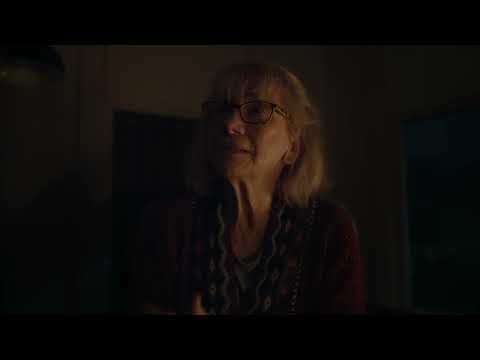
Teacup is Peacock's sci-fi/horror adaptation of Robert R. McCammon's novel Stinger. And it's not so much an adaptation of McCammon's 1988 New York Times bestselling novel as it is inspired by the novel. The way showrunner Ian McCulloch describes it, “It's like when you take a big song, and then do an acoustic version. If it's still good, it's a good song.” Teacup is a pared-down version of McCammon's epic novel. By stripping the story down to center on a smaller group of people, McCulloch was interestingly able to tell a bigger story by narrowing the focus.
McCulloch's take on Teacup follows a disparate group of people in rural Georgia who must come together in the face of a mysterious threat in order to survive. The first four episodes of the series are currently streaming on Peacock, with new episodes on Thursdays through Halloween.
The Teacup team (showrunner Ian McCulloch and stars Yvonne Strahovski, Scott Speedman, Chaske Spencer, Kathy Baker, Boris McGiver, Caleb Dolden, Emilie Bierre, and Luciano Leroux) have created a Stephen King-approved show. The living legend called the series “strange, creepy, claustrophobic, and scary” in a tweet earlier this month. Adding “All killer, no filler.” McCulloch admits he asked for the show to be sent to King without ever really expecting him to watch, let alone make any mention of it. Not only did King watch and mention the show, but he's singing its praises.
Earlier this year, I headed to Assembly Studios in Atlanta, Georgia, to take a peek behind the scenes as the Teacup team filmed the penultimate episode in the eight-episode season. The story has fantastic elements as the mystery builds. Something strange is afoot, and the two-episode premiere alone offered plenty of fare for fan theories and wild speculation.
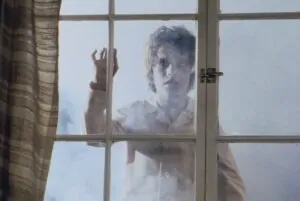
But amid the strangeness, a common sentiment among the Teacup cast is the appeal of the story's roots firmly planted in reality (and a shared love and appreciation for McCulloch). Series lead Strahovski admits, “To be honest, I really liked Ian. I am here, I think, probably because of Ian. I thought he was awesome on the Zoom and super smart. He just had a vision for this show that was smart and classy and really grounded.”

Yvonne's onscreen husband, Scott Speedman, echoes the praise for McCulloch: “I like it to be rooted in some originality. I'm looking for unique voices on the page. And trust me, they're hard to find, and then they're hard to get as an actor. I was all in as soon as I read it and then fought hard to get it.”
McCulloch's vision for the show also allowed for some enticing challenges for the cast. Teacup star Chaskay Spencer shared one of the project's biggest appeals for him: “When I talked to Ian, he said, ‘everything's underneath. Your character is going to be playing everything close to the chest. We don't want the audience to know what he's thinking.' That is a huge challenge. By nature, I'm a pretty animated guy, but this character keeps everything in. I always have to check in with Ian and the directors to ask if I'm giving them too much or if I'm not giving enough. Sometimes, I don't feel like I'm doing anything in those scenes, and the camera picks it up. I always have to check in with people. ‘Was that good?'”
The rural farm setting allowed Speedman and Spencer to do a good deal of horseback riding, which was new for Speedman. “We were shooting nights, so I was getting home at about seven or eight in the morning, sleeping for two hours, and then driving out for about an hour and a half into rural Georgia to do more horseback riding lessons. It was funny watching people's faces the first time I was on a horse. They were like, ‘Uh-oh.'”


But the lessons paid off, and fear is a great motivator. “I get a little obsessive, and I hate being bad at shit. Honestly, fear is a great motivator in terms of 70 people waiting for you not to fuck up on a horse. So that got me going, that was cool. Casanova, my horse, was very nice to me.”
While on set, we got to peek at some of the gnarly practical FX in store, some of which are already on display in the available episodes. Speedman shared his appreciation: “I know we use a lot of computer graphics, not in this show, but in general. There was a place we got about five or ten years ago where it was just too much, and it took you out. When you go back and watch stuff that I was weaned on, you miss some of the practical elements. I'm always for that as much as we can. I think it lands better. Obviously, they're going to add CG as they go here, but practical as the base of it, that's my taste. It was great to be able to see that and do that.”
What exactly do those practical effects entail? As McCulloch puts it: “You get body horror and you get creature design, but not in the way that you would think.” And we'll leave it at that in case you're not quite caught up.
When it comes to the choices made by their onscreen counterparts, Spencer says his character Ruben makes choices entirely different from his own. “I'd be out of there. I would probably dig a bunker for just my family. Yeah, that's what I would do.”

When getting into the headspace for Ruben, Spencer used playlists to guide him along. “I always try to choose music, whatever the character would listen to.” For Ruben, the playlist consisted of “A lot of country. A lot of The Kentucky Headhunters, Waylon Jennings. I also thought he was a Brian Adams fan. He's a secret Brian Adams fan.”
All eight episodes take place over 48 hours, which McCulloch says, “I don't know if we'll do that again,” should a season 2 be on the table. While the answers provided in one episode beget a crop of new questions, McCulloch hopes “By the end of episode three, you're not confused, but you don't have all the answers. Every time we answer a question, we try to ask another question. So the whole show reveals, I think. As much as it's science fiction, horror, or drama, it is a mystery. I think all good stories are mysteries.”
Through that balance of answering a question while posing three more in its place like a Mystery Hydra, McCulloch believes it's ultimately about “earning the audience's trust and then not breaking that trust. One of the hardest things in this was the mythology. When you say you're going to be inspired by a book as opposed to adapting a book, you have to make up your own mythology and make sure that it bends but it doesn't break. I have to take it as seriously as anything else. If there's a scare, I have to take it seriously. It's not just ‘a cat explodes.' I'm not saying a cat explodes…”
As we continue on our Teacup journey, inching closer to the eighth episode season finale, McCulloch believes the biggest challenge for a potential second season is “How do we make it bigger if we're lucky enough to have a season two, and keep it as grounded as season one? Widening the iris, but not throwing out all the rules.”
Hopefully, we'll have the chance to find out. Stream the first four episodes of Teacup on Peacock now. And if you're caught up, take a sneak peek at a clip from episode 6 below. Episodes 5 and 6 premiere on October 24, only on Peacock.