
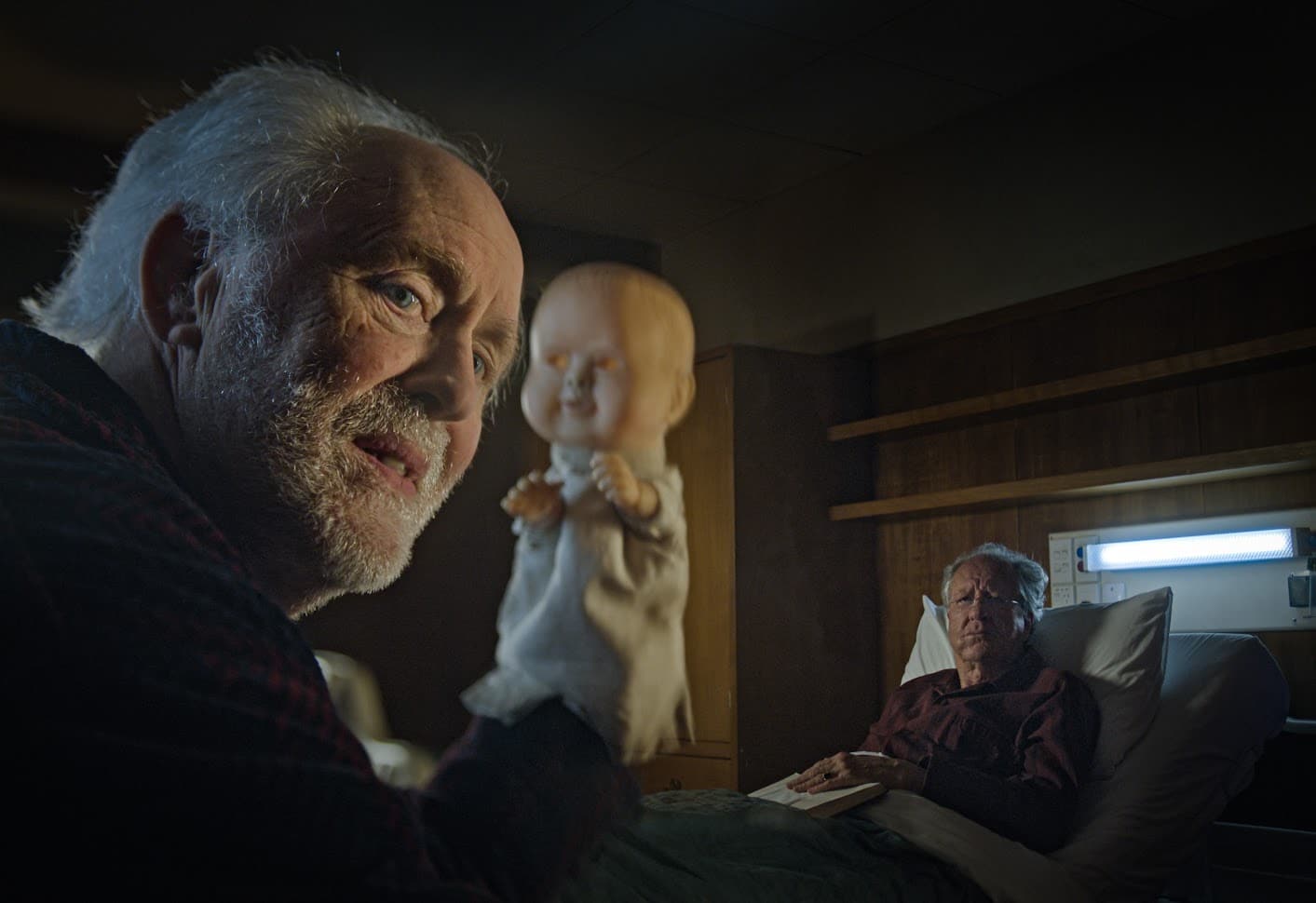
So much of horror (and media in, general) centers on the youth. I'm happy to see filmmakers like Coralie Fargeat widening the scope with stories like The Substance. Based on Owen Marshall's short story of the same name, director James Ashcroft further takes us to the other end of the spectrum, with a tale of regular folks in a retirement home. Yes, this is truly senior citizen horror. And it's a delight to see.
The Rule Of Jenny Pen stars two thespian legends, John Lithgow and Geoffrey Rush. Between them, they have racked up just about every major acting accolade that exists on both the stage and screen. In Jenny Pen, Lithgow plays a psychopathic tyrant wreaking havoc on his fellow retired residents. Rush is a newcomer to the community, a former judge, and the only person who seems willing to go toe-to-toe with Lithgow's Dave Creeley.
In many cultures, seniors are respected and revered as the elders of the community. But in many modern societies, our seniors are too often dumped and forgotten. Out of sight, out of mind. Jenny Pen addresses the horrors that come when our bodies inevitably betray us and the aftermath of what happens when our families and societies do, too.
A familiar convention we often see in horror films is the trope of children who report strange goings-on to their caretakers. The caretakers are dismissive, and the terror continues while the children are left to battle the threat alone. Jenny Pen flips the script by taking us to the other end of the spectrum. Senior citizens are being tormented, and if they dare to speak up… the caretakers are just as dismissive as the ones in those movies who don't believe the perceptive children. In both instances, the lack of listening feels like a direct lack of respect.
Lithgow's deliciously demented Dave Creeley perfectly illustrates what happens when tyranny goes unchecked. Rush's character represents just the slightest sliver of hope of a regular person willing to stand up to a bully. A universally relatable tale told within the microcosm of a nursing home facility.
“I actually think that is the great essence and the great power of this film. It's about cruelty and bullying in an age when we're seeing an awful lot of it on many, many levels,” says Lithgow. Adding, “It's almost a cautionary tale of what can happen when this goes unchecked and undetected. That's a rather grand idea, but this is a film full of ideas. It's so far beyond just the horror genre. It belongs in the horror genre, and it inhabits that genre very powerfully. But to me, it's resonant of all sorts of things.”
When the script first came to Lithgow, he wasn't entirely sold. It wasn't the script that had him questioning the project, but rather whether he could play the demented Creeley. “I can confess, I read the script, and I thought, ‘Oh my God, I don't know whether I'm capable of doing this. How will I live with myself? How will I even invite friends to come see this?' But I spoke to [direcor] James Ashcroft, and he spoke so eloquently about his serious intent for this film,” the actor shares.
Lithgow has more words of praise for Jenny Pen's director: “He's a man of tremendous perceptiveness about human beings, tremendous compassion, and an in-depth knowledge of the whole world of senior care. That just brought me along, and I have ended up having a great respect and admiration for both James and his vision.”
The story plays with our preconceived notions of what a villain and hero look like and who can step into and inhabit those archetypes. Rush has a theory on Lithgow's character, breaking down the wonderful names Dickens would use in his work, referencing characters like “Uriah Heap.” Rush points out, “Dave is probably one of the more banal male names in the world, but Creeley, I think it's a mashup of ‘really creepy.' Creeley. You go, ‘Oh yeah.'” And Creeley is indeed very creepy. Likely more so than you'd expect.
While Creeley may be an absolutely demented and deranged villain, he's also a believable beast. “I just love the complexity of characters. To me, the most interesting drama and comedy comes from good people doing bad things and bad people doing good things,” Lithgow shared. “Duality is my favorite word, and it's the thing I always think about when preparing to play a part. What is the other side to this character? In the case of Dave Creeley, I looked really hard to find out when was the damage inflicted, and how has that defined his life? Why does he take revenge? Why is he so cruel? You have to ask those questions when you play a villain. You just have to understand the person and figure out what motivates them. Otherwise, the story has no substance. There's no meat on the bone.”
In addition to the mental torment Creeley wages on his retirement home neighbors, there's also a great deal of physicality to each performance. Rush's character has just suffered a stroke, leaving him in a wheelchair with limited mobility and altered speech.
Lithgow's weapon of choice (outside of the psychological warfare he brings down like a hammer) is the titular Jenny Pen, an eyeless, worn and haunted-looking doll/puppet he wears on his hand at all times. Jenny Pen is his right-hand girl. (Forgive me.) All of these elements are extensions of the characters, as much a part of them as their fingers and toes.
“I literally did a three or four-week intensive crash course of operating my wheelchair,” Rush says. And the pun is warranted. “There was a goof reel at the end of the shoot. The editors had put together some highlights from the making of the film, interspersed with me plowing into the camera, running into staircases, hitting the side of the doorframe, never really being able to get off camera, totally around a corner because something would go wrong.”
Rush had multiple speeds on his wheelchair and used them as another tool for his performance. “I had five speeds, you see? So, I had five real dimensions to my acting. It became a question of, is this number one, slow more interesting to the ambiance of the dialogue or the rhythm of the scene? Number five was quite fast, but even faster if you're in a narrow corridor and you want to make a 90-degree quick right-hand turn. I wanted to do things like this, but I didn't want to do jokes.”
And Rush is right. The chair is never used for jokes, though there is one humorous scene where the speed is used quite deliberately to drive a bit of humor home.
“The only time I thought we got a neat little bit of humor was when I first got put into the room that I unexpectedly had to share. My character is slightly arrogant and privileged. But just for that brief moment, it looks as though he will cross the room, make friends with the roommate and just get it over and done with. He comes forward, but he turns, and I would like to think, in a slightly Buster Keaton-kind way, he turns and just pulls the curtain shut.”
In addition to puppeteering Jenny Pen, Lithgow also shows off some dance moves. It's a rather sweet scene with all of the home's residents until Lithgow joins the party and comes in, as he so accurately puts it, like a “bowling ball.”
Rush recounts: “There was a beautiful day on set where they have their weekly dance class, and that's where you saw them. It was about halfway through the shoot, and you thought, ‘We're getting to see these characters in a different light.' And Creeley … John is just taller than everybody else. James shot that with a frame where John occupied the top half of the screen, and their heads occupied the bottom, dancing to Gene Pitney, who's one of my singing heroes.”
“It is very liberating to have something very specific to work on. I worked for several hours with a choreographer. It doesn't look like a choreographed dance, but by God, we worked quite hard on getting it right,” Lithgow adds.

“Young Daisy from Wardrobe was standing watching it on the monitor, and she was just sobbing because she was looking at Irene, who really had the mental age of a child of eight.” Rush remembers fondly, “She had little lights on her loud sneakers, and she was just dancing and thanking the sky for being alive. That's when I think everyone sort of went, ‘Oh, this is really all about everyone.' It's not just tucked away in its own genre, but there's a humanity. There's a heartbeat in this film, which is very nice.”
Aside from choreography and a permanently attached Jenny Pen, you'll notice Lithgow blends into his New Zealand surroundings. “I worked hours with a dialect coach perfecting my imperfect Kiwi accent. They're great benchmarks. Things that you can really work on and rely on once you've got them in place, it's creating a superstructure, and then it lets you let loose once you've mastered it.”
Jenny Pen gives the two actors plenty to chew on. As Lithgow so perfectly puts it, “It's red meat to a tiger. Geoffrey and I, we are almost the two poster boys of character man business. We love this kind of thing.”
Watch Geoffrey Rush and John Lithgow spar off in The Rule Of Jenny Pen in theaters March 7.
