
Last Updated on February 7, 2025 by Angel Melanson
While in theory, you could run into a celebrity at any point in time, there is something tantalizing about film festivals, with their bustling press lines and star-studded post-screening Q&As that uniquely dissolve the dividing lines between star and fan. Sundance is no exception, and cognizant attendees in Park City might have noticed Rachel Sennott do a walk-and-talk interview about her new project, Molly Gordon while eating Thai food or Elijah Wood grabbing a hot beverage. As I left the gates of the Salt Lake City airport, my fellow Chicago-based critics informed me that I had just missed Jenny Pen owner himself, John Lithgow, by baggage claim.
This unique type of access is a staple of these fests, which take stars of every level and fans who are eager to get a glimpse of them and throws them all, pressure cooker style, within the confines of a bustling city. It's fitting then, that two 2025 Sundance Film Festival premieres, Opus and Lurker, explored the fallout of celebrity worship and parasocial relationships, taking their premises of individuals who gain access to fame to uncomfortable and bloody extremes. They act as more than just cautionary tales but a field guide to engagement, exploring the consequences of giving up everything to be proximate to power and influence.

While in plot and execution, director Mark Anthony Green's Opus fails to distinguish itself from the other A24 contemporaries it's being roped in with, one way it differentiates itself is by having a protagonist who, according to Green, “[doesn't] do anything stupid.“ That title of most competent final girl goes to Ayo Edebri, who plays writer Ariel. When we first meet her, she's a magazine writer for a publication whose ideas are always being overlooked (or worse, they're accepted but then reassigned to other writers) by her editor, Stan (Murray Bartlett).
At the crest of her wave of disappointment, Alfred Moretti (John Malkovich), a renowned David Bowie-esque pop star, announces his return to music with a new album after a thirty-year hiatus. To celebrate his resurrection, Moretti invites select members of the press to his artistic compound for an exclusive, once-in-a-lifetime listening session. Stan is unsurprisingly invited, but so too is Ariel.
Edebri's expression when she first receives the news contains multitudes, balancing surprise, vindication, and fear in one gaze. As she steps foot on Moretti's compound, she attempts to deduce the reason she was chosen while growing increasingly uneasy about the cult-like mannerisms of Morreti's crew (only here does one pass the bread across the dinner table by first taking a bite out of it, the chunk of loaf still damp with the last person's saliva).
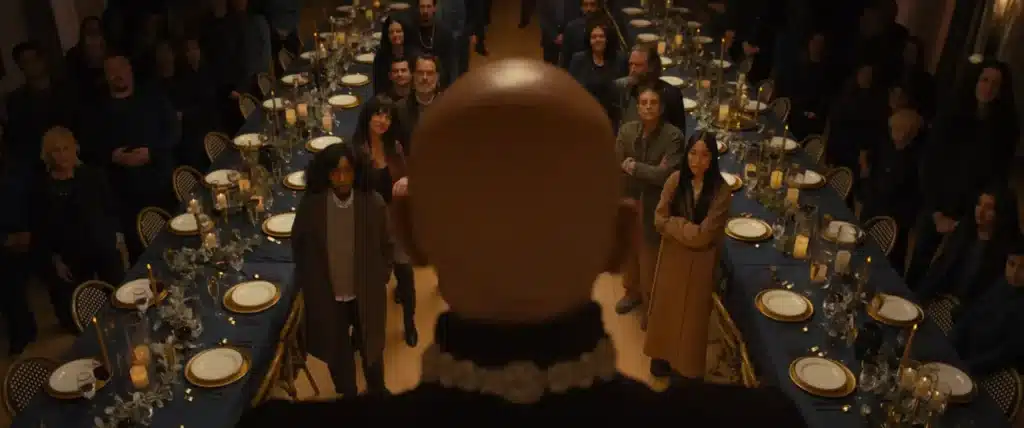
Per Green's sentiment, Edebri's competent Ariel becomes the venue through which we see that fame's corrosive faculties are strongest when people are most proximate to them. While Morettis' acolytes, superfans, and workers understandably don't pass the vibe check, what's alarming for Ariel is the way she sees her fellow invitees, from Stan to Emily (Stephanie Suganami), an influencer, act nonchalant and even endorse the increasingly strange happenings and customs of the remote land.

Whether it's people who randomly go missing or the fact that guests can't go anywhere without a staff member (a funny sequence involves Ariel trying to go for a run to get some alone time; Ariel's assistant, played by Amber Midthunder, runs in lockstep behind her). Ariel is the only person who names the bizarre behaviors for what they are. The other guests, too drawn under the spell of Moretti's talent and the realities of their privilege to have this access, are quick to dismiss any irregularity as the byproduct of artistic genius.

This becomes the way anything uncomfortable or unseemly gets explained away. It's only when it's too late, and the knives, arrows, and rat puppets (arguably the scariest tool of the three) come out, revealing Moretti's true intentions behind his generosity, that the guests realize what Ariel's been conscious of from the start. Fame doesn't excuse one from the rules, no matter how much the powerful may believe they are above them.
Things may taste better when they're exclusive, but the aftertaste can be fatal. Throughout Opus, Ariel becomes a model for how to relate to fame and talent: not by forgetting who we are and losing hold of ourselves, but by using our agency and voice to speak to how influence may be abused. From her clocking that something is amiss the moment she steps foot on the compound to the ingenuity she displays when Moretti's hospitality curdles into violence, Ariel can survive because she didn't lose herself in being seduced by power.

The nascent pop star in focus for director Alex Russell's Lurker is a couple of career controversies behind the status of Moretti, yet the film also explores the dangerous consequences of the ways people will empty themselves in the pursuit of fame. While Opus features a protagonist who is on the outside looking in as she sees those around her bend over backward to appease stardom, Lurker situates viewers into the twisted but all too relatable headspace of someone who will do anything to be noticed.
The film opens with clothing store worker Matthew (Théodore Pellerin) taking note of when Oliver (Archie Madekwe), a pop star with a growing fan base, enters his store. While Matthew's other co-workers awkwardly shuffle for a picture with Oliver, Matthew keeps his cool, unplugging his co-worker's phone from the store's speaker system and inserting his own. He plays Nile Rodgers' “My Love Song For You,“ which instantly causes Oliver to take notice. Matthew explains that he grew up listening to Rodgers (it's obvious to everyone except Oliver that this is probably the first time Matthew has ever listened to the song); the reality is that Matthew knew Oliver's music taste by lurking through his social media.
Matthew's manipulation pays off in ways beyond what he could have hoped: Oliver, thinking he's met not a fan but a true potential comrade who understands him on an artistic level, invites Matthew to his show later that day. After that taste of glory, Matthew resolves to do everything he can to be in Oliver's inner circle, hoping that as Oliver's fame rises, his stature does too.

What Lurker gets right about power is in the inherent allure of the fluidity that comes with it, how those who have it seem to be able to live a different life than the rest of us. Matthew takes notice of how people treat Oliver differently once they recognize who he is. There's a cathartic glee in witnessing how Oliver only follows the rules insofar as he can achieve a status where he doesn't need them anymore.
In one humorous scene, Oliver follows Matthew on Instagram, and Matthew's phone begins to buzz incessantly with new followers. He lies on his bed, lulled to rest by the sounds of new follower notifications. It's intoxicating, exhilarating, and just the tip of the iceberg regarding what Matthew hopes to gain from leeching off of his new friend.

What's most tragic is how Matthew will contort himself into someone unrecognizable to be noticed and kept in Oliver's inner circle. He is whoever he needs to be to have access and does everything from becoming an amateur videographer to cleaning up Oliver and his crew's dishes to be kept around. Yet what starts as innocuous becomes something much more sinister as he sabotages, blackmails, and physically wounds any potential competitor of Oliver's time and affection.
In a sobering moment for Oliver, Matthew shares that the way his obsession manifests is both universal and specific: “We all want the same thing,“ he tells Oliver, gesturing at how Oliver's “friend group“ really consists of people who want the same prestige, “I just want it more … and I'm better.” It's a rare moment of honesty that's as depraved as it is refreshing.
Though different in the characters they center and their narrative approaches, Opus and Lurker articulate a hunger for a new way to relate with great talent, revealing that empires built on egos lack a sure foundation and the whirlpool of excitement they pull people into only drowns all who enter. Ironically, while the end goal of fame is to become inaccessible and to be too important to be available at a moment's notice, such fame is isolating, and many spend the rest of their lives trying to chase intimacy and connection.
The films explore the lengths we'll go to gain proximity, how we'll hollow ourselves out for a taste of the spotlight, and how the pursuit of being seen comes at the cost of being known. It's fun to lose yourself sometimes, but as both films warn, you have to come back home too.
Update: A24 releases Opus on March 14th. Lurker has been picked up by The Substance distributor, MUBI. For more, see our list of all the new horror movies coming out in 2025.