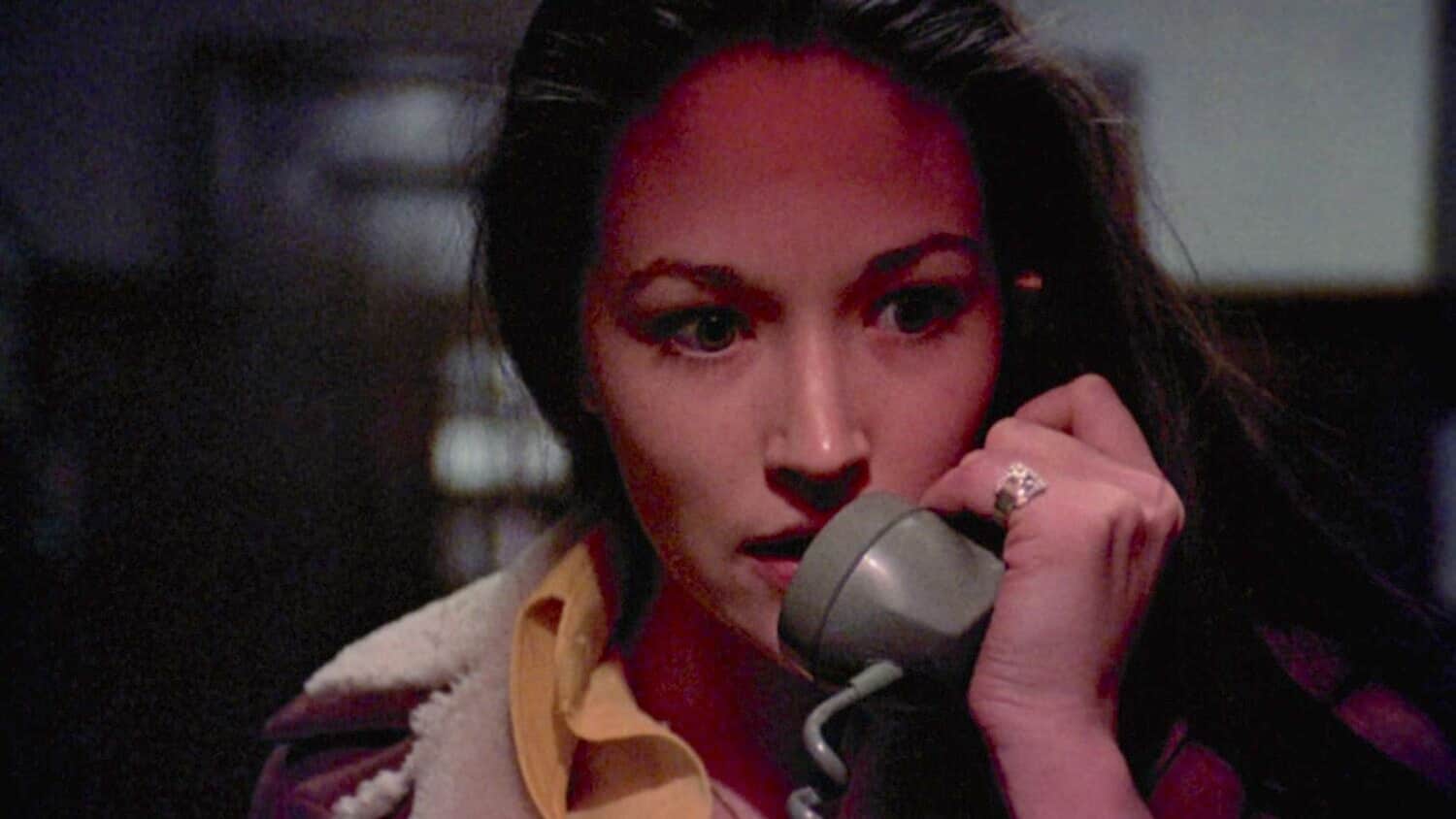
Olivia Hussey in BLACK CHRISTMAS (Credit: Cineplex Entertainment)
If you've read this column every month (bless you), you'd know that Basket Case, Silent Night Deadly Night, and the other modern novelizations from author Armando Muñoz have greatly expanded on the films that we know and love. Muñoz will take a random line or unseen moment from the screen version and create new subplots that fit neatly in the established story, never contradicting the on-screen action in any major way.
This makes the books feel like director's cuts or expanded editions of the movies, unlike many novelizations of yore, where the changes (often due to an author working from an older draft of the script) might present a different scenario entirely.
But for Black Christmas, Muñoz opted to stick fairly close to Bob Clark's 1974 classic, making his diversions both briefer and more infrequent than usual. One only needs to look at the books on the shelf to see the difference; this one is noticeably thinner than its predecessors, clocking in at a mere 240 pages, whereas the others all went past 300.

Please note that this is not a complaint; on the contrary, I point it out in case you read some of his others and didn't care for his extended ideas about the events in their respective films. Few would argue that Black Christmas is the best of the movies adapted for this unofficial series, so there's a sense of “if it ain't broke, don't fix it” going on throughout the novel, as opposed to something like 1981's so-so Happy Birthday to Me, which had a muddled third act Muñoz' version made great efforts to improve.
Amusingly, this is also the first of the five to have an existing novelization. Author Lee Hays penned one for its 1974 release, and as any fan can tell you, it's nearly impossible to find and very expensive when it does pop up on eBay and the like. I myself have never read it, but by all accounts, it plays out pretty much exactly the same way the film did, making it not worth the trouble unless you merely want it for your collection. It seems like Muñoz wanted to offer a balance between his usual extensive additions and the bare-bones version that already existed, which was the right call in my opinion.

For the (sadly!) uninitiated, Black Christmas unfolds over a 24-hour period December 23rd – 24th, set almost entirely within a sorority house where a handful of girls are staying behind for the holiday break. Our heroine is Jess (Olivia Hussey), who recently discovered she is pregnant with her boyfriend Peter (Keir Dullea), a dickish music student. Jess wants to abort the child, and Peter is not only against it but insists they get married as well.
Alas, she isn't any more interested in marrying him than being a mother, which, along with a disastrous piano recital, sends him into a bitter rage. This makes him the movie's prime suspect for the true identity of “Billy,” who has been making deranged phone calls to the sorority house line and is now murdering the ones who stayed behind.

Now, if you truly are in the dark about this movie and are reading this anyway, I have to urge you to stop reading right now and go watch it! Because I'm going to spoil the identity of the killer!!!
Now that you're back, you know I'm joking. The movie doesn't identify the killer (though it does prove it is NOT Peter), ending on a down note that suggests Billy has just killed Jess as well. It's one of the most chilling things about this very scary film, and I admit I worried that the novelization would attempt to clear up questions that should remain unanswered.
Thankfully, it does not. Muñoz offers a bit of insight into Billy's mind and provides some backstory for Peter that explains why he's so anti-choice, but otherwise leaves Roy Moore's script intact.
By the end of the book, we know that Billy is impotent and that because of his fragmented mind, he doesn't even remember his own backstory. But there's nothing in here to suggest the author wanted to point the finger at any of the other male characters in the film. In one of his few added beats of action, Jess sees Peter making his way toward the house when she's being chased by Billy, further confirming that they are not the same person (though she does ponder if they're working together).
The closest the author comes to “breaking canon” is an early sequence in which Billy murders Mugsey, another girl at the house, whom the others assume has left to be with her family as planned. In the movie, we see several sorority sisters at the party in the opening scene, but they all disappear by the next morning, presumably to go home. So the next time you watch it, pick a random girl at the party and boom, that's “Mugsey.”

But again, Roy Moore's script takes place over a 24-hour period, and there is indeed a chunk of time where neither Jess nor the other residents (Barb, Phyl, Mrs. Mac) are there, so there is a gap where Billy could have conceivably murdered someone and hidden the body without anyone thinking anything of it. We also get details on the film's handful of off-screen murders, such as the young girl in the park and the cop watching the house, adding a little extra mayhem without upsetting any established details.
But most of the added material comes from the inner monologue of both Jess and Peter. In a move I found hilarious, Muñoz turns Jess' amazing wardrobe into a subplot of sorts, labeling it a “Hands Off” sweater she wore during a protest against conservative politician Thurston Gladwell, who happens to be Peter's father.
The two men weren't close, and Jess wasn't seeing Peter at the time of her encounter with the older man, so she had no idea of the connection until only a few weeks before the story's events, when Peter dropped his wallet, and a photo of the two of them spilled out.
In turn, Peter had no idea Jess was the young woman who caused his father such grief on the political stage, and even though they weren't close, that's when he decided to get some revenge on his father's behalf by lying about using a condom when he and Jess next made love, getting her pregnant on purpose.

Then we learn, from Peter's inner thoughts, that the reason he and his father weren't on good terms is that he had impregnated an earlier girlfriend, and made no fuss when she decided to abort it, which infuriated his right-wing blowhard father. With this added backstory, Peter's extreme reaction to Jess' desire to visit Planned Parenthood has depth the film didn't offer.
Not that we needed it, since he is thoroughly established as a jerk from the first time we meet him, but if you ever wondered “Why was she even dating this creep?”, this backstory allows us to understand that his behavior turned recently. And while he isn't the killer, he does destroy Jess' sweater, seeing it as a symbol of her feminist ways that now enrage him so much.
This results in their showdown at the end having more to it than the movie version. On-screen, Peter breaks through a cellar window and approaches Jess, seemingly harmless and merely confused as to what she is doing down there. When the cops find him dead a few minutes later, we're to believe that Jess killed him in what she believed was self-defense.
Here we get the details: with Peter still raging about the abortion plan, he has decided to kill her (and the baby) himself, feeling it was his right as the baby's father and Jess, a mere woman, shouldn't be allowed to make those decisions (quick note here: Roe vs. Wade was certified a year before the movie was released, and after being overturned in 2022, was again a heated topic in this country when this book was being written/published, so the subtext of the original film becomes actual text here). It's another off-screen kill that we get the details of here, making the climax more about them than Billy.
Again, we don't find out more about Billy than the movie offered, though this extended ending not only explains where he went, but also allows the story to have a slightly more hopeful conclusion. Listening in from his attic hiding spot, he knows that the cops believe Peter was the one who killed the other girls, and with Jess stopping the madman, it's case closed. Billy decides he will move on and find new targets, having lucked out here and knowing that if he finishes the job (i.e., kills Jess), it would only prove to the cops they were wrong.
While the movie only suggests Jess is dead because the phone begins to ring (the calls always occur after a murder), here it's clear that she's actually still alive and even more determined to fight for women's rights, in honor of her now-dead sisters. Don't forget, the idea that the movie ends with her death has always been a fan theory, with nothing to indicate she's even in danger (for all we know, the phone call is from Barb's mom or something), so Muñoz's optimistic take on this unseen event isn't breaking anything.
We're also given a bit of insight into why Barb (Margot Kidder) is so prickly with the cops, and why she eggs on “the Moaner” when he calls, instead of being afraid like the other girls. Per the novel, at a frat party the previous year, she got a bit drunk and was showing off her ability to tie a cherry stem with her tongue, which unfortunately gave the frat guys the idea that she would be willing to do certain other things with her impressive mouth.

After being forced into this humiliating assault, she reported it to the police, only for them to shame her for being promiscuous and a lush. So she's been of the opinion that the police are worthless ever since, and started hitting the bottle even more heavily to cope. It's also suggested that she believes the caller poses no real danger, having experienced far worse from men who weren't cowardly hiding behind a phone line.
“Men suck” is kind of a running theme throughout the additional material. Smaller details, like the discarded drink in Clare's room, are given more weight here, with both her father and Fuller pressing for more details in a “she's to blame” kind of way, and Fuller even tries to read the girl's diary, threatening a warrant when Jess refuses to let him have it. Phyl is also frequently annoyed that her boyfriend, Patrick, keeps pestering her for sex instead of being understanding that she wants to be there for her sisters.
Even the doctor at the end (unnamed in the film but given the name Collins here! I was delighted) keeps ignoring Jess and insists on having Chris help him with the fainted Mr. Harrison, not caring that they'll be leaving her alone. Most of these amount to a few extra lines of dialogue or just one of the girls' inner thoughts, but taken as a whole, the book actually has a more feminist bent than the 2019 remake (which diverted far more from the original story than the 2006 version did), which was a nice surprise.
The only guy that comes off as Good, Actually is Chris (Clare's boyfriend, played by Art Hindle), who is virtually unchanged from his cinematic counterpart. Oh, and Claude the house cat, who heroically claws at Billy when he's chasing Jess at the end.
Otherwise, there isn't much here that would surprise someone who has seen the movie a few times. There are a few throwaway explanations for some of its occasionally thin characterizations, such as why Chris is on a first-name basis with John Saxon's detective character (his older brother used to be on the force), but I would estimate that it plays out 90-95% exactly as Bob Clark and his cast presented it to us.
I know it seems like a lot given the length of this article, but I assure you, when compared to the four previous books in this series (one of which devoted an entire chapter to something we never saw), it feels closer to a direct transcript. The new/extended scenes would probably only amount to about five more minutes of screentime, as opposed to something like the author's take on Basket Case, which nearly doubled the on-screen action.
As remake directors Glen Morgan and Sophia Takal can probably attest, fans of this film are very protective of it and its story, and would probably call for Muñoz to be on the receiving end of a glass unicorn if he messed with it too much. But he made the right call, and it is by far the easiest of his five novelizations to recommend to a die-hard fan of its cinematic counterpart.