Last month, I had the chance to explore Blumhouse Enhanced Cinema on Meta Quest. The two movies they have are The Black Phone and M3GAN. It’s like your own personal theater: you have the screen in front of you, but everything around you transforms with the scene, bringing new life to the films. You aren’t just watching Finney in the basement; you are in the basement with him. When M3GAN chases someone through the woods, you are transported there with her. You are immersed in these worlds with full 360 visual and Dolby Atmos spatial audio.
This is definitely a new way to view a movie, especially on rewatch, and you get to experience it in a whole new way. Glass flies at you during an explosion, popping off the screen and filling the room, elevating the experience. And it’s not just dropping you into the environment, the visuals around the screen change based on what is happening. In M3GAN, when the camera focuses on her, you are placed in a matrix-like setting where everything around you is scanned, and it’s as if you are viewing what M3GAN would be seeing.
After watching both movies, I had the chance to chat with Mike Anderson, Creative Lead at Nexus Studios, about bringing all of this to Meta Quest and how he developed this new way of watching horror movies.

FANGORIA: Is this your first time working with Blumhouse, and how did they pitch the project to you?
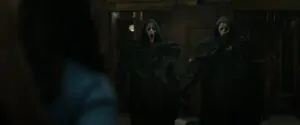
Yeah. It's my first time working with them. It was a really interesting project. It was already underway to a degree before I was brought on to it. What made it even more interesting than a normal project is that we had to sell to Blumhouse to nicely reassure them that when we took this project on, we're going to respect the filmmaker’s intention, that this is a worthwhile thing to do. And that moving these films that are beautiful, perfect films for the medium they're in, in this new medium, and doing this stuff is going to be a good idea and going to work. And so, it was a fun thing to write creative for and be like, okay, this is what we're going to do. We understand all of this. And we're filmmakers ourselves, so we'll nail it. And this is the cool stuff we can do. So, it worked out, which is great.
What was the main goal that you wanted to achieve with this project?
When I started, I just wanted to do a good job, but then I got excited and began to see its potential. And then what I touched on previously is we're operating in, I think, a new medium almost of filmmaking in this regard. And I wanted to prove not just that this is great for M3GAN and The Black Phone, and maybe some other horror films, but to really show, as I started to discover, the incredible potential for storytelling and narrative that it has. That's what we can do in headsets or wearables, or wherever this stuff is going to go in the next few years.

Can you talk to me about the development process and how much research went into bringing elements from the movie to life in a new way?
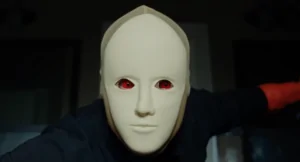
As much research as you can. I'll tell you, though, there's some interesting stuff about it. I was a prop master before I came into films. From the PA to the art department, the props to production design, all the way up in traditional cinema. Then I went into animation and then real-time animation. I adopted that early. And so, I was able to function as an intermediary between film studios like Blumhouse and NBCUniversal, and so on. And then our people making special effects, who are like, maybe they work on mobile apps, and they're doing effects for that. So, there's a big gulf there. Everyone's a brilliant artist, but there's a gulf in language.
But you know what was fascinating? When we started putting these effects in, we quickly realized two things would happen. You're going to see this effect at the same time as you're watching a similar effect on screen. This one was made in a completely different way than what you'll need to do for this to play in real time in a headset at low res while you're also watching a 4K film with spatial audio. So, there's a significant technological difference between the two, yet they coexist visually. You don't want it to look bad. You want it to look really good. That's very tricky.
The other thing is, you're bringing something into the physical realm with VR. And so, the research we started and leaned into was actually much more in the practical effects vein. So when we were like, okay, we have to come up with an effect for how the basement takes over your room in The Black Phone, because we know the scale of your room, and the walls, and the ceilings, and the floors, and it comes up over your room. Well, that's not in The Black Phone, that effect. We have to create that. So, it's a tricky situation. We were like cloud tanks. We should do cloud tanks. I mean, if you know special effects, you know I'm talking about… It's like Close Encounters of the Third Kind, where they have the spooky clouds where they pour milk into a black aquarium and then shoot that.
If we did these old ways of doing special effects with simulations and whatnot, you would have really high-quality, beautiful, physical-feeling effects that fit well within film history and horror. And you, as an audience member, wouldn't question it as much, and it felt really nice. So, there was much more practical stuff and fitting more digital effects in. It just kind of happened as we got into it. It's what worked.
My favorite experience with The Black Phone, watching it with Meta Quest, was being in the basement. I was able to look around, and I was in that environment with Finney as the phone rang. What was your favorite thing to work on when bringing The Black Phone to this new watching experience?
Super complicated, I got to say, because in a lot of different ways. It's conceptually and technically. So, technically, it's complicated because you're in it so often. I think we bring it in and out in the movie 17 times or something. You're in it a lot. It's got to be really high-res, really beautiful, really gorgeous in how it looks. We had the fabric. These geniuses who worked on it came up with an amazing way to bake light and create super-high-res textures, and all this beautiful stuff. So, it looks really good. That's a big part of it. I have to adjust every scene to match the film's lighting. But the conceptually tricky thing is that we could remake that basement exactly to the scale it was in when Finney was in it, no problem, and put you into that in VR.
But the intention, I think, to me, watching the film, and how it repeats, and repeats, and repeats in the film, it's claustrophobic, is how it feels. To make you feel claustrophobic, since it's a pretty big basement, it's shot on a set, so it's much bigger than the room in the film. But when we put it onto your walls, and it matches your walls, and your ceiling, and your floor, you're just so implicated as Finney that you feel it way more. So, that's the fun of using the Quest headset that can do all that and technically bring all that stuff in.

It seemed like a lot of love was put into bringing the immersive Perpetual Pets commercial that kicks off M3GAN. It made me laugh when the toy's droppings rolled off the screen and down to my feet. I rewound it a couple of times. Can you talk a little about that segment?
I didn't think we'd get that through. I was like, “Man, you know what we need to do right here? We got to shoot poop right out of the screen.” Trust me, it's going to be great. But M3GAN is a horror-comedy. In the opening, we're dealing with a possibly very skeptical audience. Horror enthusiasts, they're metal heads. They're tough, dude. And rightfully so. It's a packed genre. So, we knew we had to grab you and get it right. But my favorite thing about M3GAN is that the entire film is in the first few seconds, that song that's going on, and the little girl is like, “Oh, no, there's someone dead. I will have that person replaced in my heart with a doll.” That's the plot of the film. It tells you the whole plot right there.
We needed to nail the comedy. It's shot in 4:3 rather than 2.39 as well. Since it's a square, we make the screen smaller to fit it. We just lived that fake commercial, and then it goes immediately into the depths of their family. Then you have to go with this big tonal shift, so we changed the screen scale, and then we go into our scary stuff. We knew that if we could get both of those tones right in the first couple of minutes, we could nail the movie and know what was up.
The thing that really impressed me with M3GAN, and I didn’t catch it at first, was when it went to what I’m just going to call M3GAN vision, and my entire room was transformed into this matrix-like setting with things labeled “chair,” “table,” and I think it even labeled my dog. How did that concept come to be?
That's exactly what we called it! Oh, it's so great. You just do so much thinking on these projects, because everything's so brand new everywhere, and what you can do. But in terms of learning what the Quest headset is capable of, which is crazy how much data is coming in and how it's interacting with that, we just started to realize that, well, I mean, M3GAN is basically a Quest headset with legs that's walking around. It's probably the same tech, but she's analyzing the room scan and using a LiDAR scan, and then categorizing all this stuff. It's like, let's make all the data coming into the headset transparent and use it. So, it'll do your wall art, your coffee table, your sofa, your floors, your labels, everything. God, I can't even remember how much stuff we put into that, that it'll pick up. It's cool.

This experience seems great for the horror genre, creating atmosphere and enhancing the elements happening on screen and in the audio. Are there plans to do this with more movies?
I mean, to me, movies change with technology. That's a crazy young, young medium. It's been around for, what, 120 years? Painting's been around for 15,000 years. So, it's just still in complete flux. We're still dealing with the shift from TV and cinema to iPad and iPhone, and with what a movie is. I think it's just naturally going to go from a phone up into glasses, where you're going to be watching entertainment. The screens the average person will be watching are like iMac size. If you think about it, once you start building for it, you realize how huge these screens are. They're beautiful. And then you realize the potential of multiple screens, moving the screen, and the things that can happen between you and the screen. And you start to see how filmmaking is fundamentally going to change, I think, over the next 20 years, in that strength, in a really neat way, in terms of just instantly usable techniques. We called it visual sound design, which is like a dumb oxymoron.
Sound design is awesome. You can't do a horror movie without sound design. It's so stupid if you turn it off, but you never notice it. And we started adding in this atmosphere stuff where you don't notice that it's there. But in the nighttime scenes in M3GAN, we turned your room blue with blue light, and, man, it is way the hell spookier. Police lights, and firelight, and all these little scenes that you can do. Just working with lighting around there does so much for film. It's great.
I’m not going to lie, I was a bit skeptical about whether this was going to pay off; not all VR stuff does. Fortunately, Mike Anderson and his team pulled off a really cool viewing experience, and I’m excited to see what comes next in this space.
All you need to check out this new viewing experience from Blumhouse is a Meta Quest 3 or 3S and the Blumhouse Enhanced Cinema app, available here. Just rent the movies in the app.