Editor's Note: This was originally published for FANGORIA on September 18, 2014, and we're proud to share it as part of The Gingold Files.
Before The Maze Runner, and even before Cube, there was House of Stairs, William Sleator’s 1974 cult-fave sci-fi/thriller novel about five teenagers trapped in a labyrinthine environment that leads some of them to turn on the others. Forty years after its publication, it’s finally set to become a movie, and FANGORIA spoke to its producers at the Frontières International Co-Production Market during Montreal’s Fantasia festival this past summer.
Pitching the project to potential backers at the market were Scott G. Hyman and Michael Solomon (pictured above), who are producing with Michael Glassman and Phyllis Laing. The team tapped Splice co-scripter Doug Taylor to write the screen adaptation, with Jacob Tierney, of the well-received 2011 psychological thriller Good Neighbors, set to direct. Hyman recalls being one of the book’s many young fans: “I read it as probably a 12- or 13-year-old, and I remember loving it at the time,” he tells us. “It was just so weird and memorable, and then about eight years ago, I had a dream about these kids trapped on stairs, and when I woke up, I was like, ‘I remember that book, and I want to make it into a movie.’ It has been a fairly long process, but we finally got the option for the rights and put together a great team, and we’re very excited to be moving forward with this.”

He adds that it was both the characters and the setting in which they’re confined that he responded to when considering House of Stairs as a film project. “First and foremost, it was the potential visuals that jumped out at me—this incredible architecture we’re going to be able to create, and is something that hasn’t been seen before. On top of that, it has fantastic characters to work with. The five different kids William Sleator created are these archetypes that play off each other so well. We’ve been calling this sort of a modern Breakfast Club crossed with Battle Royale.”
Solomon recalls having a similar reaction when Hyman shared Sleator’s novel with him. “I fell in love with it,” he says. “The limitless environment of the stairs made it such an imaginative reading experience; I was able to picture all these stairs going on endlessly. But it was in the second and third act that the book really grabbed me, when the journeys of these kids come to an apex. Some of them become very violent and others remain non-violent, and the stand these kids take appealed to me on a meaningful level that plays really well in contrast with the rest of the story, and the genre it’s in.”
The novel’s cinematic potential is so strong, in fact, that Hyman admits, “I’m actually surprised it hasn’t gotten made as a film before. William Sleator was such a prolific writer and wrote so many great sci-fi books, and this is the most cinematic of all of them. I believe it has been optioned a few times in the past, but I don’t know by whom or how far they got. I had kept my eye on it for a while before I got the option, and never really heard about anyone making progress with it.”
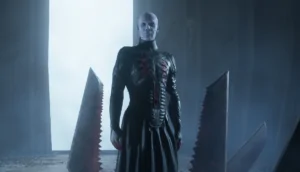
The filmmakers plan to create the house of stairs via a combination of limited sets and greenscreened extensions, and have not made any specific decisions regarding casting as of now. “The kids in the story are either 15 or 16 years old,” Solomon notes, “so we want to try and stay true to that age range, but we’ll probably go with actors and actresses who are slightly older but can play that age. We’re going to cast the net as wide as possible.”
And when House of Stairs hits screens, it will likely be as resonant as the novel was when it was first published—perhaps more so, as some of its themes haven’t aged at all. “When I first optioned the book, the literary agents and I sat down and talked for a while, and they asked me what I thought about the story’s relevance,” Hyman says. “It’s amazing that this book from the early 1970s still resonates today on a number of levels—in terms of bullying and general teen-on-teen meanness, but also society as well, regarding scarcity of supplies and government control and even scary psychological experiments that still go on. Not to put this in the same category as what we’re doing, but there was that story recently about Facebook conducting a psychological experiment on some of their users. Things like that still happen.”