Editor's Note: This was originally published for FANGORIA on August 29, 2002, and we're proud to share it as part of The Gingold Files.
The more you know about how films are made, the harder it is sometimes to determine just why a particular one has failed. It’s usually tempting to pin it on the script, but experience has taught me that the writer isn’t always to blame. Case in point: A friend of mine wrote a screenplay that a production company had in development. I went to a table reading of that screenplay, and it killed. Enter a major studio, which picked up the project, but then imposed ridiculous changes on the story and hired a director with no feeling for the material, who in turn hired actors who were wrong for their roles. The result: The movie didn’t work, and bombed at the box office, through no fault of my friend, who nonetheless retained sole writing credit.
But I digress. About halfway through FearDotCom, it seemed that the movie still had potential—the premise was intriguing if underdeveloped, the atmosphere palpable if second-hand. It wasn’t quite coming together, though, and in one of the slower moments, I got to contemplating: What exactly isn’t working here? Is it that Josephine Coyle’s script is lacking and William Malone’s direction is working overtime to compensate, that the director is overdosing on style at the expense of the plot, or did the studio step in and chop out the stuff that would give the whole thing more coherence?

Then the mother of a deceased child told an investigator that her little daughter liked to play at a creepy, abandoned steel mill, the audience lost it and I realized: Yep, it’s the script.
To be fair, there might have been material lost in the postproduction process, but even that couldn’t explain the gargantuan leaps in logic and lapses in sense that FearDotCom takes in its second half. I defy anyone to sit through this movie and explain to me how viewing the murders committed by a psychopath on his website can cause an Internet surfer to hallucinate swarms of large roaches, how the killer can either a) hole up for years in one place or b) move his elaborate torture/web broadcast center without detection and how one victim is able to write a note revealing the villain’s location and then swallow it while in the midst of being tortured, with said villain not noticing it when he disembowels her and then repackages her organs back into her body.
The project gives every appearance of being one of those movies made by people who know what horror films are supposed to contain, but have no real feeling for it. Yet Malone is hardly a genre novice (no one who casts both Udo Kier and Jeffrey Combs in a studio picture, albeit in minor roles, can be said to not be a horror enthusiast), and drenches the movie in darkness and unease, throwing in jittery visual tricks not as gimmicks, but in an evidently honest attempt to keep the viewer on edge. None of it is especially fresh, but it does manage to sustain a minor level of interest as long as the plot maintains a sense of honest mystery.
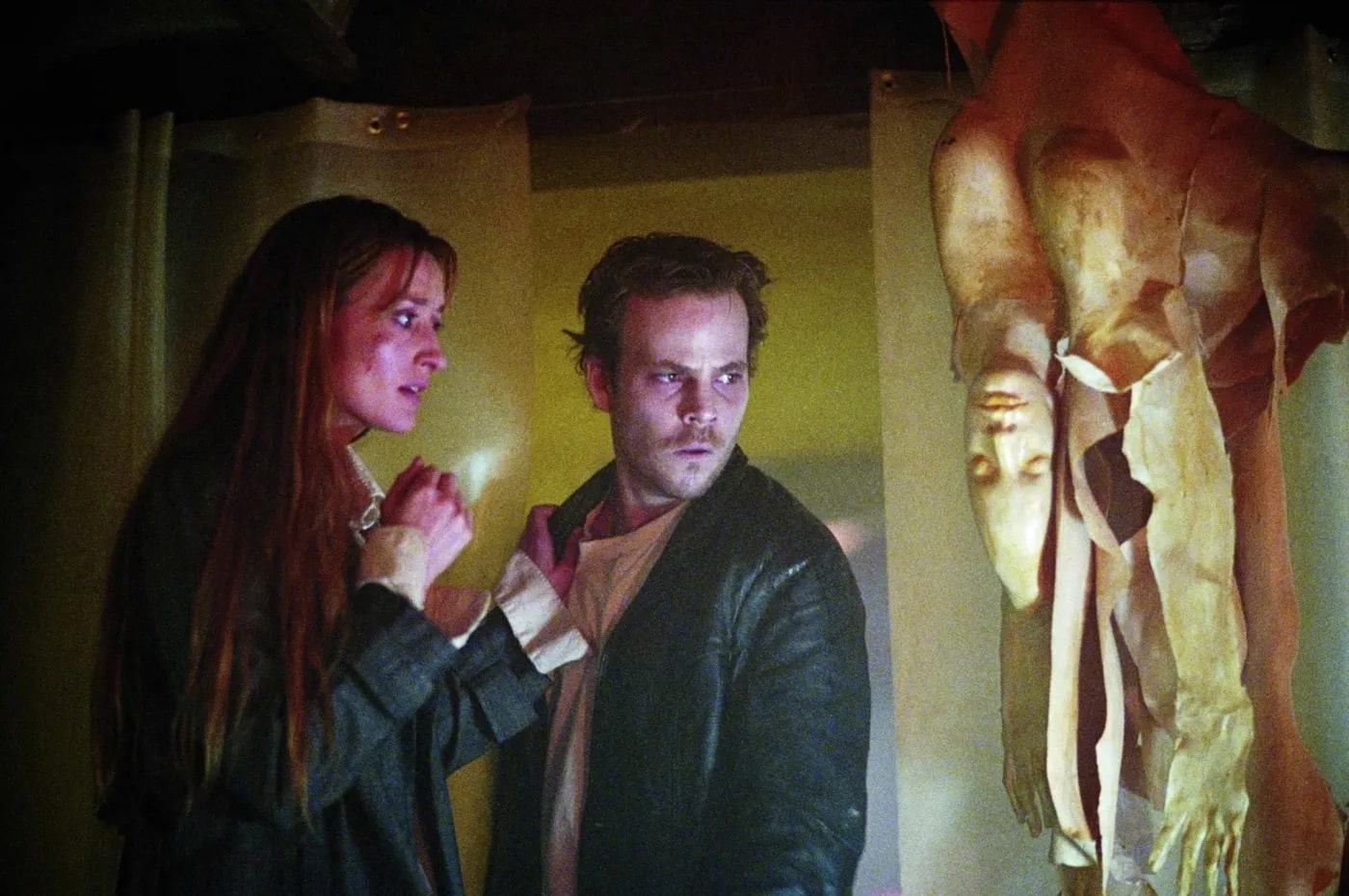
The more it tries to explain itself, however, the faster it goes down the tubes, and the whole thing ends up in a CGI explosion that does play out as a bunch of gimmickry, since it makes no sense on either a narrative or aesthetic level. Dialogue howlers are scattered throughout the last act, and the more the actors try to play this stuff straight, the sillier they seem. Stephen Dorff and Natascha McElhone, as the hero and heroine tracking the killer website, do the best they can, though they might have served themselves better playing it with tongue in cheek. But what was the gifted Stephen Rea thinking when he took the thankless role of the murderer, who appears for maybe all of 15 minutes and spends most of them spouting clichéd dialogue about pain and suffering?
Die-hard horror fans, when they’re not shaking their heads in disbelief and disappointment, might note the heavy influence of foreign fright fare on FearDotCom. The basic premise plays like a combination of the Japanese chillers Ring and Pulse, and in one of the more head-smacking moments, McElhone’s character swims through a setpiece lifted from Dario Argento’s Inferno. Now, Inferno doesn’t make a lot of sense either, but Argento manages the difficult trick of keeping the audience fascinated enough in the imagery that they don’t mind the lack of a coherent narrative. No such luck here; by setting itself up as a conventional whodunit, and then failing to satisfactorily explain not only who but how or whydunit, FearDotCom logs off of viewer interest early and never reconnects.