Last Updated on October 21, 2025 by Angel Melanson
Anyone familiar with Guillermo del Toro’s filmography will find it no surprise that in his new screen version of Frankenstein, his sympathies lie squarely with the Creature. Of course, thus it has often been in the cinematic history of Mary Shelley’s creation, most significantly Boris Karloff’s indelible turn as the misunderstood Monster. The original text has been adapted, reimagined, expanded upon, and in some cases perverted 100 different ways on film over the past century, and del Toro now contributes one of the best by going back to the source and translating Shelley’s words to images through his own personal lens.
Frankenstein, which plays select theatrical venues beginning October 17 and premieres on Netflix November 7, begins in “The Farthermost North” in 1857, as the crew of an expedition to the North Pole attempt to free their ship, the Horisont, from the ice. Into this already fraught situation come two figures, one pursuing the other. These are, of course, Victor Frankenstein (Oscar Isaac), who’s bloodied and near death, and his creation (Jacob Elordi), shrouded, animalistic and impossibly strong. After a battle with this Creature that results in serious casualties, Victor begins relating his story to the Horisont’s captain Anderson (Lars Mikkelsen). Del Toro introduces this portion as “Part I: Victor’s Tale,” signaling his ambition to honor his literary source.
At the same time, he makes Frankenstein grandly cinematic from its opening frames, as Tamara Deverell’s sumptuous production design and Kate Hawley’s swoon-worthy costumes immerse us in a 19th-century milieu merging heightened reality with streaks of the fantastical. We’re first taken back to Victor’s childhood (in which he’s played by the gifted young Christian Convery from Sweet Tooth and The Monkey), in which the man he will become is defined by his love for his mother Claire (Mia Goth) and his attempts to please his domineering surgeon father Leopold (Charles Dance). Leopold’s approach to his practice is cold and clinical—“There is no spiritual content in tissue, no emotion in muscle,” he instructs Victor—and even he cannot save Claire from dying while giving birth to Victor’s brother William.

This leaves Victor with an obsessive zeal to reverse death, and when the setting shifts to the Royal College of Medicine in 1855, he is already (in a scene employing one of a series of terrific prosthetic effects headed up by Mike Hill) demonstrating how electric currents can be put to that use. There’s plenty of electricity to Isaac’s performance as well, as he portrays Victor’s ferocious pursuit of his ambitions while also conveying the psychic wounds that drive them. When Victor finds a benefactor in the wealthy Heinrich Harlander (Christoph Waltz), he now has the means to realize his ultimate goal of bestowing life upon a being crafted from the remains of the deceased. Not to mention the perfect venue in which to set up his laboratory: a towering, abandoned building not dissimilar to the titular estate in Crimson Peak, the previous film of del Toro’s that Frankenstein most recalls in tone and texture.
Just as in that movie, the horrific elements are counterbalanced by burgeoning Gothic romance, as Victor’s eye is caught by the beautiful Elizabeth—who in del Toro’s take is not Victor’s fiancée but that of William (Felix Kammerer). She’s also played by Goth, but it’s not just memories of his mother that encourage Victor’s attraction. Elizabeth has her own deep interest in science, life and death (she’s first seen holding a skull), and she intellectually challenges Victor, with Goth in fine form as a confident free-thinker who’s not afraid to express herself while carrying deep reserves of empathy.
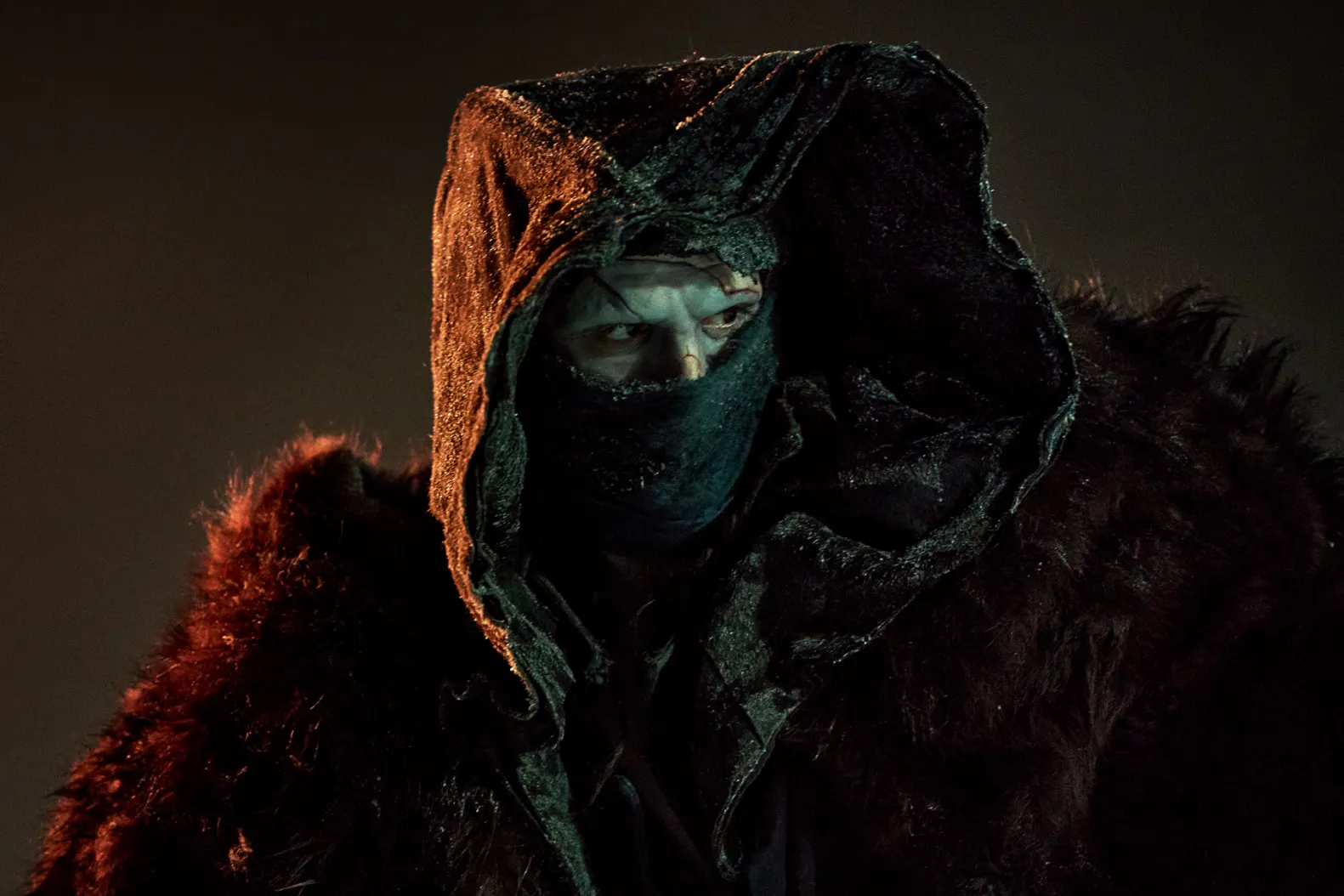
She fully expresses those when she encounters the Creature, whom Victor has pieced together from the body parts of soldiers killed in battle. He’s not visualized by del Toro and Hill as a monster, however; there’s a strange beauty to him, and with his pale skin, he resembles a statue made of the same kind of alabaster used in the face-carvings on the coffins of Victor’s parents. This visual metaphor is key to del Toro’s vision of Frankenstein, the Creature and the traumas that drive Victor’s creation of him. And not only does he represent the defeating of death, but in this iteration he is virtually immortal, impervious to gunfire and other weapons.
In a movie rife with strong performances, Elordi’s stands out as most impressive of all. In this Frankenstein, the Creature has the most pronounced character arc, beginning akin to a newborn child first discovering the world and evolving into a tormented soul at odds with the world around him. Elordi brings both a commanding physical presence and great sensitivity to the role, the latter particularly in evidence once “Part II: The Creature’s Tale” begins and the focus falls on this patchwork man. It is in this latter portion that del Toro puts his own, affecting stamp on the blind gentleman from Shelley’s novel and the classic Bride of Frankenstein, here played wonderfully by David Bradley.
As compassionate as del Toro’s portrayal of the Creature is, he hasn’t dialed down the scary sides of the story, though the most pronounced of them are Victor’s grisly preparations in the lab and a number of emotionally distressing scenes. A good deal of the violence meted out by the Creature is less horrifying than tragic in the context del Toro has created, which once again harks back to the earlier, landmark interpretations of Shelley’s texts. With his Frankenstein, the filmmaker has contributed a new entry to the canon that honors its forebears without indulging in explicit shout-outs (though in a moment that will delight die-hard fans, there’s a dialogue callback to I Was a Teenage Frankenstein!). He has done so with impeccable craft—also earning much praise are Dan Laustsen’s rich cinematography and the full-blooded score by Alexandre Desplat—and every frame of the movie is suffused with his love and respect for this seminal tale. After giving del Toro the chance to bring his long-desired Pinocchio to the screen, Netflix should be hailed for also allowing him to realize this even longer-mooted project—though it should absolutely be seen, if at all possible, on the big screen.