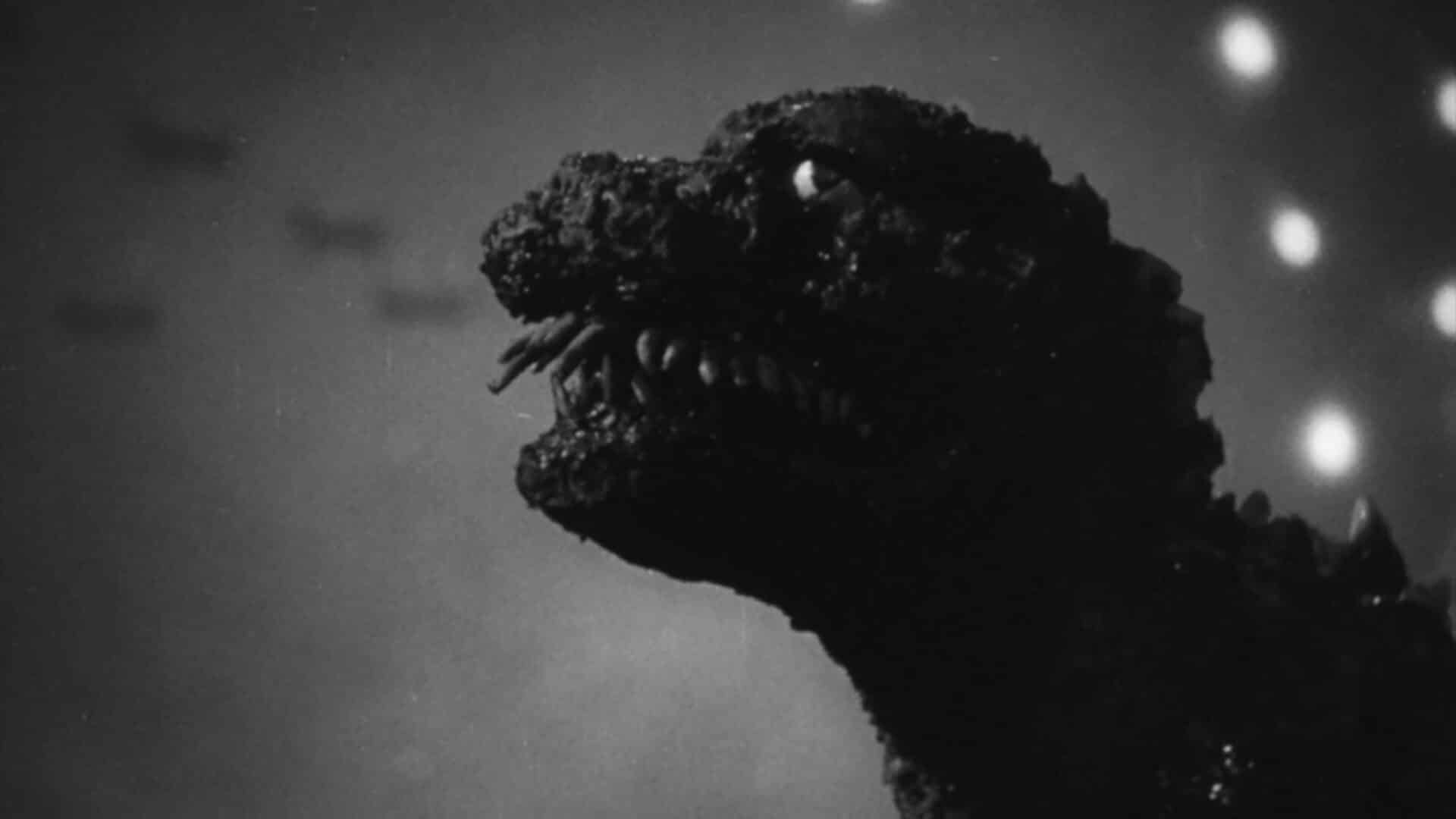
“If nuclear testing continues, then someday, somewhere in the world, another Godzilla may appear.” These words from Professor Yamane (Takashi Shimura) bring 1954's Godzilla to a close. When Yamane briefly returns in 1955's Godzilla Raids Again, he looks visibly dejected and haunted. His warning – his fear – has come to pass.
Produced during the second golden age of Japan's film industry, a time when the major studios cranked out films in vast numbers, Godzilla Raids Again‘s reputation as a quickie sequel is not entirely unfounded. The original film had performed well, so it's no surprise that Toho capitalized on its success via the contemporary industry economics that allowed fast and plentiful production.
Nevertheless, despite the manner of its inception and the perception it's gained, Godzilla Raids Again is very often a worthy sequel to its predecessor. It's a film that revisits the themes and ideas of the original by thrusting the horror and violence of Godzilla – both the monster itself and its symbolic reflections – over trapped people.
Tsukioka (Hiroshi Koizumi) and Kobayashi (Minoru Chiaki) are pilots for a fishing company. They accidentally catch sight of a second Godzilla as it brawls with new monster Anguirus on Iwato Island, and their chance encounter sets the film in motion. Their occupations differ from the usual roles associated with contemporary monster film narratives. They're not top scientists, military men, or well-placed journalists at the forefront of battling the menace as in many of Toho's other kaiju films that followed. They're civilians caught in the wrong place at the wrong time. Their lives, social circles, and plans are disrupted by the return of these impossible creatures.


The monsters naturally evoke myriad ideas here. In the first film, Godzilla isn't just the atomic bomb incarnate, but also the war itself embodied. The violence of both American atrocity and Japanese imperialism is mirrored in the monster's sound and form. Godzilla's wartime evocations are placed in direct contrast to images of post-war reconstruction and recovery. These ideas then return in Godzilla Raids Again. A city-wide blackout is enforced in Osaka to ward off Godzilla's approach, reminiscent of similar wartime practices anticipating Allied bombing campaigns.
When Godzilla comes ashore, attracted to the light of a refinery fire, the beast visits destruction on Osaka with a similar ferocity. Anguirus quickly follows, and the two monsters' destructive brawl interrupts Tsukioka's date with his sweetheart, Hidemi (Setsuko Wakayama). Images of Osaka's neon-lit nightlife are then contrasted with fire and rubble. These wartime phantoms, Godzilla and Anguirus, return to disrupt the national image constructions of the post-war years.

If Godzilla presented the nuclear door having swung open, the first Godzilla like a vanguard for the demons inside, then Godzilla Raids Again vindicates Yamane's grave warnings. These monsters are shadowy nightmares silhouetted by the fires ignited by their horrible breath. Thousands are crushed below as these vengeful children of the atom bomb scrap in the ruins of early post-war “transformation.”
To this end, the film's domestic enclosure is very potent. These characters are trapped by the movements of these impossibly powerful creatures. Tsukioka and his circle live under the permanent shadow of the mushroom cloud, and the demons of that cloud are loose now. Their hellish symbolism is sonically embodied by a particularly haunting piece of Masaru Sato's score, a track played in reverse that sounds like the guttural wailing of some terrible beast.
In a 2024 piece for Ill Will, entitled Life of Militancy: Japan's Long '68, Sabu Kohso describes the conditions of post-war Japan as legislated by the US-Japan Security Treaty and the 1947 constitution:
The implicit groundwork that made the postwar regime possible lay in its oblivion of the original violence carried out consensually between the US and Japan, including Japan's war crimes against the peoples of the Asia-Pacific Region and America's nuclear bombings of Hiroshima and Nagasaki. In order for the two states to establish the defense pact against their common enemies on the Asian Continent, this double forgetting was institutionally imposed upon the populace by means of the constitution.
These monsters haunt post-war Japan as symbolic of that which Kohso identifies as being deliberately forgotten: the immense violence of both Japan's imperial project and the enormous cruelty of two atomic bomb attacks that cannot and must not be forgotten.
A few months after Godzilla Raids Again's release, in November 1955, Japan's conservative forces were consolidated into the Liberal Democratic Party (LDP), which has governed almost uninterrupted ever since. The LDP has consistently pursued close ties with the US, sustaining the reconfigurations and continuities that constituted the US Occupation's policies and the double forgetting Kohso describes. In the film, the shadows cast by these beasts and their incomprehensible power suggest a population coming to terms with the changes imposed from above via the arms of the Occupation, carried out in collaboration with Japan's conservative elites.
One of the LDP's chief architects was Nobusuke Kishi, a former imperial administrator of Japan's puppet state in occupied Manchuria. He was also a member of Hideki Tojo's wartime cabinet and later became prime minister between 1957 and 1960, during which he oversaw the renewal of the Security Treaty as affirmed by police repression against protestors.
The legacies and figures of Imperial Japan remained a firm fixture in the post-war reconfiguration; the return of the monsters, then, is a reminder of the ever-present specter of the imperial “past” in the so-called democratic “present.” Indeed, at the film's end, fighter planes flown by former imperial pilots bury Godzilla in an avalanche of ice. Godzilla is temporarily frozen, along with all the evocations it carries. The wartime past is buried to preserve the post-war present.

Working to emphasise these ideas are the terrific special effects. The miniatures here are more detailed than those produced for Godzilla, and their placement on screen produces several resonant images. Stunning wide shots depict crowds fleeing in the foreground (via seamless optical compositing), lending a sense of scale that emphasizes how frightening these creatures really are. Furthermore, a foundational image is that of Godzilla and Anguirus squaring up to one another with Osaka Castle between them, waiting for its inevitable destruction. Similar images litter later sequels with their many monster battles, each charged with a different evocation depending on the building destroyed and each monster's purpose in the given story.

Godzilla Raids Again took a long road to its US release. Its journey involved the unmade Volcano Monsters (which would've constructed a new story around the film's special effects sequences, with Toho going as far as to send updated Godzilla and Anguirus suits to Howard Anderson studios in California for additional material). It ended with Gigantis, the Fire Monster, the title by which it was shown in the summer of 1959. I bring this up because its release partner in the US was Tom Graeff's Teenagers from Outer Space, another underappreciated gem. It isn't polished or slick, but it presents a boy from outer space touched by the kindness of a young woman and her grandfather.
For those with eyes to see, it contains an earnest sensitivity in its look at a young man raised under brutal conformism experiencing love and affection for the first time. As a double bill, these films have very different emotional centers: nightmarish visions of a resurgent horror coupled with an unearthly adolescent romance. It is precisely this juxtaposition that makes for a dynamic coupling.
In spite of its lesser reputation, Godzilla Raids Again is visually rich and thematically resonant. Its images are striking precisely because they evoke connected histories of violence, maneuvering, and enormous shifts. The film emphasizes the themes of the original Godzilla via different and specific avenues of expression, inflicting Godzilla's inherent horror over trapped people who cannot escape the historical shadows cast by the monster.
At its core, returning to Yamane's warnings, Godzilla Raids Again is horrifying simply because Godzilla returns. Everything that the monster represents is back. Another Godzilla, another Bomb. Unlike the first film, Godzilla isn't destroyed here. It's just stopped. Yamane feared another monster, and now it's here. It is halted only as long as it remains frozen – and that won't last forever.