Throwback slasher movie Hell Of A Summer marks Stranger Things star Finn Wolfhard's feature directorial debut alongside co-writer and co-director Billy Bryk (Saturday Night). The pair starred in 2022's When You Finish Saving The World and embarked upon writing and directing their first feature as a joint venture. Wolfhard and Bryk joined us along with their co-star (and producer) Fred Hechinger to chat about kills, slasher masks, and tales from first-time movie making.
The Kills
This is a slasher, and of course, that means we are racking up a body count throughout. When it came to the decision of what to show vs what not to show on screen, Bryk described it as “A big part of that discussion for us was keeping a tonal balance of the horror and the comedy, and always going far enough that the kills felt satisfying to an audience, but never going too far where it felt impossible to come back to the comedy and to the heart of the movie and this coming of age story.”
On the flip side, the duo never wanted the comedy to reach a level of absurdity that would make the stakes feel anything less than deadly high or negate the horror elements. And then, of course, Bryk adds, “There were also other logistical considerations that might involve spoilers, but as we went on in the film, we wanted to show more and more of the kills.”
As the kills and onscreen gore ramp up, a particular kill was trimmed down for the final cut. Wolfhard shared, “There's a kill involving peanut butter that originally went on a little longer, and it just didn't work in the cut.” Bryk added, “I think it really worked on its own, and then in the context of the movie, it weirdly felt like almost as though it was dragging.”
Aside from the pacing, Wolfhard notes it also came across as “Too dark.” A sentiment Bryk instantly agrees with: “It was a little bit too dark. There was one kill, from the original scripted cold open, which involved a tetherball that I thought was very funny and creative, but ultimately not right.”
Ultimately, the directors cut the tetherball kill because it would be difficult to shoot and required location changes, so they opted for a guitar kill instead. But Bryk says that specific moment in the script never failed to make him laugh. Since they're not going to use it in anything else, he broke it down for us:
“The camp owner's being strangled to death with the rope of a tetherball pole. He's been smashed into the pole, and now he's being strangled to death with the rope. There was a part where he's trying to punch the ball in the other direction to loosen the rope on him and it's not working. It felt very pathetic and funny, him desperately trying to bat the ball away, which made me laugh, picturing Adam Pally doing it. But I'm fine. I can go to sleep at night still.”
The Mask
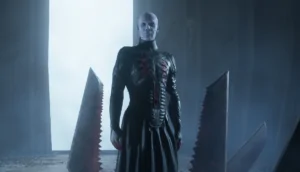
All iconic slashers employ an instantly recognizable mask or “look.” Hell Of A Summer features a very fitting devilish mask. The trick with this mask, though, is that it needed to be believable as something the killer could acquire while also being memorable.


Wolfhard says the devilish look, “Originally came from the title. We actually didn't know what the killer's design was going to look like, because we had written the script and knew it was going to be a masked killer, but we hadn't settled on anything yet. Then we had the title, and ‘From Hell,' just demonic, demon things, obviously. Then things started to make sense.”
After settling on a hellish demonic motif, Bryk elaborated on finding the actual aesthetic for the design with some inspiration from vintage carnival photos and a very famous mask designer.
“Visually, we looked at a lot of Ben Cooper Halloween masks from the '50s and '60s, which are just so brilliantly painted. The idea of this mass-produced mask was very exciting. We also looked at imagery from carnivals, and there's this great image of a fun house or a haunted house where you're entering through the mouth of this devil. There was something about the shape of that devil building. It was a picture of an abandoned carnival, and something about the aging and the fact that it's falling apart was very exciting.”
Beyond that, Bryk specifies, “It had to make sense in the world of whether this character would pick this mask and what would draw them to it. Leaning into that idea of wanting something that feels iconic, not just for ourselves as filmmakers, but for that character, wanting a mask that felt like it could stand alone and be something recognizable and iconic.”
First-Time Directors
Hell Of A Summer producer and star Fred Hechinger (Fear Street Trilogy, Gladiator II) plays Jason, a twenty-something-year-old camp counselor who just doesn't want to move on and fully transition into the “adult world.” On working with (and acting opposite) the first-time feature directors, Hechinger shared, “I was realizing, or reminiscing on how it's important to the story that it's character-driven, ultimately. There's not a kind of sardonic distance from the characters or a meta, winking detachment from them. Even though they're very funny, there's a groundedness and a kinship. The way that Finn and Billy act in the movie and direct it in some ways mirrors that or creates that spirit on set.
“I always felt so inspired by them, and also so comfortable to play and explore the scenes with them. I think they weaponized the fact that they were also acting in the movie as a strength in terms of their directing, rather than it taking anything away from it. I think they used it to create an on-set environment that was communal, but also we all just wanted to make each other laugh and felt very connected in the tempo and the rhythm of the movie.”
When it came to acting in a scene while directing, Wolfhard and Bryk admit, “When we were all in a scene together, it made it tough in some ways. We never had audio playback.”
But Wolfhard shares a positive side to it. “Once we were comfortable with giving notes almost mid-scene, breaking character for a moment and then feeding someone a line or telling them to do something, it kind of expedited the process because there was not much time to call cut, and the whole cast goes and watches video village, and you take 10 minutes to talk about it. It was very much like we were all on the ground together. If we needed something from an actor and we were in the scene with them, it was easy to get, because we could just ask them right then and there.“

Planning was also a huge part of getting what they needed in the moment. Bryk explained, “There was a lot of storyboarding for sequences that involve kills, which we were able to be behind the camera for. But there were also a number of times where we would storyboard or block these group scenes together to really try and get a sense of the rhythm before we were on set. We worked very closely with our DP, Kris Bonnell, to nail everything.“
The preparation as directors allowed them to step in fully as actors when the time came. “When we're tapping in as actors, we're able to jump in, do the scene, be directing, and then running back and trusting and checking that all the cameras are moving in the way that we want,“ says Bryk. Adding, “But we really did hit our stride at a certain point, and the collaboration and the experience became a lot easier as a week or so went on.”
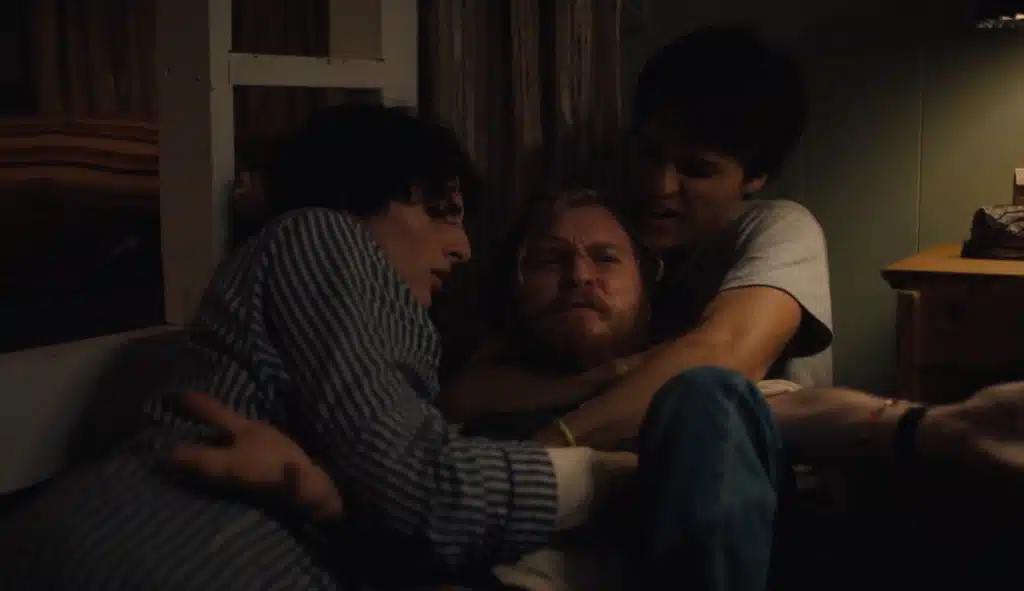
Wolfhard remembers feeling that they'd really hit their stride, “There's a scene where all of our characters are stuck in a storage cabin together, and I remember that was the point where I think we were really on a kick. When it came to just talking to actors and giving notes, everything just felt very… I don't know, a lot more slick.”
Bryk adds, “By that point, we were just flying through it. Those are some of my favorite scenes in the movie. People were really firing on all cylinders. We filmed it all so quickly. There was also some brilliant work that our DP did to pre-light that room as much as possible.”
As far as the actors feeling as prepared as possible, Hechinger recalls, “We had the most incredible ensemble of actors, and we all stayed in the same bed and breakfast that we took over. It was like our camp, in a sense. Sometimes Finn and Billy would have us rehearse a day or two before, and I have memories of beginning to play around, experimenting with the scene in this strange tavern, where you could start to get a sense of different rhythm stuff. By the time that we were filming it, I would imagine there was just more preparation.“
They're also acutely aware of the dangers of falling into overthinking and perfectionism. A positive attribute of the rapid shooting schedule Bryk notes is, “Sometimes if you have too much time and you have the opportunity to go back between every single setup and too many people are huddled around it, I think you can lose some of that energy and momentum that you need. But I'd say, for the most part, it would have been great to have audio playback and more time. “
Wolfhard agrees and has witnessed it firsthand: “I think I've just seen it so many times with so many directors, where they get so caught up in it, and we end up actually getting further away from it.”
But Bryk has a solution to avoid falling into that trap: “That's why I want to shoot on film. It gives you that similar sense that you have to be moving, you can't be very wasteful. Unless you really can be wasteful with film, in which case you're in a very good place!”
When it comes to going back and making changes, Wolfhard is wary of the rabbit hole: “Your brain sees stuff that you want to change, but when you think about it, those scenes are that way because of exactly what it was and how we did it. So there's nothing that you can really change.”
“I also think some of the funniest stuff is what happens between people,“ Hechinger adds. “It's so reactive, and it's baked into the script because so much of the script is about the insanity of group dynamics. But I will say I'm remembering the storage bunk scenes, and there is a frenetic, delirious energy to those scenes that I think is a very unique and special thing, to be with a group of actors that can all tap in together and lean into that.“
Catch all the summer camp slasher mayhem for yourself when Hell Of A Summer opens in theaters April 4.