Last Updated on November 11, 2024 by Angel Melanson
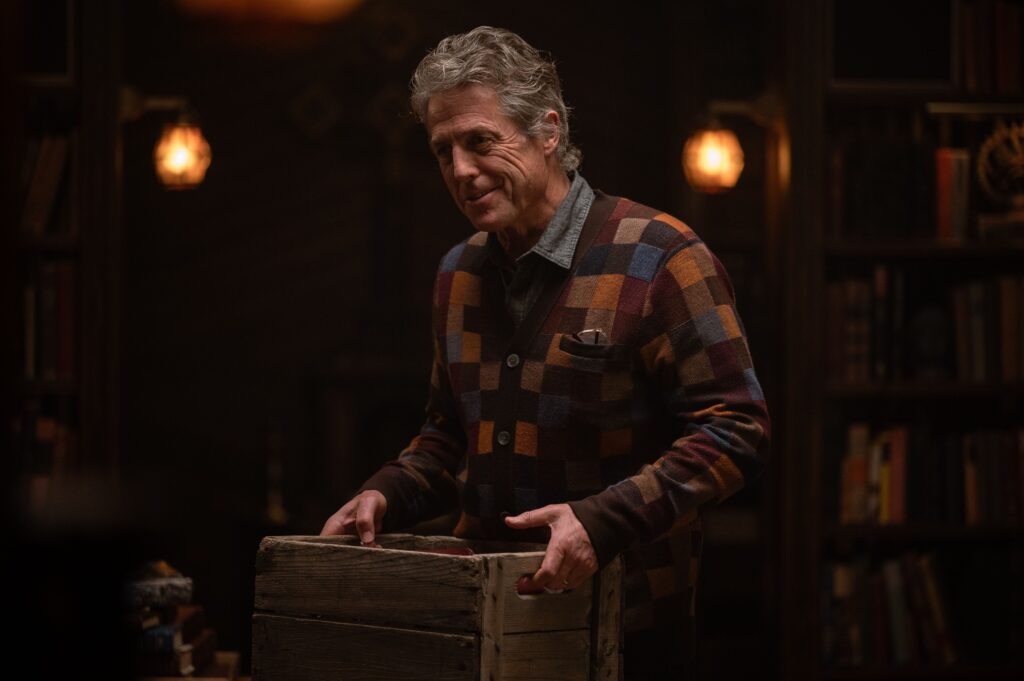
Heretic follows Sisters Barnes (Sophie Thatcher) and Paxton (Chloe East), two Mormon missionaries invited into the home of Mr. Reed (Hugh Grant). They can only enter if a female is present and the charming Reed assures them that his wife will soon make an appearance with freshly-baked blueberry pie. But as Reed challenges their faith and dissects their beliefs, the two girls begin to suspect something sinister is underway. Confirming their worst fears, Barnes and Paxton find themselves trapped within his residence and subject to smoke and mirrors and a game of spiritual warfare… a game they may not survive.
After Heretic's premiere at TIFF, we caught up with directors Scott Beck and Bryan Woods (A Quiet Place, Haunt, The Boogeyman) to discuss the terrifying undertones of religion, twisted mind games and final girls.
Why do horror and religion seem to go hand-in-hand?
Scott Beck: Religion is terrifying. It can be terrifying from history and what it has made people do. It can be terrifying in rituals, whether those are rituals that are subservient to the idea of what religion truly is or become steeped in mythology. But I think there is something about religion and how it can steer people down certain ideas and beliefs, and control others with it. That certainly seems like it's ripe for being horrifying.

Let's rewind. Heretic was supposed to be your second film. How long has this concept been percolating in your minds?
Bryan Woods: Scott and I have known each other since we were 11. We grew up together in the same town. We have always talked about larger-than-life questions, such as what happens when you die and whether God is real. If so, what is the one true religion if there has to be one? We've always had these conversations and 10 years ago, we started writing this idea about two modern missionaries who knock on the wrong door. We stopped writing it for a couple of reasons.
Reason number one: it felt like a movie that was really personal. It almost felt like we were writing a home movie, like a movie only we would want to watch. That was one fear we had with the project. Fear number two was that Mr. Reed, who is played by Hugh Grant, has this intense knowledge of every religion in the world. We found the character too difficult to write, in terms of his dialogue. We found we weren't fluid in his language. It felt like we were pretending to know what he knew in a way that was counterintuitive. It almost felt like an impossible script to write. So, we put it away.
We wrote A Quiet Place and The Boogeyman and all these other projects in between, but we kept coming back to Heretic because it felt really interesting to us. The more years that went by, the more time we had to fill our heads with some of Reed's knowledge and study religion… study a lot of atheist thinkers, a lot of philosophical thinkers, and just cram in a fun way. Not in a “We are doing homework to write a script,” but in a way that we are really interested in these subjects.” We really felt like we needed time to absorb them.
Then, just over two years ago, we picked it back up. It felt like now was the moment. We were feeling very vulnerable. My father had passed away. It was just one of those moments we all have in our lives where everything seemed awful. From a place of depression, we were able to go, “Now we are able to write this thing that is very personal and crazy.” Then, we set off and wrote it.
The beginning of the film features a cat-and-mouse battle of wits. What's the secret to establishing a sense of dread and slowly ramping up the tension during dialogue-heavy sequences?
SB: It's constantly trying to be patient with making things weird, but every few minutes, changing the temperature of the room, so to speak. It's little details in Reed's house that at first seem very innocent, but then you look a little closer, and it's a little off. It can be missteps in terms of how one communicates with another, where they feel they have offended the other party, and then, they feel they have to bend over backward to make them feel comfortable. But then the other person starts playing this chess game. You start seeing all the pieces move around.
We were so nervous going in to make it so every aspect had different layers that were shielded at first. That extends to Hugh Grant's performance. It extends to the production design. It extends to how the camera moves. It can be boring at first, but then it starts to be more articulated in its movement. The sound design starts amplifying. All these little details have to lull you into a sense of innocence at first. Then, piece by piece, you start seeing you are in a situation you are trying to measure. “Is this actually dangerous, or am I just perceiving it to be dangerous? Is there really something sinister beneath here?”
Mr. Reed comes off as warm, sincere, and charming. The audience, however, also gets a sinister vibe from him. What was your vision for the character, and how did you draw that performance out of Hugh Grant?
SB: It always seemed like it had to be someone who is hyper-intellectual, and they probably have a strange way with the world, where they feel disconnected. But, one-on-one, he is very engaging and excitable. He's excited to share these ideas. We were in certain situations throughout our lives, but there is this one circumstance where we found ourselves in the middle of Iowa.
We were student filmmakers scouting locations for a short film. It was about the end of the world. We wanted a beautiful, white picket fence. We found this one house in this small town in Iowa. We knock on the door, like a cold call, kind of like missionaries. This elderly couple answered. We said, “We love your house. We would love to use it for a film.” They offered, “Come on in. Sit on the couch and let's talk about what your film is.” We go in, and it's very quaint, like Mr. Reed's living room.
“So, what's the movie about?” “It's about the end of the world.“ They are like, “Stop right there. That is fascinating because, yes, the end of the world is coming, and it's coming within the next few years.“
Suddenly, they start spouting this belief that they had, of utter sincerity, that the Apocalypse was right at the cusp of our fingertips. The room felt totally different now. Beautiful little trinkets that they had now took on a sinister quality. We saw that in Reed, where you can walk into a place and feel totally at ease. But then, the turn of a phrase suddenly has done a 180.
So much of who that character is, and what Hugh did, was study every single line of dialogue in pre-production, and then apply an approach for every single one of those moments. Once we were on set, he could live as the character. And he was having fun. I think Reed was having fun sharing the ideas with Paxton and Barnes. As an audience member, you find yourself looking at this person who might be totally safe. They may be dangerous, but they have compelling ideas. There needs to be a degree of layers behind anyone with a villainous streak.
Reed makes an analogy between religion and Monopoly. Was that an unexpected find? Where did that stem from?
BW: Over the course of our 10 years of researching religion, we were almost attempting to put religion into terms we could understand. You know, making comparisons to fast food and Monopoly games. So that was kind of the fun of it. Writing that sentence was an intense process.
Our writing process is things start off very fuzzy and out of focus. “OK, we know we want to present some kind of analogy, and we are not sure what it is, but we are roughly outlining.” But as we write it, “Maybe it's a comparison to this, and maybe there is a historical event we can compare it to. Or maybe there's some kind of game element that we can compare it to?“
We did a million different drafts. At first, it was like, “OK, is it chess? There's a chess comparison. Checkers? That's not quite as interesting. Is there a pop culture thing?“ Monopoly is something we always go to. In our script for A Quiet Place, the Monopoly game board was a big part of one of the early set pieces. Then, we were trying to find different analogies and comparisons and music.
Again, we wrote 100 different versions of it. Then, we finally landed and threaded the needle of this sequence. It was a sequence we were immensely proud of because it took a lot of work to get to it on the page, and we felt really good about it. We were terrified as directors because we were like, “We will never get Monopoly's permission to put the Monopoly boards in this blasphemous movie. We will never get Radiohead's permission to air their dirty laundry about lawsuits. It will never translate into the movie.“
Luckily, we had a great producer on this, Stacey Sher, who is really an icon. She started her career with Pulp Fiction and other incredible movies ever since. She and the other producing partners guided us into trying to check all the boxes to make all those scenes come to life and make sure we could pull off our vision for it. It was a tough one, but it was a really fun sequence.

Barnes and Paxton might be potential victims, but in many ways, they are a match for Reed. How important was it to create two characters that can go toe-to-toe with him?
SB: As far as we are concerned, it was imperative in order for the movie to work on all cylinders to have each character, not only have a different relationship with religion but this intellect that could persist throughout the night's events. One thing we find so fascinating in the world of Mormon missionaries is that, by nature, they are very young, usually between the ages of 19 to 22. There is a perception that there is naivety sometimes. You are living a sheltered life underneath these different bylaws of the religious organization. Therefore, you have less life experience, but you are out there sharing your faith.
We have such a big family and group of friends that are in the Mormon church, and that's not the experience that we ever witnessed. This movie was an opportunity to show what Mormon missionaries are as human beings. Sometimes, there is a complexity in one's belief system, even if they seem so beholden to a religious organization from the outside.
It felt like Pax and Barnes represented a slightly different part in their path to faith. At the same time, though, they are mashed together. They have interesting personalities that sometimes clash. It felt interesting to see those two be somewhat awkward on screen, but also to be able to go toe-to-toe against Reed at certain moments, where it does become more life-and-death stakes.
It was enthralling to watch them verbally spar.
BW: With A Quiet Place, part of the fun of writing that was, “Can we do a whole movie without dialogue? Can we tell a story that is emotionally resonate, from beginning to end, with no dialogue?“ The fun challenge of Heretic was the opposite. “Can we frighten or unnerve an audience using dialogue as the vessel for the scares instead of the shadows or a jump scare?“ We wanted to use different muscles to generate suspense. At least, that was the experiment we were attempting.
That might be the case, but there's still plenty of violence and blood. In what ways did you want those elements to punctuate what the girls were going through?
BW: We love movies where the violence and gore are unexpected. We think a lot about how part of the power of a Guillermo del Toro movie is that there is this beautiful, poetic quality to his films. Then the violence is unexpectedly graphic. It was on our minds that we had this dialogue-driven chamber piece about ideology, philosophy, and dueling perspectives.
The hope is that when the violence comes, it comes out of nowhere. There are some unexpected moments of violence and gore later in the film that we are proud of. Our craftspeople, like Chris Bridges, who did the gore prosthetics and some of the effects work for us, worked with us on a prior film called Haunt, where he did all these incredible faces of these monsters. Some of the stuff he achieved from a technical perspective on this movie was very challenging but it also felt very fresh and new because of the context in which we are using gore in this movie.
I'd add that all horror movies are about death. This movie, where it confronts the idea of what happens when you die, always felt like we wanted to toe the edge of the characters' experience of mortality. By virtue of that, we knew there would be darker edges to this movie than just the discourse of philosophy.
Potentially mild spoilers below.
Reed presents the girls with two options that could possibly lead them to safety. Was there ever actually a right choice and a wrong choice, or was that all part of his mind game?
SB: I would say the answer lies so much in what the movie is about. It's between belief and disbelief, between atheist thinking or believing in something higher. What is the answer to that? That's a personal truth. We are excited about the reception so far. Our ambition is that there is something more you can take home from this movie, where it can be a little reflective or get you talking with others, whether they are cinephiles or somebody you want to have higher-level conversations with. That's at the core of that.
BW: At various times, the movie is putting belief and disbelief on trial. It's debating those two things. Reed has a line where it's like, “It's all terrifying. If God is real, that is scary. If it's not true, that's scary.“ We share a little bit of that fear between belief and disbelief. But what scares us the most is the certainty. “I know what the one true religion is“ is a little creepy to us. Or, “I know there is no God.” That's a little terrifying to us, too. That is something we are looking at, not just belief and disbelief, but certainty.
Not everybody survives this ordeal. What kind of discussions did you have regarding who should be the last person standing?
BW: Any time you have a chamber piece with a small, finite amount of people, you do those calculations. It's theme-driven, where we arrive at the end of the movie. We write from the gut and heart and put ourselves in the characters' shoes.
SB: I wouldn't necessarily say it's always preordained; the choices that appear in the script ultimately become the movie. There's a degree to which it is instinctual, and it's beholding the characters.
BW: When we are writing it, we are down in the basement. We are Sister Paxton. We're Sister Barnes and we are Mr. Reed. We are fighting it out.
SB: To us, it feels inevitable. Hopefully, it feels inevitable for an audience. That's inside bias. It is a discovery of what the story tells us, as we are its first audience members. That's always the fun in filmmaking for us. You don't know exactly where it is going to go. We hope that ride translates to the audience's experience.
BW: We love satisfying an audience and giving them what they hope for and want, just as much as we love annoying an audience and giving them what they don't want. In this movie, we are playing with fun payoffs. We are also playing with a lot of anti-climaxes.
Heretic is now in theaters, read our full review right here. For more, read our interview with Beck and Woods in FANGORIA #25.