

The Bride! is a love story.
After more than a century of loneliness, Christian Bale’s stapled and scarred “monster” Frank longs for his life’s companion. His titular Bride arrives with a jolt in the form of Jessie Buckley’s “reinvigorated” dead woman, a beauty with an inky splatter across her face and electric-shocked hair.
But love can be an absolute horror.
Lawrence Sher, the movie’s cinematographer, says he was compelled by the tension underlying the romance, one “built on a fundamental lie.”
In director Maggie Gyllenhaal’s take on The Bride of Frankenstein and Mary Shelley’s original Frankenstein tale, the more than 100-year-old Frank tells his bride that before her transformation, they were engaged to be married (she can’t remember her name or where she lives). He conceals the truth — he was so lonely he dug up her grave so Dr. Euphronious, the scientist played by Annette Bening, could bring her back to life.
“There’s a sense of dread knowing that eventually, that might come out and the whole thing sort of falls apart underneath it,” Sher says.

The journey of Bale’s Frank and Buckley’s Bride, which starts in 1930s Chicago, connected Sher with his passion for outlaw movies like Butch Cassidy and the Sundance Kid (1969) and “love on the run” films like Badlands (1973), Bonnie and Clyde (1967), Thelma & Louise (1991) and True Romance (1993).
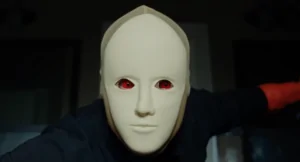
“It really isn’t this kind of gothic (story), what you would think when you’re thinking of Frankenstein, even when you think about Guillermo del Toro’s most recent version, which is excellent, but is very different from this film,” Sher says. “And so we really talked about tone and talked about that yeah, it takes place in the 1930s, but it’s really kind of a movie more in the 1980s. And it has this sort of punk sensibility to it. You can think of Sid and Nancy (1986) and those kinds of films as well, of just this kind of crazy love. And I really responded to the fact that it really is, at its heart, this love story, and it’s also a story about somebody finding their voice.”

Or voices. Mary Shelley herself intermittently erupts from The Bride’s mouth after the audience is introduced to the Frankenstein author, also played by Buckley. She resides in a kind of limbo or other dimension veiled in moody shadow. The famous writer’s English-accented, almost bellowing voice is channeled with fury through Ida (Buckley before the “reinvigoration”), a gangster-adjacent Chicago woman. The collision of voices shows what happens when a woman tells the whole ugly truth. Shelley and her pointed language seem to possess Ida, pulling the strings that lead to her death and eventual resurrection as The Bride.
“I’ve worked with some great actors in the past, but she was as possessed a human being as I’ve ever seen,” Sher says of Buckley. “It is that thing that you kind of want out of every actor … I felt this every single day and every single take, every single moment that she was in front of the camera. You didn’t wanna look away because it all felt so unbelievably present and visceral and immediate.”
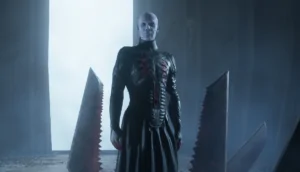
Sher says the first day of filming involved a scene that ended up being cut. In it, Shelley makes her entrance with “a little peek” at her possession of Ida.
“It just was amazing, truly, watching somebody perform at such a high level. It was exciting and thrilling. It was better than I thought it would be, and I already had very high expectations of who she’d be as an actor … It really is her film and she just owns it and has to do some really challenging things, a lot of very specific word work in terms of the dialogue and particularly switching back and forth between Mary Shelley’s voice and (The Bride’s) own … She’s just, flat out, the best actor I’ve worked with.”
The Mary Shelley of the black-and-white limbo dimension greets audiences near the start of the film. “We did talk a lot about just how to present these scenes in which Ida and Mary are speaking, and then the Bride and Mary are speaking back and forth to each other in this sort of almost schizophrenic and manic way, and how we would do that,” Sher says.
The Bride! filmed throughout New York and New Jersey, but the cinematographer started testing out different visual concepts during early makeup tests in Los Angeles. “Every time we were doing those, I had a camera, and we were playing with ideas of double exposure, and certainly this void and limbo lighting that we ended up doing,” Sher says.
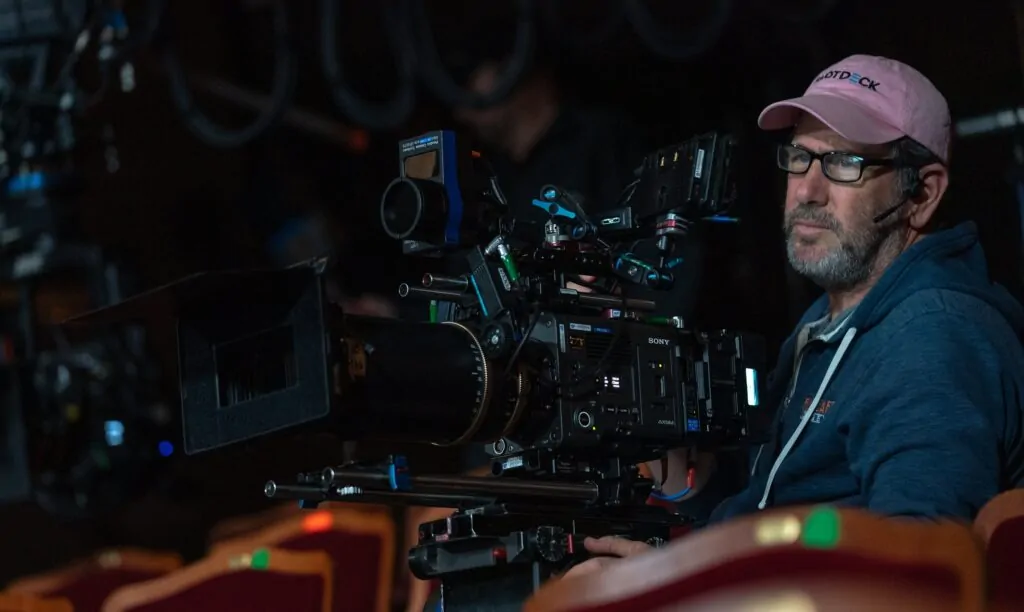
Joker, IMAX and Frank’s movie dreams
Sher worked on Todd Phillips’ Hangover movies and Joker movies before boarding The Bride!
He received an Oscar nomination for Joker in 2020 before returning for Joker: Folie à Deux (2024). Emma Tillinger Koskoff, who produced both Joker films from Warner Bros. Pictures and DC Films, sent Sher the Bride script and recommended him for the movie.
“It was just the best script I’d read,” he says from Singapore, where he’s prepping for Baltasar Kormákur’s Netflix crime thriller The Big Fix, starring Riz Ahmed and Mark Wahlberg.
Sher appreciated the originality of Gyllenhaal’s story and knew bringing it to the screen would present “challenges that are exciting and scary.”
He didn’t know Gyllenhaal, but they had met briefly 20 years prior at the wrap party for Garden State, because her husband Peter Sarsgaard (at the time, they weren’t yet married) was in the Zach Braff-directed 2004 film. Sher and Gyllenhaal got on a Zoom call for a conversation about the script and her vision. Months later, she invited him to join the film.
“I’d never read the Mary Shelley book,” Sher says. “It wasn’t like I was even that familiar with the 1930s Frankenstein.” He says he was probably more acquainted with Mel Brooks’ Young Frankenstein (1974). But he knew Jessie Buckley’s sparkling work and could picture her as The Bride.
In Mary Shelley’s 1818 novel Frankenstein; or, The Modern Prometheus, scientist Victor Frankenstein starts to make a bride for his monster after the monster asks him for a companion. However, he fears what the finished work might mean for the world and ends up destroying her before she is complete. In James Whale’s 1935 Bride of Frankenstein film starring Boris Karloff as the monster, the titular character played by Elsa Lanchester is only in the movie very briefly and doesn’t speak. Gyllenhaal wanted to know what this Bride was thinking and feeling, and what she would say. She certainly says and does a lot in The Bride!

The plot of the film, which Sher calls a big, “scope-y” adventure, includes a development reminiscent of the Joker films. The Bride inspires a movement among women who, like Ida, would “prefer not to.” They emulate the look of her striking mouth, which is stained with a splotch of black blood. The scenes recall how people in Gotham copied Arthur Fleck’s clown getup with makeup and masks.
Gyllenhaal previously directed Buckley in The Lost Daughter, her 2021 feature directorial debut, for which they both received Oscar nominations. She had never helmed an IMAX film before. So when Sher was finishing work on the IMAX film Joker: Folie à Deux, he brought her to IMAX headquarters in Los Angeles to show her some of the film, along how they’d change aspect ratios and expand the image. “I think that was exciting for her and she really embraced it,” he says. “And then we just started really attacking the script and going ‘OK, which scenes feel like they are opportunities for this?’ They really came out of both the relationship between The Bride and Frank and their sort of transformations. So the first time we see it happen is when Ida gets pushed down the stairs and basically dies, and that’s a moment of great transformation. When Frank first walks up to Euphronious’ lab and finds her house, that’s a moment for Frank’s transformation.”
This image expansion happens again when Frank goes to his safe place, a movie theater, to watch his matinee idol Ronnie Reed, played by Gyllenhaal’s brother, Jake Gyllenhaal. There, the man behind the supposed monster dreams away, picturing himself up there on the big screen like his cinematic hero.
“That’s something that certainly all the people making the film could relate to, but I think (also) so many people who just enjoy movies, and also the idea of having a sort of a relationship with somebody onscreen,” Sher says.
Another emotional, image-expanding transformation happens when Frank first connects with the reanimated Bride.
“Those became the guideposts of when we would protect for IMAX and likely expand in the finished film,” Sher says. “But what’s nice is you can edit the film, and then while you edit it, you sort of see different opportunities and you kind of continue to refine what those moments are that you’re going to expand to a different aspect ratio. And that continued all the way until, like, the final days of post.”
Sher appreciated Gyllenhaal’s commitment to understanding and using the technology. “Even though she’s been acting for years (including in The Dark Knight opposite Bale as Batman), she was so incredibly both curious but also really, really, genuinely interested in understanding everything she didn’t know … whether it was a conversation about shooting anamorphic or shooting spherical … I think this movie afforded her the opportunity to really expand her palette and her skill set as a director.”

The Bride goes to the club
Sher filmed plenty of musical performances with Joaquin Phoenix and Lady Gaga in Joker: Folie à Deux.
A freewheeling underground oasis brings modern club vibes in The Bride! Sher, who grew up in Teaneck, New Jersey, filmed those scenes inside old Newark trolley tunnels under the site of the former Hahne & Co. department store.
“It was a cool place to shoot,” he says of The Bride and Frank’s “first date night,” a glimpse of freedom and joy before the evening turns grim and they go on the run. A big ballroom dance scene later in the movie, as the action moves to New York’s Times Square, was filmed at Steiner Studios in Brooklyn. Choreography features bodies jerking like the zombies of Michael Jackson’s Thriller, channeling The Bride’s reinvigoration. “It also is a bit of an homage with ‘Puttin’ on the Ritz,’” Sher says — the song that Gene Wilder and Peter Boyle performed in Young Frankenstein as Dr. Frederick Frankenstein and the Monster.
The 1930s meets 1980s vibe of the production helped Sher with problem-solving, like when it came to deciding if strobes and fluorescent, colored lights were period-appropriate. “That really loosened us up,” he says, along with Gyllenhaal’s willingness to lean into fantasy. For a scene where Frank and The Bride are at a drive-in movie, the production used an LED wall so the movie screen could be the only source of light. For a car chase through a dark park on Long Island, Sher used a Sony FX3 camera to deal with the low light. “It allows you to kind of almost see into the dark and really do the thing that I wanted from an emotional standpoint — to feel like, what would it be like to be getting chased in the woods? Really it would just be the headlights that would do all the work.”
As for the actual reinvigoration scene, the filmmakers were mindful of other Frankenstein and Frankenstein-adjacent films, including Yorgos Lanthimos’ Poor Things (2023) and Kenneth Branagh’s Francis Ford Coppola-produced Mary Shelley’s Frankenstein (1994). Gyllenhaal and Sher’s many references for the film included movies like David Lynch’s Wild at Heart (1990) and The Elephant Man (1980), along with the body horror of David Cronenberg’s The Fly (1986) and John Hughes’ “let’s build a lady” sci-fi comedy Weird Science (1985). For some violent scenes, they turned to Gaspar Noé’s Irréversible (2002) and Tony Kaye’s American History X (1998).
“There’s this great little carbon arc thing that happens at the beginning of the movie Persona (1966, Ingmar Bergman) that was a bit of an inspiration,” Sher says of Ida's resurrection. “If you were making a movie in the 1930s, you were actually using these carbon arcs, which are actually a piece of carbon that when you light it on fire, it burns so brightly that it’s one of the cleanest, brightest sources of light. And so that became this idea of ‘oh, maybe all this power is moving towards the spark of igniting carbon arc, and it would be so blindingly bright’ … that transition that happens when it goes almost to white, and then she comes out of the white, and you see this kind of form of her face, kind of like a Polaroid, the chemicals starting to sort of make a picture out of nothing. That was an idea that I really liked.”
For all the light, some of Sher’s favorite moments are when The Bride is sitting in the dark, freshly reanimated. Frank is “bemused, sort of scared, but also joyful,” he says. She looks utterly confused as they embark upon their “meet cute.”

A behind-the-scenes video Sher filmed on his phone has been making the rounds in promotional clips for The Bride! At the start of each day, Bale would invite the cast and crew to join him in a primal scream session.
“That was pretty great,” Sher says, and “very Christian. When you make those screams with all your might, 10 of them, it’s really cathartic and somatic in the way that allows your body to sort of release stress.” Plus, Bale puts on a gruff voice as Frank, which could be easier after a bit of yelling. But the actor would also spend hours in the makeup chair.
“I think it came out of that,” Sher says. “It was a way for him to release that energy and then people really started joining in.”
Read our review of The Bride! here.
