
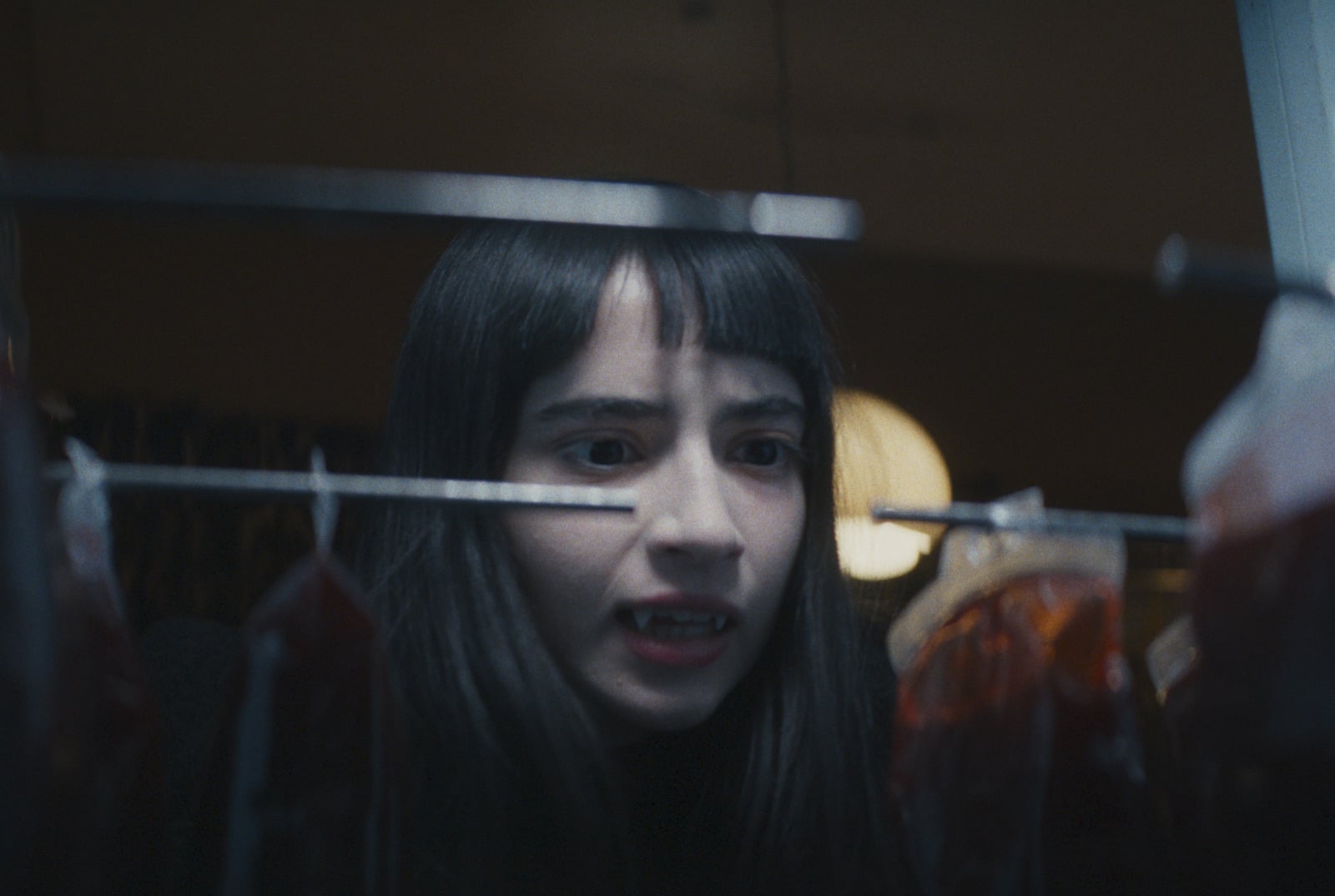
If you missed Ariane Louis-Seize's Humanist Vampire Seeking Consenting Suicidal Person in theaters over the summer, now is a perfect time to watch it on Blu-ray or Digital. Letterbox recently listed it as one of the top ten horror films directed by women. In the contemporary canon of vampire cinema, Humanist Vampire (as I shall refer to it henceforth) distinguishes itself from the coven through bone-dry humor and human depth. In fact, if you ignore all the vampire material, you might just mistake it for a film about two teenagers struggling through crushing alienation.
Louis-Seize structures Humanist Vampire using few references to vampire cinema, and when she does lean into those references, they're typically sparse. The film's relationship to the cinema of Montreal, where she resides, better defines it than its relationship to vampire lore and popular culture. Montreal is the source of Humanist Vampire's comic sensibilities, style, and ennui. FANGORIA chatted with Louis-Seize once more to talk about her influences and how she decided to explore the existential isolation baked into vampires' identities.
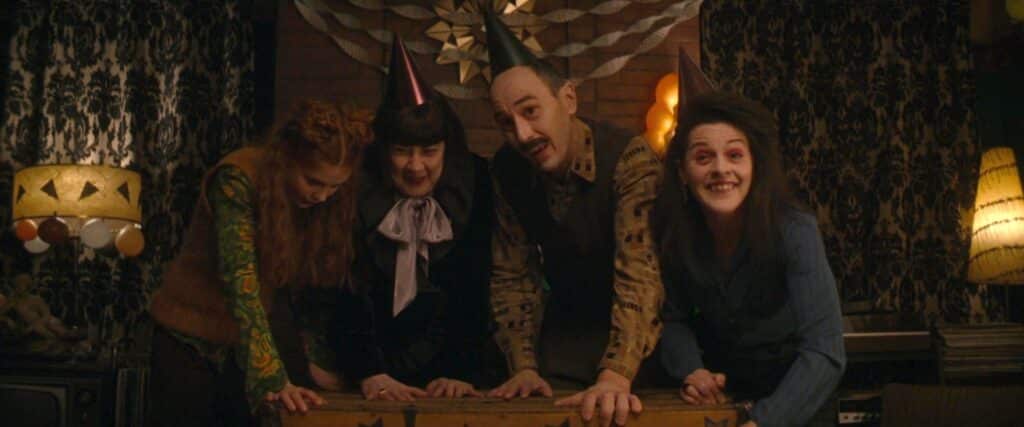
Dracula keeps showing up in vampire movies, and I was at a point where I thought we needed vampires to take a rest. Then I saw this. Besides the fact that I love the title, it's a unique take on vampirism. Do you have similar feelings about vampires running their course? This is a new way to take them; was that part of the intention?
I don't think I had this reflection before writing the script, but for sure. I'm not a vampire geek, by the way. It's just that a couple of vampire films have stuck with me throughout the years. For my first short film, which is not a vampire film, I made the main actress watch one specific vampire film — A Girl Walks Home Alone at Night, because I wanted to direct her like a vampire. Since my first short film, I have wanted to explore the vampire universe. I think it's more because vampires are misfits, and I like weird, I like misfits. I like playing with attraction and repulsion.
It was just a nice playground to talk about very human themes. I wanted to mix some classic inspiration with something more contemporary. I have always liked indie coming-of-age dark comedy dramas, I wanted to mix a young vampire with all the thoughts you have when you don't know who you are, and you have lots of contradictions inside that you don't know what to do with. I had this flash of this vampire who is a humanist, so she can't deny either of those parts of her. She tries to push her vampiric instinct and has to find a way to live with all those contradictions inside of her.
There are so many vampire films made before, and maybe it's not new to use that figure to talk about death and sexuality. But I never made my vampire film, so it was my stake to just try to do something different, more contemporary and playful. I thought about this while writing the script because I didn't want to do the same old story about vampires. It's hard to renew yourself when you're doing something that's been there for years and years. By mixing tones and treating my vampires like regular humans, I wanted people to connect with them. They're the same as us but with different problems. More complicated, but the same dynamics we know in our society.
This is a vampire story, so the expectation would be that it would contain a lot of vampire tropes. Instead, it really is about how people are lonely and life can be hard. Sasha's a humanist vampire, but to your point about the audience connecting to her, she feels more human. Was that more important to you than playing up the stereotypes of vampire cinema?
Yeah, I also wanted to do a luminous film about death. Actually, it's more about life than about death at the end of the day.
You mentioned A Girl Walks Home Alone at Night. When I saw Sasha in her long black coat with her long black hair, that conjured that movie for me. The only other movies that come to mind are Let the Right One In and Only Lovers Left Alive; they're both under the same umbrella, but it doesn't feel like you're referencing them. If anything, this feels more like it's in [Stéphane Lafleur's] branch of Quebec cinema.
He was the editor of my movie! I've always loved the universe of Stéphane Lafleur. He's one of my favorite Quebec filmmakers. I really like how he mixes the mundane with surreal elements, and how comedy is mixed with sadness. I feel close to his sense of humor and I think that's what worked so well between us during the editing session.
Only Lovers Left Alive was a reference for the costumes and the makeup. Jim Jarmusch managed to do something where the characters look awkward and different but still merge into society. That's the fine line I wanted to achieve as well. Also, the film Under the Skin; it's not a vampire film, but it's an alien one, about a non-human who wants to explore what it is to be human. That was a big reference for me and for Sasha's body language and physicality.
Sasha is so quiet in this movie, but she always stands out. When you talk about the costuming and the characters fitting in, even though they're a little bit awkward, I actually go right to Noémie O'Farrell, as Sasha's cousin, Denise. She reminds me of Only Lovers Left Alive. She's weird, she's mean, but she's also cool as hell.
Yeah, and she has a soft spot as well. She's direct, deadpan, and arch, but she just wants her cousin to spread her wings. At the end of the day, it was like an evolution for this character at the end, when she tries to make Sasha feel good by just putting her hand on her knees. She tries, but it's not in her to be reassuring. For me, it was important to see this soft spot in her.
The key for me is that Denise fits in very well among humans, whereas Sasha and Paul have this way of standing out while still invisible. How did you strike that balance when directing their scenes together and individually? That feels essential for the film to work.
Yeah, that's true. It was easy when I found the right actors. I already had Sarah Montpetit in mind. I had seen a couple of her films before, and I thought she was made to play a vampire. She has something unique and mysterious; we can see so much in her eyes even when she does nothing. There's this whole world there. So I thought, “I can believe she's 68 years old,” weirdly. [laughs]
But for Paul, I had no idea who would be the right actor to do that. I had a bunch of auditions, and everything sounded wrong. I started to think that my script was not good, maybe, or the dialogue because it's tricky to play.
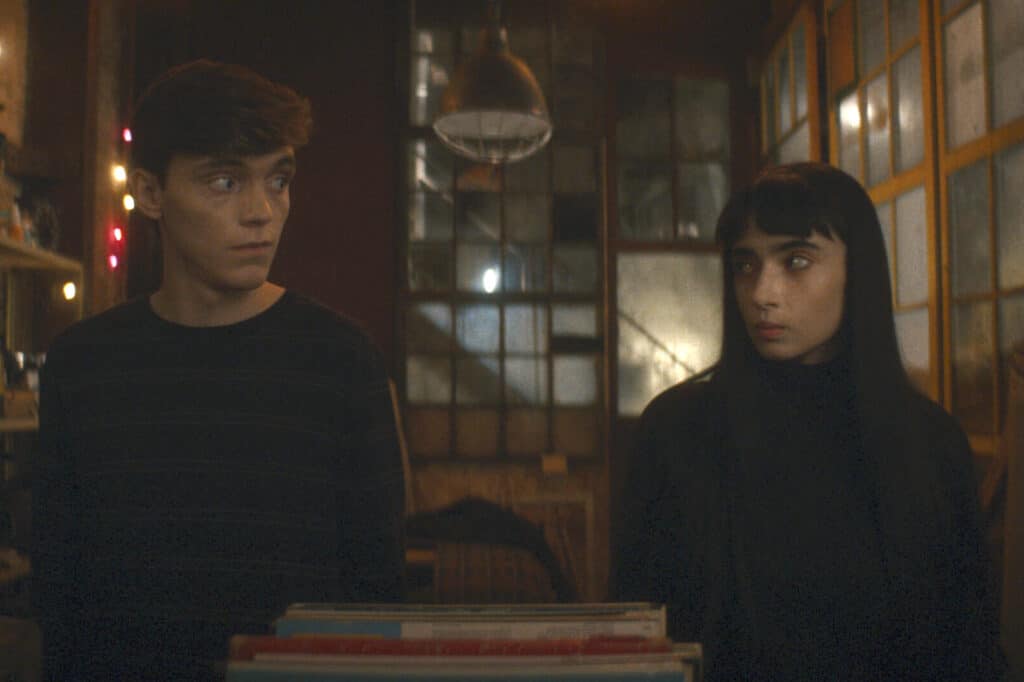
It's like you said, it's a weird dynamic to build. They need to have it right away. I was so relieved when I discovered Felix Antoine because it was like a meeting with my characters. I was like, “Okay, it wasn't my script that wasn't good, it was just that I hadn't found the right actors.” When I auditioned the two of them just to see their chemistry together, I saw the tone of my film taking place in front of my eyes. It was so upbeat and awkward, but also so charming, like two small animals trying to understand each other. They were both weird but in different ways. For me, they were the only possible actors for the roles.
They became very close friends, but we managed to keep that weirdness between them and that weird chemistry. It was easy after that because they are very bright and understood the film's rhythm. We also did many rehearsals to find the pivotal moment in every scene where it's not funny anymore and becomes more dramatic. I like to create those pivotal moments where the audience is laughing, and at some point, they say, “Oh, I'm feeling an emotion right there, and it's not funny anymore.”
