Last Updated on July 22, 2025 by Angel Melanson
There are probably more remakes and reboots of bad horror movies than good ones, so it shouldn’t surprise anyone that I Know What You Did Last Summer is the genre’s latest to receive an update. While I won’t spoil exactly how, Jennifer Kaytin Robinson’s 2025 film qualifies as much as a legacy sequel as it does a reimagining of the superficially intriguing premise of the 1997 original — in fact, the director and co-writer’s “why not both?” approach manages to rank among its biggest virtues.
Juicy appearances by original cast members Jennifer Love Hewitt and Freddie Prinze Jr. offer a more mature counterpoint to the youthful, appropriately frantic turns by Chase Sui Wonders, Madelyn Cline and the rest of its young-adult cast, while Robinson’s cheeky, self-aware handling of the material keeps the tone buoyant even when, you know, people are getting murdered with a fisherman’s hook.
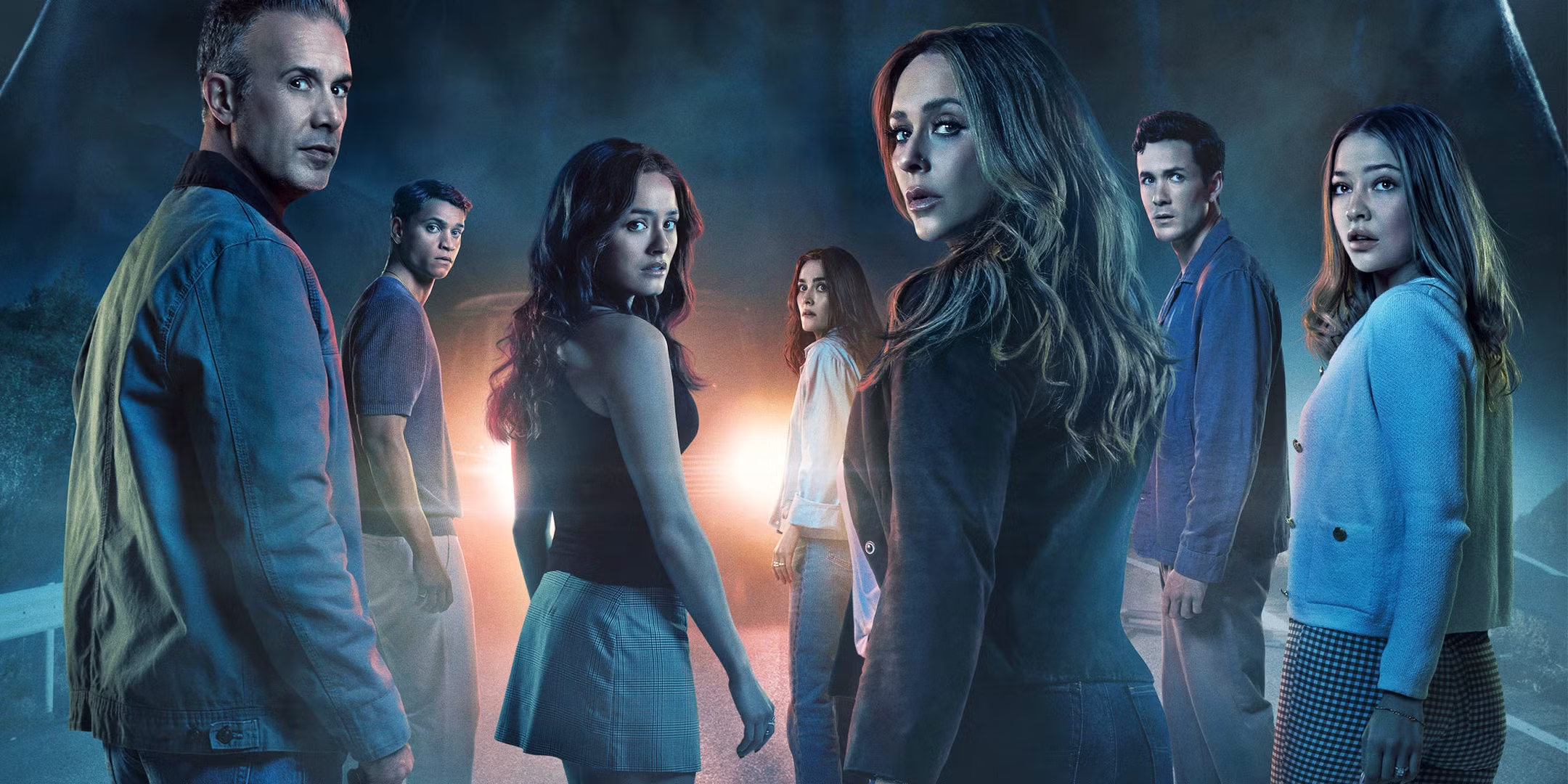
Wonders (Apple+’s The Studio) plays Ava, who returns to the sleepy coastal North Carolina town of Southport for the impending wedding of her best friend Danica (Cline) to longtime boyfriend Teddy (Tyriq Weathers). Reunited at the celebration with her ex-boyfriend Milo (Jonah Hauer-King), the four of them drive up to a nearby bluff to watch the town’s Fourth of July fireworks, inviting estranged high school friend Stevie (Sarah Pidgeon) along for the ride. In the darkness, a car speeds by while Teddy is horsing around in the middle of the road, breaking through the guardrail and smashing on the rocks below. Panicked, the five of them report the crash to authorities but make a pact to never speak again about the incident outside of the group. A year later, Danica and Teddy have broken up and she’s set to marry someone else, but at the engagement party she receives a mysterious card that says “I KNOW WHAT YOU DID LAST SUMMER.”

After eliminating the possibility that a jealous Teddy might have sent the letter in a moment of vindictiveness, the quintet becomes convinced that someone is trying to punish them — a belief confirmed after the brutal death of one of their loved ones. Yet when the local cops refuse to investigate further to avoid the risk of damaging the town’s reputation, Ava and her friends uncover the hidden history of murders in Southport, and reach out to Julie James (Hewitt) and Ray Bronson (Prinze), the only people who might be able to help them make heads or tails of their predicament before they’re all murdered by a figure wearing a fisherman’s slicker and brandishing a very big and sharp hook.
First off, anyone who likes to hear the word “slicker” is in for a real treat; over the past 28 years the Fisherman has branded himself so effectively that no character will dare refer to his attire as something as pedestrian as a raincoat, and they all seem very eager to repeat it over and over. More substantially, the film’s script (by Robinson and Sam Lansky, from a story by Robinson and Leah McKendrick) serviceably updates several crucial elements of the original film, such as actually involving the police in the inciting accident itself, although the cops being in the pocket of prominent businessman (and Teddy’s father) Grant Spencer feels too often like a literal “get out of jail free” card for the murderer. In telling this story now, there are some really provocative ideas to explore in I Know What You Did Last Summer about personal accountability, institutional corruption and so forth, but Robinson and her collaborators don’t seem especially interested in them except as plot devices.
Thankfully, as a director Robinson keeps her tongue planted firmly in her cheek and the cleverness she brings to circumstances that in the first film were pretty dire keeps it from feeling purely like an obligatory retread. Is Ava hooking up with women after her breakup with Milo because she’s acting out after the murder, or was she always happily bisexual? Is Danica’s obsession with New Age wellness an empty-headed distraction (and audience punchline) or the key to unlocking the truth about the Fisherman’s identity? In Robinson’s hands, such ideas mainly exist to inject humor as connective tissue between violent encounters — and because of that they’re welcome. Also missing is the original’s featherweight social commentary between Southport’s rich and poor; here, everyone’s resources are limitless.

For better or worse, Hewitt and Prinze’s characters are burdened with managing the trauma of keeping a secret and then dealing with the aftermath. The reason for this might be that, outside of Billy Campbell as Teddy’s father Grant, there seldom seem to be any real grown-ups around — or really, almost any characters who aren’t absolutely essential to the plot. To be fair, this is another carryover from the first film, in which Julie’s mom makes cursory appearances at the beginning and disappears, and the father of Sarah Michelle Gellar’s character shows up in one scene at her family home but doesn’t say a word. But there are shockingly few other characters (even extras) suggesting that Southport is popping off as it would be for a Southern beach town on July 4th.
As nimbly as Robinson navigates the tone of the material, there’s no getting past the fact that too many scary moments are punctuated with LOUD NOISES instead of inventive filmmaking. There are multiple occasions when the Fisherman simply appears out of nowhere right behind a character, and there’s more than one moment where a kindly hand on someone’s shoulder is accompanied with a slam that sounds like a garbage truck dropped off of the Empire State building. To give the filmmakers just a bit of leeway, the killer was a shape-shifting teleporter in the original one as well, but in any era the killer’s aptitude for instantaneous cleanup of forensic evidence is nothing short of magical, even with Southport’s buffoonish police force on the case.
As a person who’s fully unable to tell how old any person of any age is, Cline and Wonders deliver performances with effective and believable emotionality, but by the end of the film it’s hard to tell if these are full-fledged graduates making their way in the professional world or people who just got out of high school. The answer to that question is further complicated by some pivotal relationships that seem to be tethered to primary school drama, even as they drink and smoke like, well, grown-ups. The broad-chested Spencer’s casting seems almost like a do-over for casting Ryan Philippe in the ’97 film (who was significantly smaller than the hulking football qb in the script), but he carries the same energy as an actor like Billy Magnusson, more clever than smart but carrying around a sense of entitlement that forces viewers to choose between wanting him to die and hating to love him.
As actors, Hewitt and Prinze are ill-equipped to provide the gravitas needed to offset the younger characters’ petulant desperation, but it oddly serves Julie and Ray’s inability to move on from the events of the first film. Hewitt in particular captures Julie’s determination to strike first when a scenario arises like the one she was involved in decades ago, especially one where she risks nothing. Meanwhile, Prinze delivers a couple of powerhouse speeches that ultimately fizzle as a consequence of what the script asks of Ray.
Yet without belaboring the film’s central metaphor — sometimes it’s best not to dredge up the past — I Know What You Did Last Summer abets itself by pretty much being exactly as middling and perfunctory as its predecessor. Is delivering exactly what you expect a good or bad thing? If there are full-throated fans of the original, one supposes they would say yes, but everyone else may feel that this series wasn’t worth returning to, so many summers later.