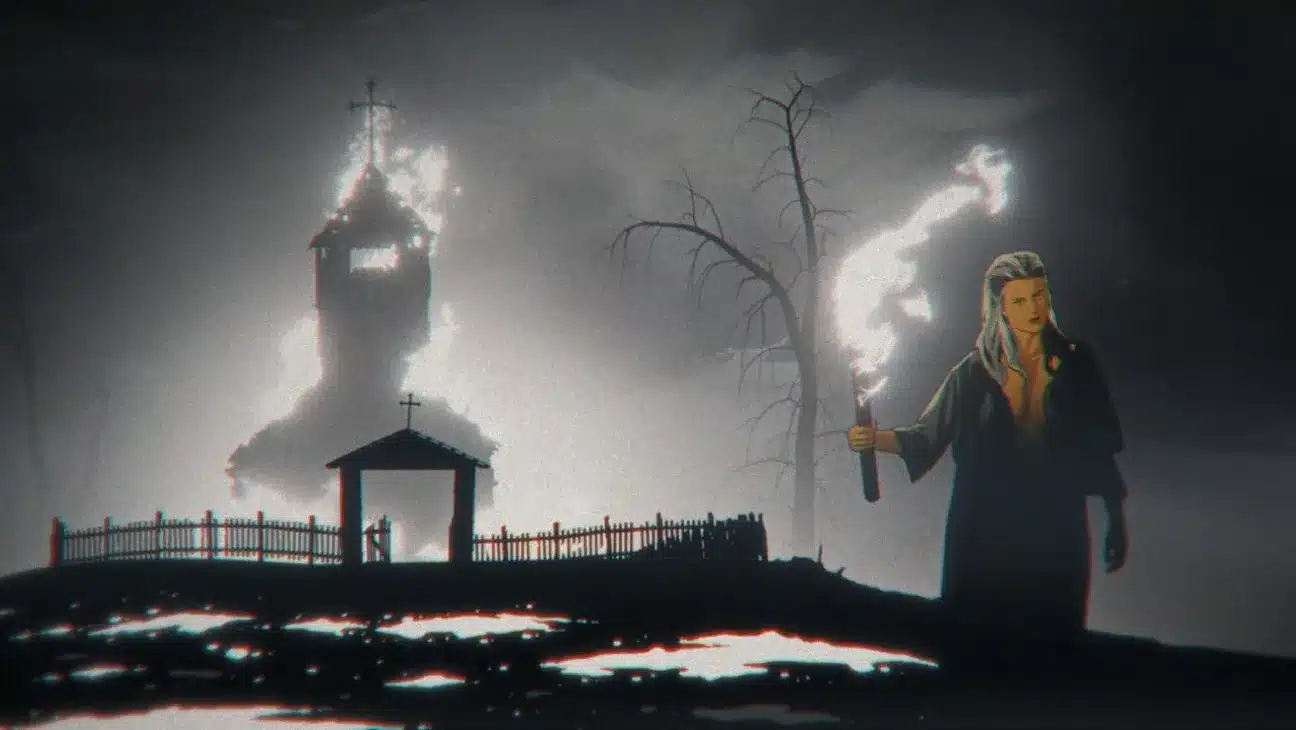
If legendary cult animator Ralph Bakshi (Fritz the Cat, Fire and Ice, Wizards) had ever made an animated horror film, it might look a lot like Dog of God. Pooping farm animals, erect phalluses, icky gelatinous sex … this isn’t a Disney cartoon. Not by a mile!
Latvian co-directors Lauris and Raitis Abele also co-wrote the film with Ivo Briedis and lead animator Harijs Grundmanis. The folk-horror freakout world premiered at June’s Tribeca Film Festival. Dog of God is now blasting through the summer and fall genre fest circuit, next landing at Montreal’s Fantasia today, July 21. Florida’s Popcorn Frights and FrightFest UK follow in August.
The film takes place in a deeply-pious 17th century Latvian town mired in superstition, political corruption and religious hypocrisy. The main story focuses on a contentious witchcraft trial that reveals the presence of an unconventional werewolf in the community’s midst. Remarkably, Dog of God is based on the true story of the 1692 Livonian werewolf trial of Thiess of Kaltenbrun.

Dog of God is brought to life via rotoscope animation (popularized by Bakshi back in the day), where animators trace over live-action footage frame by frame. Handling the job for Dog of God were the 2025 Oscar-winning animators behind Flow. The youngest Abele sibling, Mārcis, served as the production’s cinematographer.
While enjoying their film’s recent Tribeca launch, the brothers Abele discussed the inspiration for their unusual story. “Well, Latvia is quite a small country, but it’s also one of the most forested countries in Europe,” Lauris says. “We also have a rich tradition of folklore regarding shapeshifting creatures—including werewolves. Unlike the werewolves of Western European tales, Latvian werewolves were sometimes seen as dark forest entities that can play with one’s mind, might be protectors or warriors with supernatural abilities, and less as cursed individuals.”
According to Lauris, these superstitions remain relevant in the modern age. “In rural Latvia, belief in shapeshifters persisted well into the 19th century,” he says. “But even today, if one goes to the countryside, you can hear a werewolf story from a local, or someone knows someone who has had a werewolf encounter or some other misleading forest spirit like ‘vadātājs’ or ‘malduguns.’ These spirits make people walk in circles, lose their way, or even vanish forever.”
The Abeles have wanted to explore these myths since the start of their careers. “We were always into that,” Lauris says. “My film school diploma short film that I shot and directed together with my brothers Raitis and Mārcis was also based on a werewolf story that happened during World War II and was written down by a priest.”
After the release of their docudrama Baltic Tribes (about the last pagans of Europe), the Abeles were approached by screenwriter Briedis. “He shared an old script of his about the famous werewolf trial, Old Thiess of Kaltenbrun, and told us he believed we were the ones to bring it to life,” Lauris continues. “Initially, we developed it as a live-action feature, but then Raitis proposed a new vision for the project.”
Younger brother Raitis chimes in: “At that time, I was working with Gints Zilbalodis during the early stages of Flow, helping to set up the animation pipeline. Being immersed in the world of animation, the idea suddenly struck me: What if Dog of God could be made as an animated film? I shared the idea with Lauris, but he was initially hesitant, as he already had a clear vision of the film as live action. However, after conducting the first animation tests together with animators Harijs Grundmanis and Aigars Gercāns, it became clear: Animation was the best way to tell this story. Somehow, all the core crew members’ visions aligned—we were on the same page.”

Nostalgia also influenced the Latvian duo. “The dark fantasy animation of the 1980s was awesome,” Lauris says. “The visual experience, the storytelling and the overall pushing the envelope of what can be achieved with animation was most valuable to me.
“As kids, we watched Fire and Ice, Heavy Metal, Gandahar, etc.,” he continues. “When we were ready to start shooting Dog of God, it was suggested we check out the more or less recent rotoscoped animation The Spine of Night. That was awesome too.”

Raitis came across Livonian werewolves while visiting the Big Apple, of all places. Well, sort of. “One of my first encounters with the Livonian werewolf happened in New York, at the Strand bookstore,” he recalls. “It was a dark winter evening in December 2010, and I was wandering through this endless world of books when I found a title by Adam Douglas called The Beast Within: History of the Werewolf. To my surprise, a large section of the book was about Livonian werewolves.
“Livonia—the old name for what is now Latvia and Estonia from the 13th to the 18th century—was suddenly there, in a book by a British author,” Raitis continues. “I was amazed. How did this guy know so much about our lands? And even more astonishing: He knew more than I did at the time about our specific, more-pagan and folklore-rooted belief systems around werewolves. Douglas had gathered many cases and historical reports, and even categorized the Livonian werewolf as a distinct branch. So yes, werewolves have been haunting both me and Lauris for quite some time now.”
Not only did the Abeles notice a lack of Latvian werewolf movies on the screen, the paucity of adult animation needed to be addressed as well.
“The problem is that these days we have a lot of nonsense producers who value profit more than art, so they want to make animations that could be consumed by everyone, and the product that will come out will always be bland,” Lauris says. “I wish there would be more brave directors and producers who would return to the more serious approach to animation. Anyway, why wouldn’t [more people do it] if it’s an adult animation and one can do pretty much everything that is considered legal? What’s to be afraid of after the likes of Game of Thrones? That explored a lot of so-called taboo themes and had record viewership.”

With a full slate of international screening dates quickly lining up to take Dog of God through the fall, the Abeles excitedly recall their springtime world premiere.
“[It was] ‘Just a perfect day,’ as Lou Reed sings,” Lauris says of his Tribeca trip. “We had a soju drink with our crew in a Korean restaurant, went through the park to the premiere. The picture quality and sound were very good at the cinema. Afterward, we met the audience and went to the afterparty. Big shout-out to the awesome Proletariat craft beer place! Afterward, some of us hung out in New York till 7 am. It was my first time in the U.S., and I got to experience that famous NYC ‘ghost hour.’”
“What I can also add is how warmly we were welcomed by the festival organizers,” Raitis notes. “Dog of God was our first major American festival—our first big step across the ocean. I had previously been in New York with my short film Leftovers and Leftlovers at the Psychedelic Film and Music Festival in 2018, and Baltic Tribes was screened at the New York Baltic Film Festival. But Tribeca—this was the first large-scale U.S. festival experience for us, and we truly felt embraced there.
“The Q&As went really well, and the conversations afterward were just as rewarding,” Raitis continues. “I even shared a beer with programmer Jonathan Penner and also had a great chat with [co-programmer] Matt Barone. Everyone we met from the festival team was kind, engaged and curious. We sincerely hope to return soon, and we’ll do our best with our next film, a live-action thriller called Wagner and Satan.”
Festival play serves as the perfect barometer for new films, though the Abeles went into their initial public showing with a great deal of apprehension.
“It was truly a world premiere for the film—we hadn’t done any test screenings with audiences back home, nothing at all,” Raitis says. “So naturally, it was a bit stressful not knowing how it would be received. Watching your own work with an audience beside you—it changes how you see it. You view it with your own eyes, but almost through a different lens.”
“I was happy that we got the laughs of the audience in the right places where we hoped it would work,” Lauris says. “We were surprised how much the U.S. audience concentrated on the sex-related themes, when for us that was just some background theme and aesthetics.”
Adds Raitis, “Fortunately, the premiere went really well. One of the highlights for me was that many of our core team members made it to New York. There were about 13 of us—which is a lot, considering how small our crew was. So around half of the team crossed the ocean with us. Of course, I would’ve loved to have everyone there, but as you probably know, New York isn’t exactly the cheapest place to visit. It’s been a fantastic start for this film—even better than we imagined.”
For updates on Dog of God’s festival and release dates, go here @dogofgod_dievasuns .