Jelena, a middle-aged woman in her third trimester, sits on a park bench. Inexplicably, an unknown voice comes over her cell phone with a deadly mission and a dire warning: Kill the people on his hit list or her unborn child (conceived in vitro) will die.
The talkative caller claims to be the god Siddhartha, the “Creator of Content,” and wants to “flush the toilet” of the world. With Jelena as his assassin, that means eradicating those he deems humanity’s worst offenders. But he’s not targeting mass murderers, corrupt politicians or child molesters. He wants to take down society’s dirty cops, sleazy internet influencers, religious hypocrites and reality-show phonies.
Such is the premise of Karmadonna, the directorial debut of confrontational screenwriter Aleksandar Radivojević. Radivojević previously co-wrote one of the most controversial pictures ever, A Serbian Film, which shook up the festival circuit in 2010. Karmadonna makes its American premiere this Saturday night at the Brooklyn Horror Film Festival (tickets here), where the jury just awarded Radivojević a Best Screenplay award. (Catch him in person at this weekend’s showing with his producer, former FANGORIA scribe Heather Buckley.) Expect Karmadonna to follow in A Serbian Film’s divisive footsteps, though the imagery this time is even nastier and more grotesque. Love it or hate it, A Serbian Film did leave a few things to the imagination (thank Heaven!). Karmadonna is a gruesome free-for-all. But like A Serbian Film, the smartly-scripted Karmadonna has a brain in its head, even when an actual brain is held up to the camera in glistening closeup.
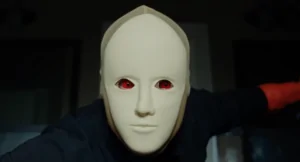
At first reluctant, Jelena (played superbly by Yugoslavian actress Jelena Djokic, the heart and soul of the movie) goes about her bloody business. The film takes on an episodic approach as our heroine confronts each of her victims, who sometimes engage her in angry philosophical debates to incite her (and the audience). Likewise, her god-oppressor (voiced with determination and menace by Sergej Trifunovic) never gets off his soap-box diatribes, egging on his pregnant pawn.
The kills get more and more inventive and grisly, starting with a throat slashing by Euro dollar(!). Not that we can’t wait to see these sleazeballs get it. They belittle and insult Jelena, calling her Granny and the like. The smug writer/influencer goes up in flames (fanned by Jelena) in a spectacular fire stunt. Meanwhile, his abusive dad, a religious zealot living like an oligarch, is offed with an empty shot glass to one eye (quickly filling up with blood) and a crucifix to the other. We can’t blame Jelena if she increasingly takes relish in her murderous deeds. We sure do. Kudos for the awesome practical FX!
The film’s final act takes place at a sanitarium-cum-TV studio. Bane, a meek self-help guru, has become the hostage of a couple of crooked TV executives, and the vengeful Deity won’t have any more of it. Not only is Jelena carrying out his savage bidding, but he can also possess mortals directly, Evil Dead-style, to spice things up. The halls will soon be running red like an unhinged Troma movie. Even stronger stomachs will now be needed to digest the climactic eye gouging, head bashings, castrations, machine-gun blasts, eviscerations and other escalating gore that closes out Karmadonna.
On the surface, Karmadonna reminds me of several disparate films, including the 1990 French cult flick Baby Blood, as well as writer/director Larry Cohen’s God Told Me To and the Cohen-scripted Cellular. Stylistically, the loopy cinematography and Dutch camera angles by cinematographer Aleksandar Jakonic evoke Sam Raimi’s work, as do the glowing red eyes of the possessed. You can imagine Radivojević taking many cues from the transgressive films of Takashi Miike as well.
Is Karmadonna for you? Fans of quiet horror and slow-burn storytelling need not apply. Karmadonna is a cinematic assault on the senses. If you love over-the-top gore mixed with a big dollop of social commentary, this movie will fit the bill. The Serbian Radivojević has something to say about religion, politics, entertainment and social media, reflected through his country’s own cultural lens. If America is truly entering an age of assassination culture as some pundits insist, then Karmadonna could not be timelier.