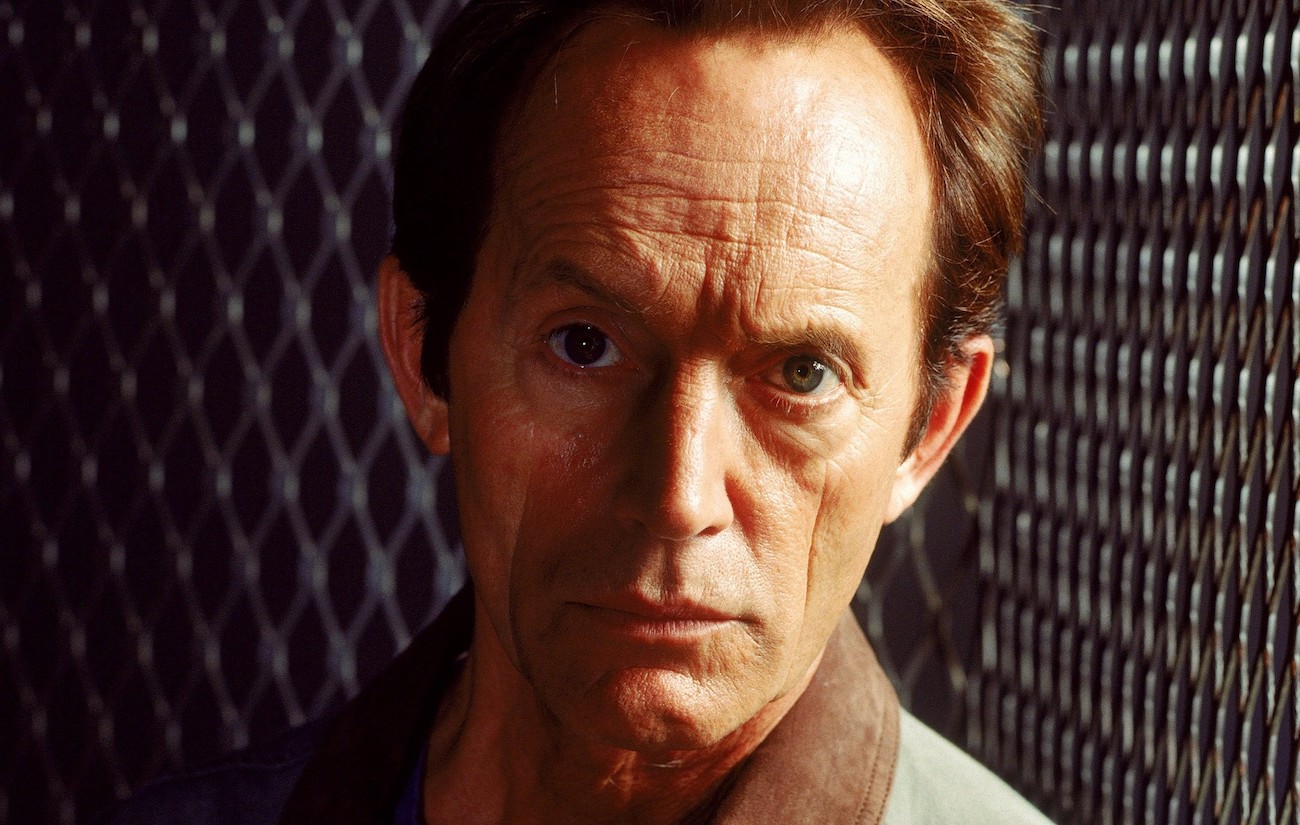
Editor's Note: This was originally published for FANGORIA on September 3, 2004, and we're proud to share it as part of The Gingold Files.
It seems strange when one looks back and realizes that Millennium debuted nearly a decade ago, and one reason is that, in a sense, it has never gone away. Along with Se7en (an acknowledged influence), Chris Carter’s series helped establish a visual grammar for screen serial-killer storytelling that persists to this day; what is last month’s Suspect Zero, for example, if not a feature-length expansion of Carter’s show?
Millennium also set a new standard for televised explicitness when it comes to the presentation of gruesome crime scenes, one that is now routine in the likes of CSI and its ilk. Back when I first got a sneak peek at the pilot, though, I remember being truly startled when Lance Henriksen’s Frank Black opened a crude coffin to find a young man buried alive inside, his eyes and lips stitched together, a severed head in a plastic bag beside him. As Carter says in his commentary over this very scene, “Needless to say, this is not your usual television fare.”
The challenges and obstacles involved in getting such a program on the air are a frequent subject of the extras contained in Fox Home Entertainment’s DVD boxed set of the series’ first season. This first round of episodes remains the show’s best; even with the occasional weak link (like “The Wild and the Innocent”), Carter and co. deliver a series of chilling stories anchored by Henriksen’s portrayal of Frank Black. Tormented by his (don’t call it psychic) ability to get into the mindsets of the serial murderers and other villains he investigates, Frank nonetheless is compelled to use it to help put a stop to evil. While largely focusing on a new malefactor each weak, the season also introduces a through-line involving the Millennium Group that utilizes Frank’s services, and points the way toward a more apocalyptic threat in the manner of Carter’s The X Files.

Like that series, Millennium brought feature film-level technical qualities to TV, and the disc transfers do them complete justice. The constant darkness is properly deep and black, and the fullscreen images handle the constant rain, mist and gloom with no loss of clarity and very little grain. The Dolby 2.0 Surround audio may not make full possible use of the medium, but certainly adapts the original televised elements to the fullest.
The only major complaint about the extras is that there aren’t enough of ’em; by this point we’ve been spoiled by the multiple commentary tracks in Fox’s X Files and Buffy boxes, so having only two here feels like a bit of a letdown. (Personally, I would love to hear Henriksen talk over a complete episode, but there’s always Season Two…) The pair of commentaries that are present are pretty strong, though: Carter on the pilot and director David Nutter on its follow-up story, “Gehenna.” Carter provides a solid overview of setting up the series, as well as specifics of shooting this particular episode. He both acknowledges his influences and points out other shows inspired by this one (even citing Mad TV’s hilarious “Suddenly Millennium” parody), and notes how the film’s foreboding tone especially resonates now in the wake of 9/11.
Nutter’s talk doesn’t get into much in the way of production minutiae; rather, he focuses on the themes he wanted to express. A recurring subject is the challenges involved in following up the pilot—both in explaining and developing its themes and reconstructing its sets. (The owners of Frank and family’s original “yellow house” wouldn’t let the crew back after the first time around, so a new one had to be found and dressed for the series.) Surprisingly, he even brings up Trancers (more precisely, he actually helmed two of its sequels) as a point of comparison to one shot.

The documentary “Order in Chaos: Making Millennium Season One” fills in a number of fun details, like the fact that William Hurt was initially considered for the show’s lead, and allows a number of the creative team and cast to add their own insights. The series’ extreme subject matter is a key concern; the best story here concerns a Standards & Practices woman who initially gave the pilot a pass, then requested cuts after she subsequently had nightmares about it. An S&P rep even flew to the set to be on hand during shooting of the sexually themed “Loin Like a Hunting Flame” episode. Other fun trivia includes the fact that the company didn’t have clearance to use the Millennium title at first; during shooting, the pilot was provisionally called “2000.” (Another odd note in hindsight: Millennium didn’t manage to stay on the air long enough to see the event that gave the show its name.)
Rounding out the package is an interesting featurette on the Academy Group, a team of former FBI agents-turned-crime consultants who inspired the series’ Millennium Group. They discuss threat assessment, their beliefs on evil and how the job affects them—all integral concerns of the series. There’s also a brief piece on the creation of the spooky title sequence. And kudos to whoever decided to go with this set’s packaging, which has each disc contained within a mini-case as opposed to the ungainly foldout design of past Fox boxes. More like this one, please!