I cannot recall when I acquired Paul Monette’s novelization of Werner Herzog’s 1979 Nosferatu: The Vampyre, but I am endlessly delighted at its existence. Follow me here: it’s a novelized adaptation of a remake of a film that was an unauthorized adaptation of a source novel. Tracking from Bram Stoker’s 1897 original Dracula to this is like playing a game of Telephone but with rat fangs.
I bring up the rodents’ (as opposed to Klaus Kinski’s) fangs because the biggest difference between Monette’s take and Herzog’s film is that there is way more rat action. They tear through a herd of cows, knock down doors, and even devour a workaholic goldsmith who decides to keep going to his shop while the rest of the town stays indoors after the plague sweeps through the area. Given the issues Herzog had on set with his furry stars, it’s likely that even if any of this stuff was in the script the author was working from, it would have been deemed far too difficult to shoot properly.
But it’s one of a few things that give the book a more horrific feeling than the film itself. Unsurprisingly, Herzog didn’t aim to terrify his audience, opting for something a little (OK, a LOT) more meditative and even languid, keeping most of the violence off-screen entirely. Monette doesn’t exactly dwell on these things but presents something more chilling and closer to traditional than the onscreen version. There are more visions and nightmare scenes; one in particular occurs near the end, as Lucy dreams of being on a ship that is menaced by giant crabs and spiders, something that has no onscreen counterpart at all.


There’s also a lot more with Renfield, including more of a relationship between the man and Dracula. At one point, Dracula finds a cat (who has just devoured one of the many rats) and captures it, bringing it to Renfield for a little snack and feeling proud, “like a doctor,” of keeping his people strong. He also allows Renfield to feed on him, which serves as the resolution of a much longer sequence following the latter’s escape from his cell.
In the movie, Renfield does this relatively quickly and then disappears from the story after a brief encounter with his master. Here, he kills a guard during his escape and then wanders the town for a bit, noting other bits of insanity going on and realizing he didn’t need to be discreet because his blood-covered clothes and crazed demeanor wouldn’t stand out among the crowd.
Monette also adds some absurd touches here and there, like Van Helsing witnessing a police officer arresting a goat and a man selling a tulip to a corpse. In fact, the book as a whole has much more detail in the settings and among the background characters than the movie tends to offer, giving it a more fleshed out feel that occasionally seems intentionally a way to contrast it with the sparse images from cinematographer Jörg Schmidt-Reitwein.
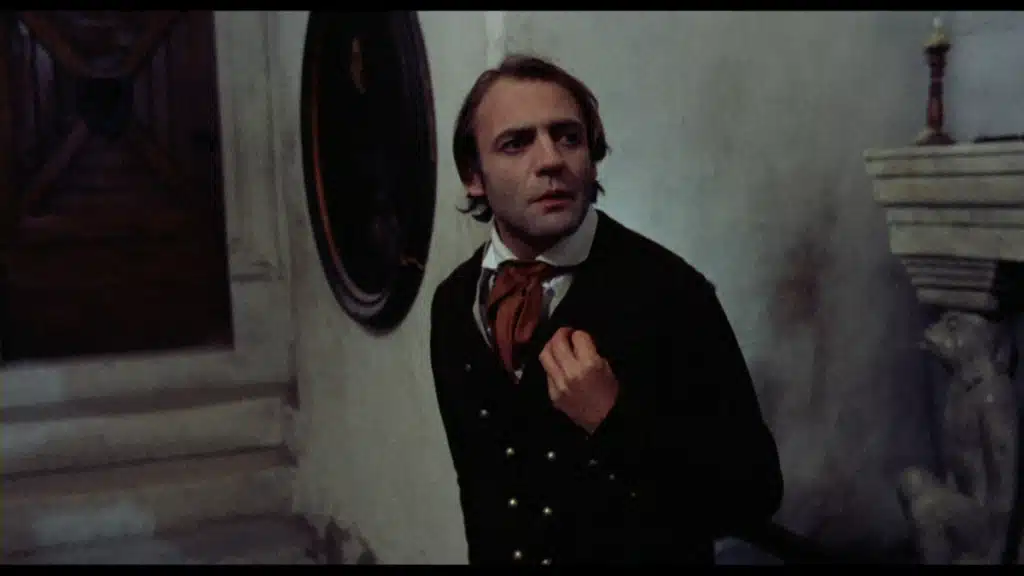
The author also (thankfully) skips some of the movie’s dialogue and presents it as an inner monologue, which helps clarify or dig deeper into the characters’ states of mind and avoids some occasionally clunky bits. For example, in the movie, Harker (Bruno Ganz) says aloud (to himself) something like, “Oh, he’s leaving for Wismar! He’s after Lucy! I have to stop him!” which is, of course, silly to see and hear. But on the page, Harker keeps these ideas inside his head, with added insight into his mental state. In that same scene, Monette has him consider taking his belongings for a moment, only to realize that everything he owned was trivial when compared to his beloved Lucy.
On that note, the love story actually plays out better on the page, and I attribute that to a mix of Monette’s character expansions and the fact that we aren’t looking at Klaus Kinski. A notoriously awful human being, it’s hard to ever sympathize with his take on the character; his performance is fine, but even under all that makeup, you still see the monstrous actor unworthy of any level of sympathy.
But here, Dracula’s tragic loneliness actually comes across more naturally, and I found myself pitying the poor immortal sod more and more as the story went on. There’s nothing like this in the movie, but he even tries to shield Lucy from the damaging sun as it kills him, loving her until his very last moments. Still a villain, no doubt, but a more sympathetic one than I ever considered the two or three times I’ve seen the movie.

In short, if you’re a fan of the film, I think you’ll agree that Monette did a fine job of diving into its world and giving us more to (sorry) chew on. There are few full-on additions beyond the ones I’ve mentioned, and it’s even less often that it actually contradicts the onscreen version (at the end, Harker rides off into a desert onscreen, but in the book, it says it’s the mountains; that’s about as extreme as it gets).
But he expands on nearly every scene and gives us insight into the characters’ minds while fleshing out some of the supporting roles (Lucy’s brother Schrader and his wife Mina are barely glimpsed in the film but get more to do here) and the town of Wismar itself. You really get the sense of the plague taking over, something the movie left fairly vague.
It’s not too expensive on eBay and the like, so it’s an easy recommendation to fans, and maybe even to those who enjoy the usual Dracula tale but felt Herzog’s movie didn’t quite offer up enough in the way of horror. And it serves as excellent proof that Stoker’s original story is so compelling yet malleable that even a novelization of one of its many remakes can carve out its own identity and hold someone’s interest no matter how many times we’ve experienced it in some form or another.