Last Updated on March 16, 2024 by Michael Gingold
Editor's Note: This was originally published for FANGORIA on October 11, 2011, and we're proud to share it as part of The Gingold Files.
You know the cinematic-rehash market is getting saturated when The Thing is advertised as coming “From the Producers of Dawn of the Dead,” and both films in question are reduxes. And while the 2011 Thing is being billed as a prequel and not a remake, a remake is what it is.
The creators of the new movie set themselves a significant challenge in electing to tell the story of the Norwegian base in the Antarctic that fell victim to the shape-changing alien before it made its way to Kurt Russell and co.’s turf. Not only is the ending a foregone conclusion, but the creature’s tricks can’t help but be familiar—not to mention the fact of dealing with a cast of Norwegian characters. The script by Final Destination 5’s Eric Heisserer hedges the latter bet by centering on an American graduate student in paleontology, Kate Lloyd (Mary Elizabeth Winstead), who is called to that research station to check out an unusual specimen recently dug out of the nearby ice. Upon arriving with her assistant, Adam (Eric Christian Olsen), she makes the acquaintance of helicopter pilots Sam (Joel Edgerton) and Derek (Adewale Akinnuoye-Agbaje), plus Dr. Sander Halvorson (ubiquitous Euro-guy Ulrich Thomsen), who also speaks English…oh yeah, and the team of Norwegian specialists staffing the place.
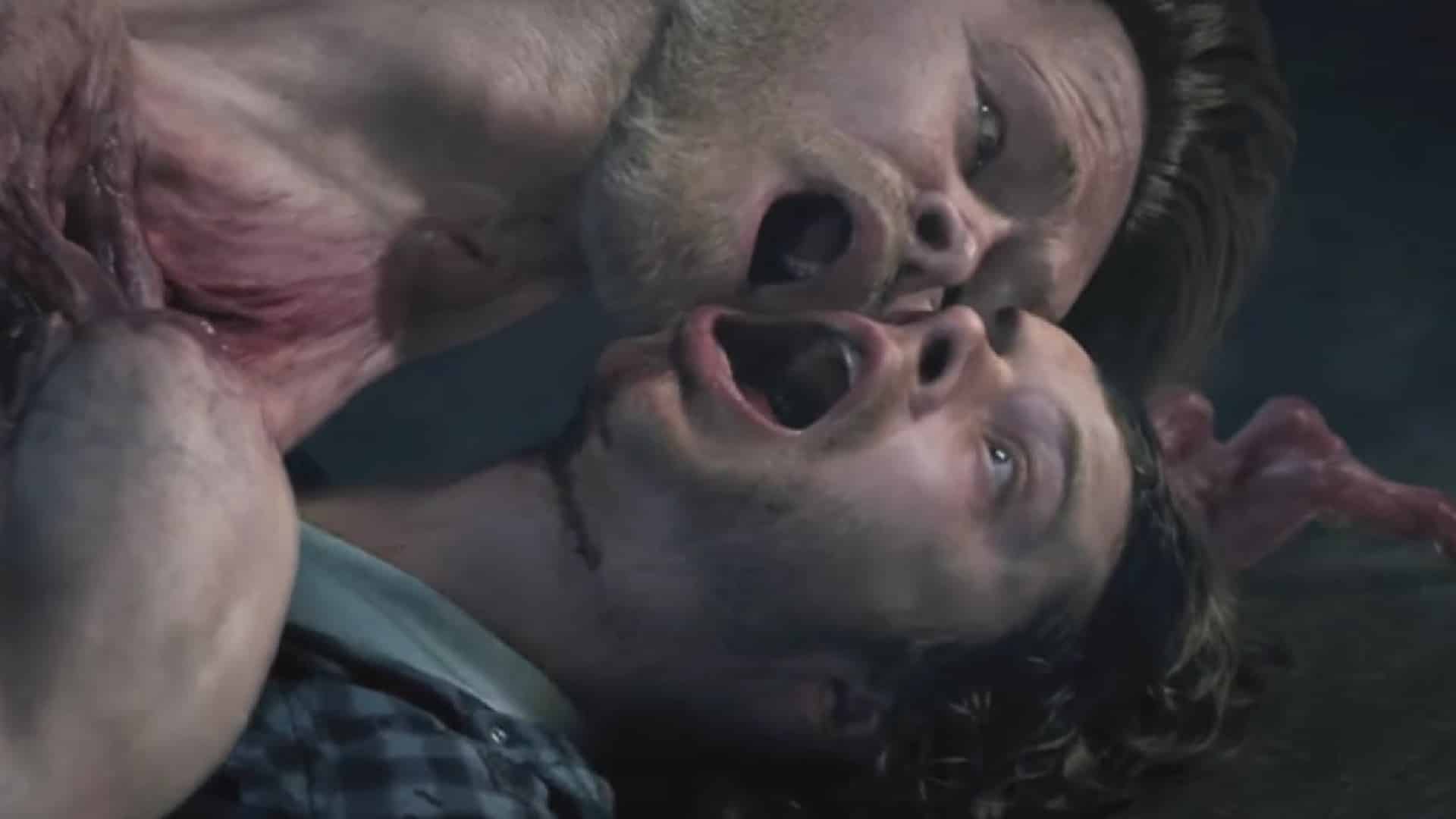
Although Heisserer and director Matthijs van Heijningen open their movie with a spectacular setpiece in which a scouting team discover the extraterrestrial’s crashed and buried spacecraft the hard way, this Thing doesn’t carry the doomy tone in its opening act that suffuses John Carpenter’s 1982 classic from the start. When the frozen alien is extracted and brought back to the base, it puts everyone in good spirits: Dr. Halvorson believes he’s made a significant scientific discovery, and his crew thinks the find will make them rich and famous. Only Kate seems a little nervous about probing this new unknown species, and of course, she’s right. It’s not long before the creature has escaped its icy prison and starts claiming human victims, and Kate is the first to realize that it is not only consuming its prey, but duplicating them as well, to the point where it’s impossible to tell from looking at them who’s still themselves, and who’s an alien double.

There might have been a way to play out this scenario so that it didn’t seem like a simple regurgitation of Carpenter and screenwriter Bill Lancaster’s viscerally paranoid landmark, but the makers of this Thing haven’t found it. It hits most of the same key beats, including an autopsy on a half-transformed mutation that reveals the creature’s biological process. It does offer one clever addition to the scenario, a potential way to distinguish between humans and xenomorphs—though when played out, it’s just not nearly as dramatic as the famous “blood test” sequence in Carpenter’s movie.
The ’82 film took a lot of heat at the time from critics who derided what they saw as a lack of character development, yet one of that Thing’s strengths is the way it defines those characters by how they react to the scenario, and the vivid ways their personalities come out under pressure. There’s little memorable interaction in the new Thing—one of the only revelations is that, surprise surprise, Dr. Halvorson might value preserving his discovery at the expense of those around him—reducing the dwindling number of survivors to generic types. And while having the Norwegians speak among themselves in their own tongue in front of the uncomprehending Americans does a little to exacerbate the us-vs.-them tension, it doesn’t allow the audience to get to know them very well.
Then there’s the little matter of the FX. Carpenter’s movie was also attacked at the time for the explicit manner in which Rob Bottin savaged and distorted the human form, but now his work is rightly held up as an unparalleled masterpiece of grotesquerie—which also set a very high bar for anyone following it up. The 2011 Thing does employ a number of ghastly full-scale physical creations by Alec Gillis and Tom Woodruff Jr. that score high on the ick factor, but once the transformations become visible and the monsters become ambulatory, the filmmakers inevitably fall back on CGI. It’s high-level technically, and the designs are impressive, but you never forget you’re watching digital creations. It’s the tactile feeling you get when viewing Bottin’s beasts and disfigurements—the sense that they’re really there—that makes them work, and that can’t be duplicated by computer. Like the Thinged-out characters themselves, this movie’s critters closely resemble their forebears, but they lack a pulse.
The Thing is not a bad movie in and of itself; it’s professionally made, all the actors are up to their tasks and there are moments here and there that get a little bit of the hair raising. Yet in adhering so closely to the prior model, it opens itself up to comparisons it can’t help but suffer from, and judged on its own terms, it doesn’t deliver either the suspense or gross-out impact it’s striving for. When it does go somewhere, in the final reels, that the original didn’t go, it still doesn’t show us anything truly fresh. The last shots, which dovetail directly with the opening moments of Carpenter’s film, will put a smile on the faces of the original movie’s fans—even as it leads once more to those unflattering comparisons. It’s nice that the folks behind this Thing have done as much as they have to honor their predecessor (Marco Beltrami’s score carries a few echoes of Ennio Morricone’s unnerving tones), but the result begs the question: If you’re just going to make the same movie over again, and not do it as well, what’s the point?