Last Updated on March 16, 2024 by Michael Gingold
Editor's Note: This was originally published for FANGORIA on June 6, 2012, and we're proud to share it as part of The Gingold Files.
—
How do you make a genre film about a family trying to survive in a postapocalyptic environment against vicious enemies stand out? You focus on the family instead of the enemies, and compelling human drama over bloodshed. That’s what director/co-writer Justin McConnell did with The Collapsed.
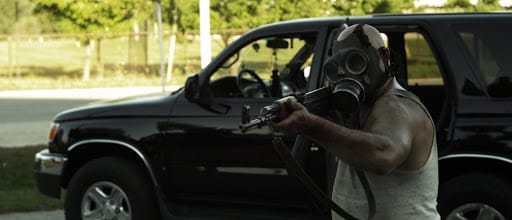
The movie focuses on the Weaver family, played by John Fantasia, Lisa Moule, Steve Vieira and Anna Ross, as they trek from a city to the countryside in search of safe haven, all the while trying to avoid mysterious, unseen enemies as well as other, threatening humans. McConnell and co. were originally planning to shoot a larger vampire-themed project called The Eternal, but financing problems led them to tackle The Collapsed instead, as McConnell explains…
When The Eternal hit a snag, how did you come up with the concept for The Collapsed?
My co-writer/producer, Kevin Hutchinson, and I basically got fed up and decided to workshop an idea we could shoot with the budget we were able to raise at the time. We went in knowing we had only had a certain amount of money pooled together, and wrote keeping every dollar and cent in mind. It all came down to figuring out what kind of story we could tell that would still get noticed, but that we could tell well within our means. We were down to three basic concepts: one was a quiet serial-killer thriller along the lines of the great underseen British flick Tony; another was a creature feature involving a prison that we at one point could book very affordably per day, until it closed to shooting; and the last one was the bones that eventually formed the skeleton of The Collapsed.

Did you aim from the beginning to make a more subtle kind of postapocalyptic survival thriller, or did that approach grow out of the story?
I think it mainly grew out of the story. I wrote starting from character behavior first; how they reacted to each event dictated the flow of the story. In a way, the apocalypse in these sorts of films is always a catalyst to get to the root of human issues, and we tried to explore that. Reaction has been mixed, but we didn’t exactly set out to make a crowd-pleaser from the start; we took risks, for better or worse. I knew I wanted the film to be an exercise in the dying art of the slow burn, of building simple suspense from atmosphere, situation and environment. I like the idea of what may be lurking around the corner, of the unseen, because often the thing that pops out and goes “Boo!” isn’t nearly as terrifying as what we can create with our own minds. I like to believe we made a thinking-person’s horror film, and even those who don’t like it will at least admit we attempted something different.
Did you have any outside financing, and if so, was it difficult to get backing for this less explicit type of movie?
Partial financing came from outside sources, but people close to the production. The whole film was funded by myself and a few others. In this case, because the cost up front wasn’t particularly high, and I know everyone well, it wasn’t that difficult. But I know first-hand how tough it can be raising more from our quest to get The Eternal and our other projects made. And how tough the market is right now. The Collapsed is a tough sell in the eyes of some, because it doesn’t have the tried-and-tested formula that distributors can just move countless units of in their sleep. It has zero name actors, has some good gore but is pretty reserved in that respect, isn’t exactly paced like an action-thriller and takes its time building suspense. A very respected UK distributor once told me, “It falls between two stools—it’s not obviously horror enough to sell huge to that crowd, and not art-house enough to be a huge festival hit.” I consider myself very lucky that we’ve found distributors who believe in the film. I know it’s not the next Evil Dead, but as a debut narrative, it’s on a great run.
Where did you shoot, and what was your schedule?
We shot on multiple locations across southern Ontario, Canada, over a 14-day period. We did all the city stuff in the first two—very long—days, then went north of Toronto for the rest. The majority of the forest stuff was shot at a farm about 90 minutes north of the city, in a town called Janetville. This great 100-acre property had so many different forest looks that we didn’t have to hike far to keep things looking fresh, or make it appear like the characters had trekked a vast distance. The property was also used by LARPers on a monthly basis, so what you’re not seeing off to the side of some shots are makeshift elven villages and plastic graveyards. It’s very tough filming a movie in 14 days, because you don’t have the time to shoot every line and every performance until it’s perfect.
The Collapsed is distinguished by its strong performances. How were the actors cast?
We held auditions over a three-day period in Toronto, after putting up ads on Mandy.com, Craigslist and various casting sites. A couple of people self-recorded on-line auditions. We saw a lot of people, then narrowed them down to our top choices after reviewing the audition tapes. Our lead, John Fantasia, was a quick first choice, and we’re very glad we made it. He brought so much to the film, and really elevated it. The one snag was that he was one of the e-mail auditions, and we didn’t even know he was from Seattle when we gave him the role. We didn’t have money to fly someone in or pay much beyond the day rate we were offering, but John was so adamant about doing the role that we took the risk. He came to Toronto and lived here a month, did rehearsals and generally was a trouper. Everyone in the cast really stepped up, and considering how difficult it is to find good actors on the non-union level, we got lucky with the people we were able to get.
Was it a difficult shoot?
It was more exhausting than difficult, especially for me. I felt like sleeping for a week when we were done; I’m sure most of the crew did. We’d do 12-hour days, which are pretty standard, but most of them also had an added travel component. Most days the round trip was three hours, and I made sure to make that generally fit in the 12-hour block, but some days the transportation time would be huge—five-hour round trips, etc. I also had the money to feed the crew decently, but nothing to pay someone to prepare or cater the shoot—so I did it. I overstuffed—and broke—my fridge and kitchen, and each day I’d come home from set and spend an additional couple of hours preparing a day’s food for 15-20 people. The average shoot day, I’d get to sleep around 3-4 a.m. and then have to be up again at 6 a.m. to get ready for the next day. After 14 days of that, you run the risk of burning out.
There were other problems with the effects not doing exactly what we wanted, and on our squib day, the heavy wind basically vaporized our practical gun gags. In the end, we amped those up a bit digitally, but since the actual squib hits are there, I think the marriage of the two schools of effects work well. I just found I always had to be on top of everything, every second of the day, to make it all work. I owe a huge debt to my great cast and crew for making everything run as smoothly as it did. You have to be adaptable with time on an indie—I’d show up with a 40-50 shot list each day, and end up cutting that down to about 30-40 by day’s end.
The fact is, we put really solid work into preproduction, where the movie is made anyway—it’s the most important stage of the whole thing—and that removed most of our problems before they arose. Aside from the city scene in the parking lot—originally, that was supposed to have dialogue, but it was so loud on location that we just shot it silently and rebuilt every sound and the environment later, in post. I actually think it works better as it stands now than as it was written.
Do you think the movie’s different approach to the genre gives it an advantage in the independent-horror scene?
I think it’s a double-edged sword. We’ve definitely gained more notoriety than many comparable films shooting with the budget we had, and the response has been really good. The film has also opened a lot of doors for my team in terms of our future. It stands out in the right circles for being different/unique, and if we were just another low-budget zombie story or something, we might get lost in the crowd.
On the other hand, there’s something to be said for the purely commercial approach. There’s a very good reason that so many zombie, vampire, werewolf, slasher, etc. films exist, why filmmakers continue to return to the same well for ideas: because they work and usually are an easy sell. The general public, more than ever, seems really hungry for the familiar. Or the nostalgic. There’s this whole movement right now of grindhouse throwback homages, some made ironically, some less so, and they sell like hotcakes—though I’ll be the first to admit I’ve never seen, and probably wouldn’t trust, hotcake sales figures. I have no doubt that if we did some well-made splatter-happy flick, with all the tried and tested elements, that we could probably get larger minimum guarantees and more distributors knocking down our doors, but that’s not what we wanted to do.
I grew up on a steady diet of the weird, different and risky. I’ve seen countless films in my lifetime, and most of my favorites don’t have the stock horror elements. I value directors who subscribe to the auteur style, try to have their own voice and attempt to do anything outside of the pack. I also see how they split audience opinion with every film they make, and don’t mind that. I know going forward that not everyone is going to like what I make, and that’s just the way it is. We’re making stories we want to see, and it turns out we aren’t alone in wanting to see them. That’s a great feeling, and sticking to our guns has gathered us some strong early support. I know people like to be scared, but some of them also like to be challenged, and that’s who we made this film for.
Do you sense a particular Canadian horror movement right now, and if so, what sets these movies apart from films shot elsewhere?
Yeah, I’ve seen it build steadily the past few years, and it’s really invigorating. There’s a huge genre push in Canada right now, unseen since the early days of David Cronenberg, George Mihalka and Bob Clark. There’s us at Unstable Ground, the great folks at Foresight Features [Monster Brawl, Exit Humanity], Black Fawn, Raven Banner, Astron-6, Yer Dead [Hobo With a Shotgun], the guys who made The Corridor, talented folks like Geoff Redknap in BC, Douglas Buck, Karim Hussain, Nictophobia, this talented up-and-comer Darryl Shaw [Android Re-enactment]—the list goes on and on. What makes it truly notable is it’s a true scene, sewn together via social networking, common festivals and a somewhat anarchic spirit. Most of us know and support each other; there’s very little competitive attitude.
And it’s driven, in many ways, by rebellion. Canada is a completely different beast than the U.S. when it comes to film production—it’s a lot like the UK, in that most of our media is government-sponsored through grants and funding programs. Over the years, Canadian film has built up a stigma for, to put it bluntly, sucking. Even our own people aren’t proud of the product we make. A lot of that has to do with the process of getting a film of any kind of notability made in this country. You have to apply to any one of a number of funding bodies, and there is an extensive approval process on every element of your film. You think financers, producers and studio notes are bad? Try government-mandated quotas, cultural requirements and a real legislated necessity to make all of our product “Canadian” both thematically and structurally. So you end up with cross-cultural buddy-cop movies getting a “hockey” serial killer shoehorned into them to make them more Canadian. Telefilm even has an anti-graphic-violence clause.
A few good horror films have been made over the years under this system, but this new indie film movement is really starting to change all that. Of everyone I mentioned, almost all of them are producing entirely outside the standard government system. Using venture capital and private investment, on a large scale for the first time in decades, the indie film industry is really starting to ramp up its output. People are finally saying, “Screw the system” and doing it themselves.