Editor's Note: This was originally published for FANGORIA on October 27, 2000, and we're proud to share it as part of The Gingold Files.
“Film lies,” says a character in Book of Shadows: Blair Witch 2. “Video tells the truth.” With that line, director Joe Berlinger (who also scripted the sequel with Dick Beebe) sets up the underlying theme of his film—but also sets a trap for himself. After all, whether one ever believed its events were real or not, the original Blair Witch Project derived much of its power from the vérité-style, largely videotaped presentation of its frightening events. Could a 35mm sequel told as a straight narrative match, or at least approach, its power?
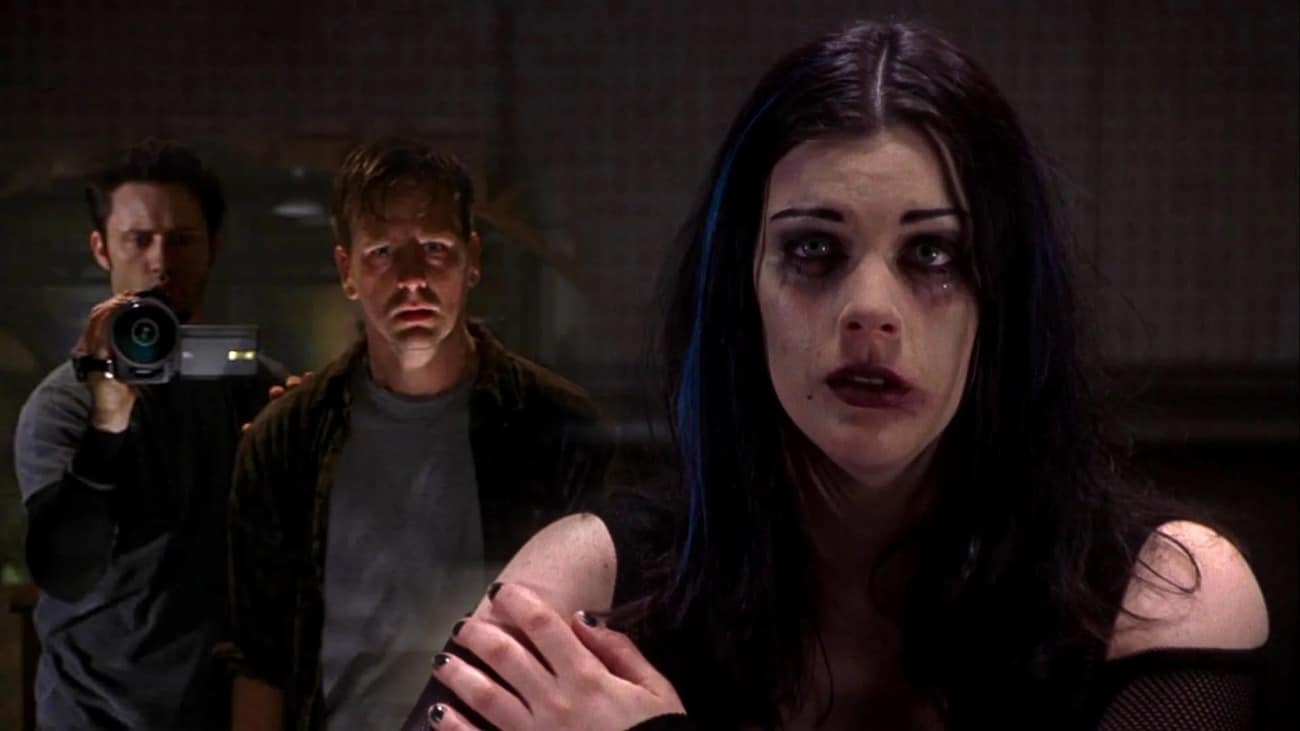
Sadly, the answer is no, but Book of Shadows doesn’t fail for lack of ambition. The idea, as most anyone who has taken an interest in the sequel knows by now, was not to follow up the first film’s events but treat that movie as a movie, and explore its effects on a group of devotees. To wit, five young people with varying degrees of interest in Blair Witch and its mythology camp out near what is supposedly the remains of the Rustin Parr house. They black out for part of the night, awakening the next morning to find their equipment trashed; they then repair to the converted warehouse one owns, where they start scanning through a bunch of videotapes they’ve shot for clues. Strange things appear on the video images, and soon before the characters’ eyes, and paranoia begins to seize the group. The questions soon become: Has a witchy presence followed them back, or has their own Blair Witch-mania taken over their psyches? And how much of what we the audience are watching can we trust as real?

Intriguing questions, but their effect is undercut by a number of factors. For one, the characters, as both written and performed, don’t engender sufficient sympathy to get us caught up in their plight. Secondly, in a major miscalculation, the film is littered with flash-forwards to a redneck sheriff (overacted by Lanny Flaherty) interrogating the survivors, which not only lets us know who makes it through the night but also too clearly signposts the story’s resolution. And despite his provocative overall theme, Berlinger stumbles with the horrific details, reaching into a grab bag of stock terror tropes like evil kids, shock cuts of graphic gore and flashbacks to the group’s leader (Jeffrey Donovan) thrashing and frothing in an asylum.
Another problem is that the film seems caught between expressing a truly independent vision and pandering to the marketplace. Berlinger has hired all the right craftspeople to give the movie a haunted atmosphere: cinematographer Nancy Schreiber, John Waters’ regular production designer Vince Peranio and composer Carter Burwell, whose music sometimes evokes an Italian horror feel without slavishly borrowing from Ennio Morricone or Goblin. On the other hand, too many scenes are presented in montages that seem MTV-trendy, and Burwell’s contributions are all but drowned out by an overabundance of Goth rock and heavy metal (Marilyn Manson, Rob Zombie, etc.) that seems to be here solely to fill a soundtrack album.
Finally, there’s that question of whether film truly lies. Certainly, audiences in this media-mad age have come to trust video as a “true” representation of events, while celluloid is a medium that’s open to manipulation. But when one sits down to watch a motion picture, one implicitly gives oneself over to the fiction it is creating, and accepts it as “real.” Thus, it was not enough for Berlinger to present what might be the characters’ imagined reality, and ask us to see it as possibly a fiction within a fiction; he needed to get inside the characters’ heads, to allow us to see through their eyes, as the original movie did. Book of Shadows, by both design and execution, keeps us too far removed from its protagonists, and with the exception of the closing moments (which, paradoxically, reveal the “truth”), we’re never scared enough, either of them or for them.