Last Updated on March 16, 2024 by Michael Gingold
Editor's Note: This was originally published for FANGORIA on April 10, 2007, and we're proud to share it as part of The Gingold Files.
The most shocking and harrowing moment in the teen thriller Disturbia actually occurs close to the very beginning of the film. Given that it has been showcased extensively in the movie’s advertising, it’s not really a spoiler to reveal that following a pastoral fishing/bonding episode between teenager Kale (Shia LaBeouf) and his father (Matt Craven)—the kind of sequence that, in a movie like this, you know can’t come to a good end—a violent accident steals Kale’s dad from him. The setpiece truly jolts not only due to director D.J. Caruso’s startling and visceral staging, but because it shatters an honest and realistic camaraderie that LaBeouf and Craven elicit in their brief minutes together. Thus it’s easy to understand how Kale becomes a sullen student who decks his Spanish teacher when the latter brings up the tragedy in class, which gets Kale sentenced to a summer of house arrest that propels Disturbia into the meat of its story.
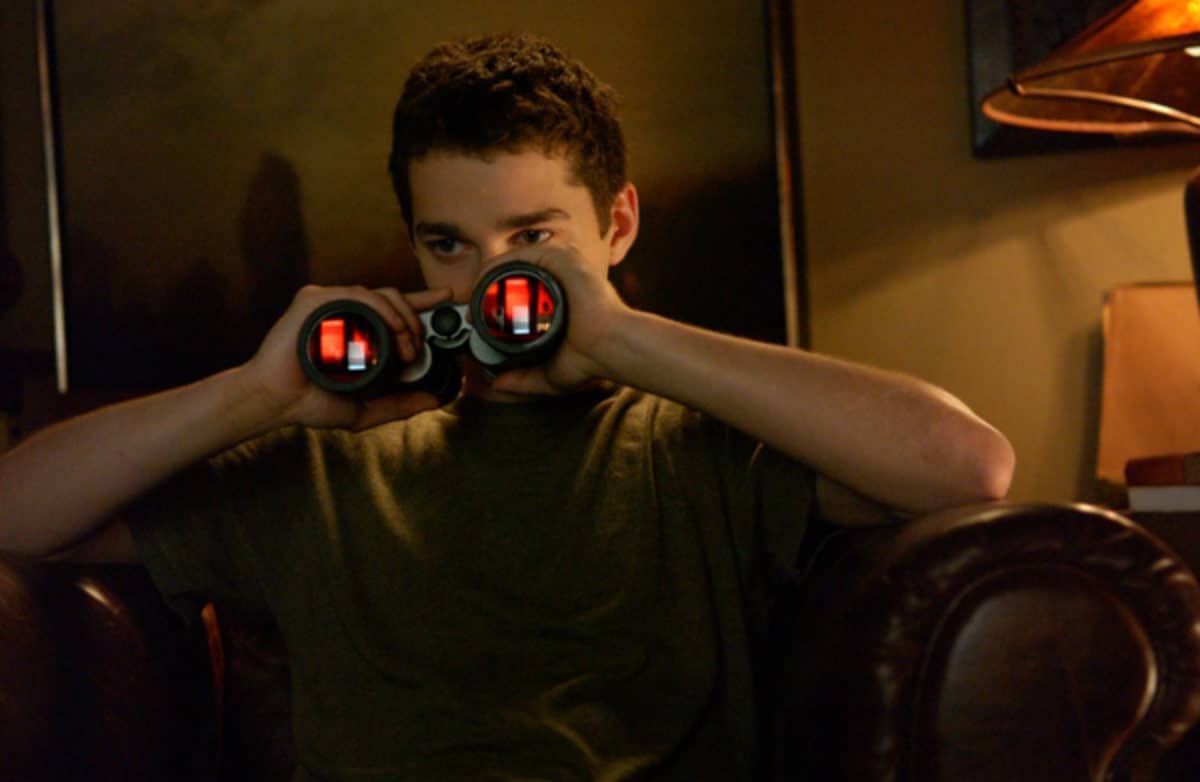
Clearly a modern gloss on Rear Window, Disturbia (scripted by Christopher Landon and Carl Ellsworth) distinguishes itself somewhat by having fun with aspects of current living and technology that never existed in Alfred Hitchcock’s time. For a youth of today, home confinement (effected by an ankle bracelet that alerts the cops if he strays beyond his yard) would hardly mean being cut off from either entertainment or communication—and thus Kale’s mother Julie (Carrie-Ann Moss) also relieves him of his computer and video-game privileges as part of his punishment. Turning to a lower-tech form of amusement, Kale begins checking out his neighbors through binoculars and, amongst assorted mini-scandals taking place in the surrounding homes, discovers the promises of both sex (in the person of lovely new girl-next-door Ashley, played by The Grudge 2’s Sarah Roemer) and violence (Mr. Turner, portrayed by David Morse, may be a serial slayer of young women).

Those, of course, are the twin lures of the genre within which Disturbia itself squarely resides—though the film, which never pushes either past the boundaries of a target-audience-friendly PG-13 rating, eschews any self-reflexive commentary along those lines. Mostly, it’s content to be a straightforward, slickly made youth suspenser that’s anchored by LaBeouf’s very fine and sympathetic performance, whether he’s enacting Kale’s contentious relationship with his mother, his burgeoning relationship with Ashley or his suspicions about Mr. Turner. For quite some time, Disturbia eschews gratuitous shock tactics and actually allows us to get to know its principals—a refreshing change from the usual teen-oriented genre fare. Genuine concern is built up for Kale as he vainly tries to convince the authority figures around him of what’s going on at Mr. Turner’s place, and enlists the help of Ashley and his goofball friend Ronnie (Aaron Yoo, as one of the few recent wacky screen sidekicks who’s actually likable) in gathering evidence.
What keeps Disturbia from working to its full potential is that there’s never any doubt placed in Kale’s or the audience’s mind that Mr. Turner is in fact a callous murderer. A blood-splattering shot about halfway through confirms for the viewer what Kale is already sure he knows, and without any mystery left to the story, the rest is left to click through the inevitable developments: Mr. Turner realizes that Kale is onto him, Kale realizes that Mr. Turner realizes he’s onto him, Mr. Turner threatens Kale’s friends and then Kale himself, etc. Under the circumstances, Morse doesn’t have to overstate or overplay his role’s villainy, and he uses his physical size and a matter-of-factly menacing tone to suggest a man practiced enough at both murder and covering it up to be certain he’ll be able to do it again. Repeatedly, perhaps.
Caruso whips up a nicely tense setpiece in which a camcorder-toting Ronnie invades Mr. Turner’s house while Kale watches on a home monitor, but things tip a little too far over the top in the final reels. The action here lurches into overstated mayhem that fudges the veneer of realism created by what has come before. Suddenly, we’re in movie-land as the characters’ actions veer well outside the bounds of plausibility, and Mr. Turner’s modest home is revealed to contain at least a pair of complete serial-killer habitats, including a watery pit of corpses in the basement (a setpiece suggested, Fango was told, by DreamWorks topper Steven Spielberg himself, apparently recalling how well it worked a generation ago in Poltergeist). The cast and the craftsmanship—most notably Rogier Stoffers’ sharp cinematography—insure that the movie never completely loses dramatic interest, but had it gone deeper, darker and/or smarter in the home stretch, Disturbia might have truly lived up to its title.