Last Updated on March 16, 2024 by Michael Gingold
Editor's Note: This was originally published for FANGORIA on April 17, 2006, and we're proud to share it as part of The Gingold Files.
Can a movie actually create sympathy for a 30something man who trolls the Internet for young teenage girls? And, perhaps just as much to the point, should it? Those questions are and will be begged by Hard Candy, a psychological squirmfest that juggles, for a while expertly, our sympathies for the species of predator and prey that have been getting quite a bit of attention in this Internet age.
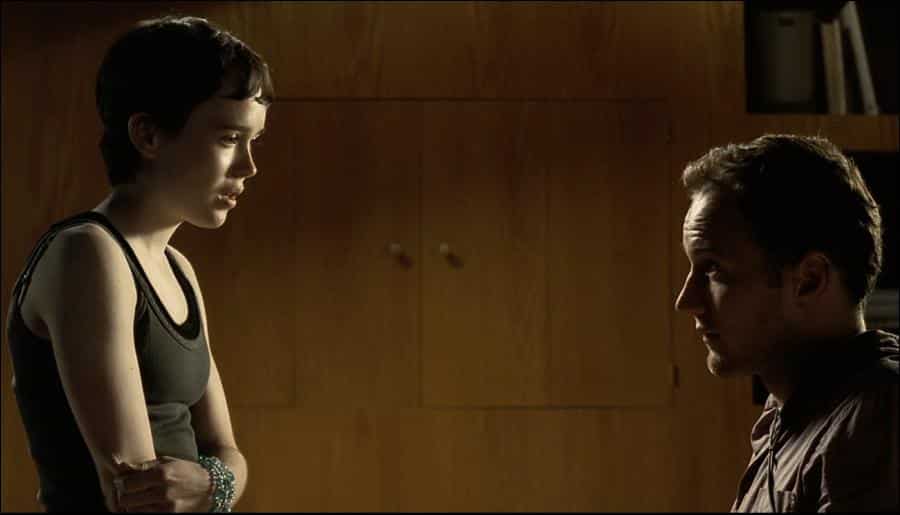
It is on-line where 32-year-old photographer Jeff (Patrick Wilson) first meets 14-year-old Hayley (Ellen Page), and the movie’s opening image is a computer screen bearing an instant-message conversation between the two. The next we see of them, they’re meeting face to face for the first time in a coffee shop, and here as on-line, their conversation is full of carefully coded seduction-and-flirtation dialogue, very well-crafted by playwright-turned-first-time-screenwriter Brian Nelson. They wind up back at Jeff’s place, where it turns out that he’s a photographer with a particular interest in young female models. All the warning signs are there, but just as Jeff seems poised to take their relationship beyond the conversational…
Well, anyone going to see this movie will know that Hayley turns the tables on Jeff, and it quickly becomes clear that she’s had this in mind from the beginning. I won’t reveal the particular punishment she has in store for him, but suffice to say that it’ll make every male watching the movie mighty uncomfortable. Director David Slade, also making his feature debut, tightens the screws expertly during this extended sequence, largely using suggestion (including a few half-clear glimpses of a video monitor, as Hayley tapes the act) to put the viewer through the wringer right along with Jeff. It reaches the point where Slade and Nelson clearly want the audience to ask themselves whether Jeff’s actions really warrant the payback Hayley is inflicting upon him.

This uneasy ambiguity makes Hard Candy creepily compelling for the first hour or so, with a pair of performances that are dead on target. Wilson’s smooth-talking is as persuasive as his suffering, and Page is a revelation. From the early scenes, in which Hayley projects a mix of innocence and curiosity, to the moments when she shows her true colors and beyond, she never misses an emotional beat. Some of her dialogue might have played as too calculated and wise-beyond-her-years coming from a less skilled actress, but Page makes it all of a piece with her ferociously precocious character. Hayley’s a girl with a mission, and Page makes you believe every minute of it.
Yet as more of her mission is revealed, the movie loses some of its emotional grip. Again, without giving too much away, it turns out that Hayley is pursuing a very specific agenda, and she becomes somehow less scary when she is thus transformed from a random avenging angel to someone pursuing a very particular grudge. Jeff is clearly not guiltless from the very beginning, but up until the third-act revelations, Hard Candy functions very well as a sort of metaphoric cautionary tale about what can happen when one pursues one’s dirty little obsessions. The more specific it gets, the less identifiable it becomes on this level, and thus less frightening.
There are many, of course, who will see Jeff as getting what he deserves from the beginning, and taken at face value, Hard Candy’s victim and villain are clearly demarcated from the start. But it’s the way in which Slade, Nelson and their two leads layer character and subtext to blur those boundaries that makes the movie scary and provocative for a good portion of its running time.