Last Updated on March 16, 2024 by Michael Gingold
Editor's Note: This was originally published for FANGORIA on April 3, 2011, and we're proud to share it as part of The Gingold Files.
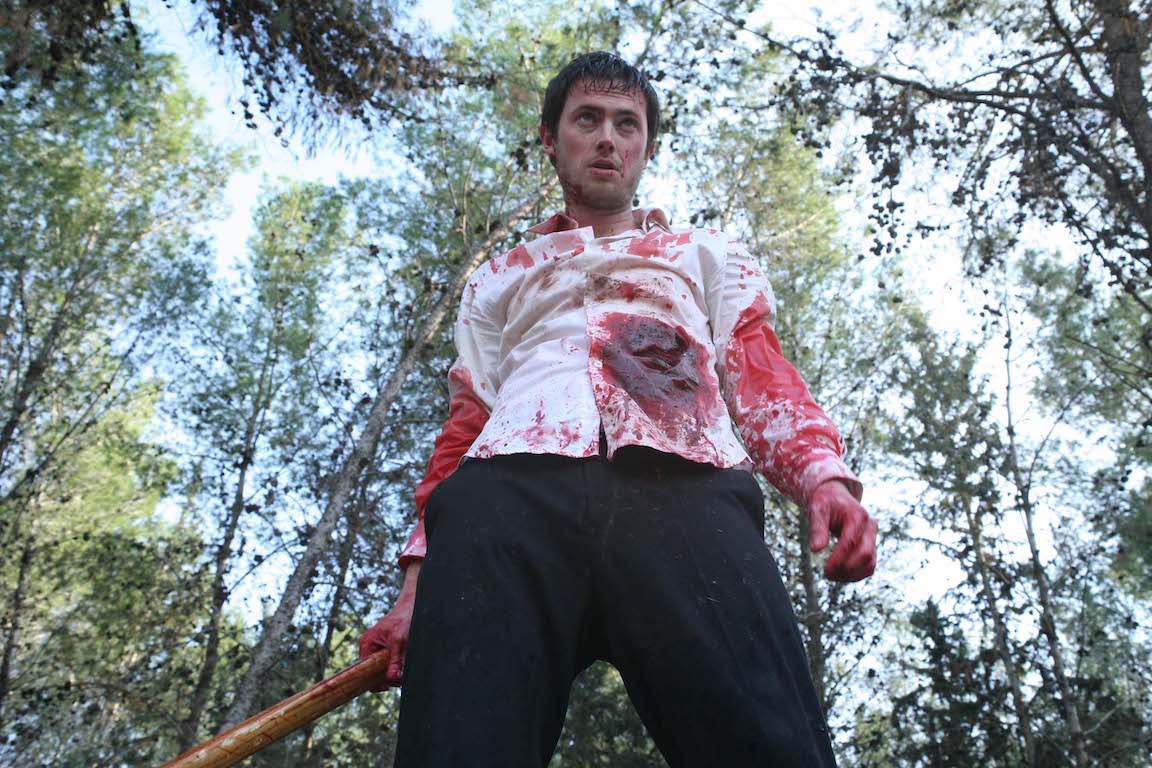
Here’s something you don’t see every day: a slasher movie from Israel. Here’s something else you don’t see every day: a slasher movie where the story is of equal if not greater interest than the slashings. And here’s something you should definitely see: Rabies (Kalevet), which is both of those things.
You might think there’s nothing more to be done by this point with the killer-in-the-woods subgenre, but Rabies (making its North American premiere later this month at New York City’s Tribeca Film Festival) does it, and does it well. Genre features from filmmaking industries taking their first steps into the field are sometimes simple regurgitations of already-established formulas, but not this time. Writer/director/editors Aharon Keshales and Navot Papushado have built a better body-count picture, taking the standards and expectations built up by decades of psycho-killer flicks and turning them on their ears, with clever, chilling, blackly comic and resonant results.
Rabies (the title, by the way, is more metaphorical than descriptive; there’s no “infected” action here, though a dog does figure into the storyline) starts off with familiar ingredients that lull you into thinking you’re about to see more of the same-old same-old. After a prologue with a couple in trouble, we join a quartet of teens on their way to a tennis tournament: preppie Mikey (Ran Danker) and his sex-crazed buddy Pini (Ofer Schechter), and two gal pals, outspoken-and-thus-possibly-lesbian Adi (Ania Bukstein) and the more timid Shir (Yael Grobglas). It goes without saying that their drive gets interrupted, and they wind up stranded and separated in the midst of a woodsy “fox preserve.” Also figuring into the ensuing action are a brother and sister, Ofer (Henry David) and Tali (Liat Harlev), on the run from…something; park ranger Menashe (Menashe Noy) and his girlfriend Rona (Efrat Boimold); and a couple of cops, Yuval (Danny Geva) and Danny (Lior Ashkenazi). Oh, and a seriously disturbed guy (Yaron Motola) who has a knife and, as he demonstrates early on, is not afraid to use it. “What a screwed-up day,” Adi eventually says, and she’s not kidding.

We get a pretty good look at that blade-bearing villain fairly quickly, so building a whodunit is not one of Keshales and Papushado’s concerns. Rather, they tease and surprise the audience via the actions of the would-be victims as the tension mounts, and Rabies not only defines its characters but builds its drama and suspense out of how they react to their life-threatening circumstances. Some of these reactions do fall back into the familiar—it’s not a big surprise when Yuval turns out to be a misogynist who uses his authority as an excuse for abusive behavior—but the filmmaking duo also have fun with the conventions of the mad-killer-in-an-isolated-locale genre. Cell phones work—up to a point—and one of the vehicles involved has trouble starting well before that becomes a dangerous disadvantage.
There’s more dark humor involved in the threats to the dwindling ensemble—beyond the handheld weapons, there are also bear traps and even unexploded mines to contend with—and the way the two filmmakers structure some of their setpieces. At several moments, they cut away right before the moment of a crucial revelation or action, then return just after an unexpected result has occurred. Which is not to say they blunt their punchlines; once the action heats up, heads and bodies are violated and blood is splattered with abandon. The filmmakers take their time getting to this point, which may frustrate more impatient gorehounds, yet the time they take letting us get to know all the players means that their eventual deaths have all the more impact. For all the over-the-top episodes of violence, Rabies also takes loss of life seriously when it counts, and a couple of moments late in the game qualify as honestly tragic.
There’s even something of a theme running through the proceedings, involving relationships (mostly romantic but also familial) and how they motivate those involved in the midst of this murderous scenario. Yet Rabies never pauses to get “deep” or introspective at the expense of the action, nor does the presence of those latent mines suggest that any of this is to be read politically; Keshales and Papushado are making a genre entertainment first and foremost, and keep their eyes on that ball throughout. As first-time filmmakers, they happily resist show-offy camerawork, shooting and cutting the mayhem for emotional impact rather than stylistic flash—though the movie does look great, with lots of moody sunlight-through-the-trees cinematography by Guy Raz (also a feature first-timer, making an impressive debut). This is more than just a calling-card movie for the up-and-coming duo; it’s a solid work of psycho cinema, one that demonstrates not only their enthusiasm for the form but an ambition—and ability—to do different and exciting things with it.