Last Updated on February 18, 2025 by Angel Melanson
Can a movie be bleak but also beautiful? Jayro Bustamante’s Rita proves the answer is yes.
The Guatemalan filmmaker’s fourth feature is, like his 2019 film La Llorona, only slightly connected to the supernatural. Similar to how the earlier movie’s inclusion of folk horror tropes revealed state crimes against indigenous people, Rita exposes a cycle of repression and demonization against young victims of sexual abuse that is ongoing in Bustamante’s native country. While the film thankfully implies more than it shows, the ramifications are no less horrifying. The worst of it comes as the credits roll, when you learn how much of the film is based on a specific, true tragedy.
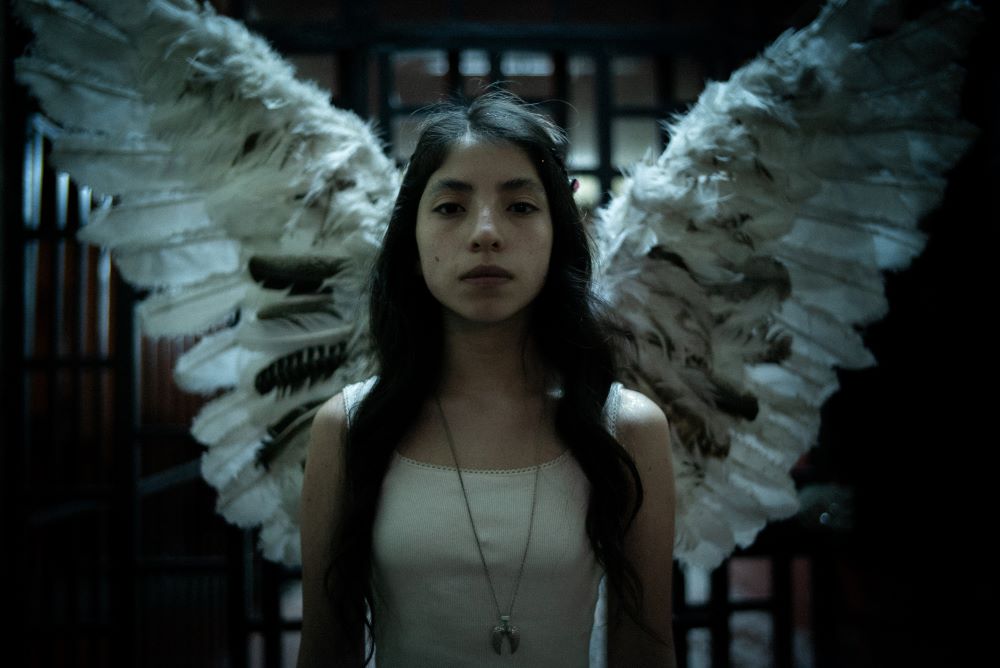
An opening voiceover warns us not to believe in fairy tales, despite imagery that dips its toe in and out of fantasy. Our 13-year-old heroine Rita (Giuliana Santa Cruz), en route to a care facility for orphaned or abandoned girls she calls a “fortress,” sees what look like sprites running through the woods and wills-o’-the-wisp emerging from darkened doorways. As she’s shown to her dormitory, the ceiling reveals dark, thunderous clouds as she is brutally hazed by other girls and told to put her wings on. Everyone else appears as an angel, and while it’s clearly just an in-world prop, it’s impossible to know how much of what we’re seeing is real.
This disorientation is a great way to get us in the head of a frightened newcomer unsure of whom, if anyone, she can trust. In time, though, she (and we) find our footing. In addition to the angels there are princesses, fairies, some wild wolves and “stars” — snickering, misty, floating creatures who we’re told are spirits of the recently deceased. The special effects, however, are kept to a minimum. The various groups are primarily determined by costumes that feel yanked from a school play. This is in no way a disparagement — the “lived in” look of Rita is one of its strongest points.
The other thing that grabs you are the performances. Rita and the other girls actually look to be 13 or so (except for their leader, “La Terca,” who looks maybe 17), so when the guards treat them cruelly you are instantly sympathetic. At first their acts of rebellion are playful, like a food fight. When they are locked up in their dorm for 24 hours and not allowed to leave, even to relieve themselves, they collect their liquid waste in pots with the intention of spilling it down the hallway while chanting “revolutionary pee!!”
The rebellions and reprisals soon get more serious, and Rita is too sharp to play along when asked to pose for alluring iPhone pics near a ring light to “help with her trial.” She’s at the facility in the first place because she refused to return home to an abusive father (and cowed mother) following her second abortion. Her sole interest is in pressing charges against her father to rescue her younger sister. Sadly, not only is there no system in place to help, the adults in power are roadblocks. Well, worse than roadblocks; they clearly mean to do her more harm.

Damn, this all sounds depressing as all hell, doesn’t it? But Bustamante’s trick is to lean into the fable aspects, a mix of folktales and Peter Pan and even a smidge of the X-Men. There’s even some kitsch with the uniforms of the guards; they have a V (the beloved ’80 sci-fi series) quality mixed with the sentries from Eminiar VII on the original Star Trek. This fun aspect is tempered, however, when one of these guys tries to rape a 13-year-old. Bustamante doesn’t push this into the obscene, but even with dignified framing and cuts, this is a very difficult movie to watch.
This is risky material, especially with the magical realism element, and not every filmmaker can make it land. Bustamante, however, comes to it in good faith and has the goods. His first movie Ixcanul, about indigenous workers on a coffee plantation, was a rich social realist drama that got in deep with the customs of that community. Blending in supernatural elements, as he does here and in La Llorona, is a great step not only for him to widen his audience, but to get creative in the storytelling.
Not every sequence works, however. There are some “visions” Rita has that feel pretty rote, especially compared to how singular the rest of the movie is. It almost feels like a producer said to him “gee, you gotta sprinkle in some shuddering images, flashing lights and wacky sounds on the soundtrack every X amount of minutes.” It doesn’t detract too much, but it certainly doesn’t add, plus you’ve seen it a hundred times before. In terms of gore, there’s not too much. The horror aspects are more in the human behavior — and that, sadly, is both on screen and off.