Last Updated on March 16, 2024 by Michael Gingold
Editor's Note: This was originally published for FANGORIA on June 2, 2010, and we're proud to share it as part of The Gingold Files.
—
Some of the promotional materials for Splice have been selling it as a sex-monster romp in the Species vein, and that does the movie a disservice. Director/co-writer Vincenzo Natali aims for something more ambitious here, a variation on the Frankenstein theme—he has even named his scientist protagonists Clive and Elsa.
Played by Adrien Brody and Sarah Polley, they live and work together and generally interact with the familiarity of a married couple, even though there are no rings or other physical evidence that they’re actually hitched. Elsa is definitely interested in creating a child with Clive—only she winds up conceiving it in the lab, not the bedroom. Instead of a bolt of lightning, gene-splicing is the tool the couple use to create life—they’ve specialized in whipping up hybrid animals for medical purposes—but the big pharma firm that backs their experiments balks at their request for permission to add human material to their DNA cocktail. But Elsa—whose interest in such an offspring, we quickly discern, is more maternal than medicinal—makes the combo in secret, and by the time Clive realizes what she’s done, the evidence is literally staring him in the face.
Elsa’s “monster” is eventually named Dren; that’s “nerd” spelled backwards, and N.E.R.D. is also the acronym of Clive and Elsa’s company, an example of the sneaky humor peppered through Natali, Antoinette Terry Bryant and Doug Taylor’s screenplay. Mostly, though, it’s played straight, and with more depth than one often finds in studio-released techno-horror flicks. (No doubt it helped that Splice was produced independently—by Guillermo del Toro, among others—and subsequently picked up for wide U.S. release by Dark Castle Entertainment and Warner Bros.) Brody and Polley, both in top form, have a number of fine, subtle moments between them—in particular, following a pivotal setpiece I’ll refer to only as the bath scene.
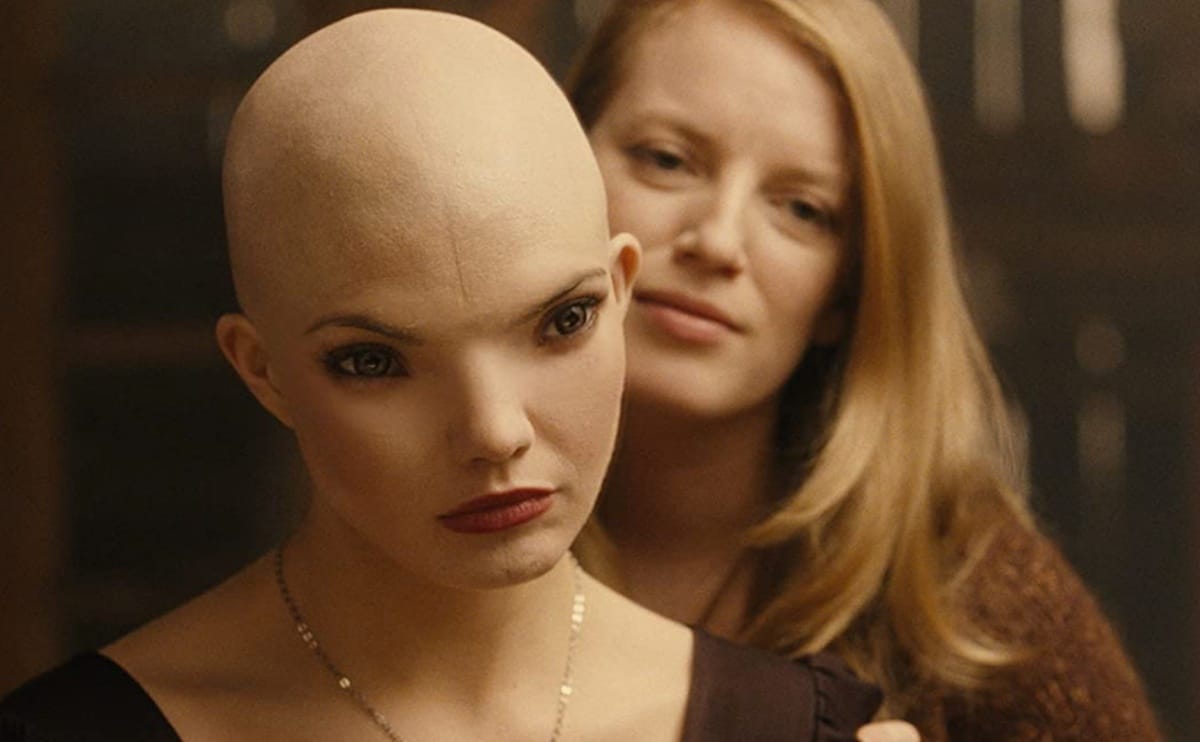
The comfortable, lived-in and ultimately strained chemistry between the two is matched by their completely convincing interplay with the ever-evolving Dren, brought to life via seamless CGI by C.O.R.E. Digital Pictures, makeup FX by Gregory Nicotero and Howard Berger and, as she matures into “adolescence,” a terrific wordless performance by stunning model/singer Delphine Chaneac. It is when Dren reaches this stage that her relationships with her “parents” begin to change. At first the picture of a loving mother—consciously reacting against what was evidently an unhappy childhood with her own mom—Elsa reacts badly when her progeny starts rebelling. Conversely, Clive can’t help but start noticing what a remarkable physical specimen Dren has become—and her own sexual curiosity might lead him to ignore her more animalistic physical attributes…
As you can tell, there’s a heavy streak of Freudianism running through Splice. There’s also a distinct, if hard to define, Canadian veneer to the picture that goes beyond a few obvious echoes of David Cronenberg’s work (David Hewlett, as Clive and Elsa’s contact at the pharmaceutical company, even seems styled to resemble John Getz’s Stathis Borans from Cronenberg’s The Fly). Shot in and around Toronto, the movie bears a stark, chilly atmosphere—cinematographer Tetsuo Nagata, production designer Todd Cherniawsky and composer Cyrille Aufort all work in perfect concert to this end—punctuated by grisly bits of body horror and all-out splatter.
While some of these graphic outbursts—most notably a scientific demonstration that goes awry in spectacular, crimson-drenched fashion—deliver the goods, Splice is at its weakest when it fully embraces its horror side in the last 20 minutes or so, descending into the kind of monster-on-the-loose clichés that the movie, up till then, has gracefully avoided. After any number of evocative scenes of character-based tension and terror, it’s kinda sad to see Natali resort to stuff like one character fumbling for a dropped flashlight in dark woods while Dren waits to strike just offscreen. And given a final physiological change Dren undergoes, Natali misses the chance to give the story one more perverse twist suggested by a throwaway line of dialogue Clive delivers earlier in the film.
But then, one has to expect a few glitches when a filmmaker splices together as many concerns as Natali does here. And his combination of horror, science fiction, twisted family drama and one protagonist struggling with the echoes of her past is an experiment that, in the end, can be deemed a success.