Last Updated on May 27, 2026 by Amber T
Her debut film Relic announced Natalie Erika James as a genre force to be reckoned with. Genuinely scary, emotionally gripping, and anchored by top-notch performances, the film remains one of the best horror films of the decade.
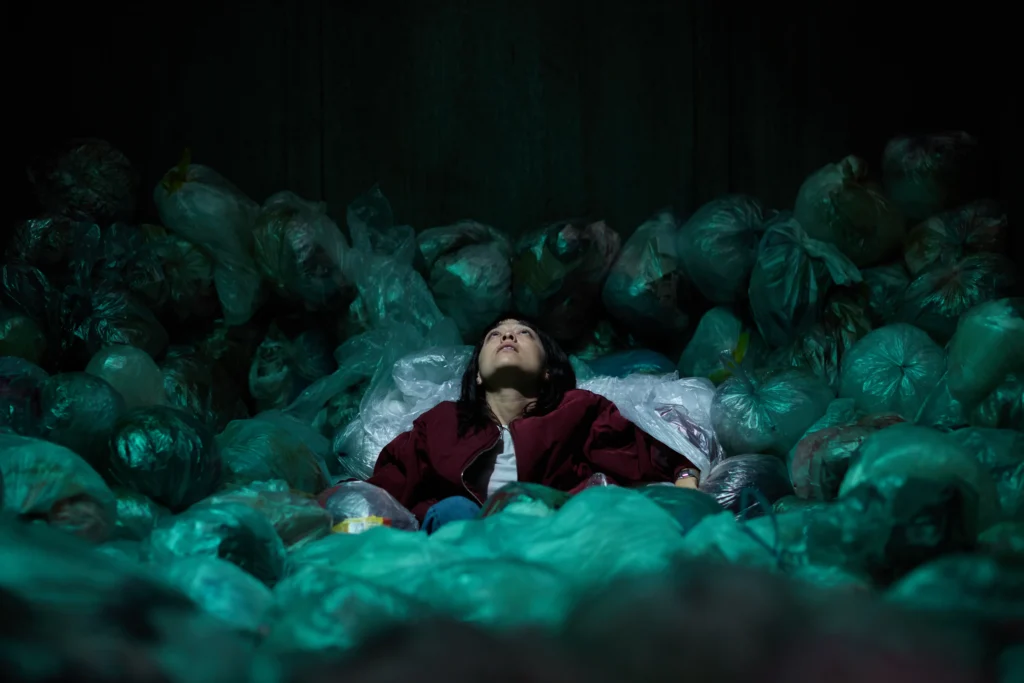
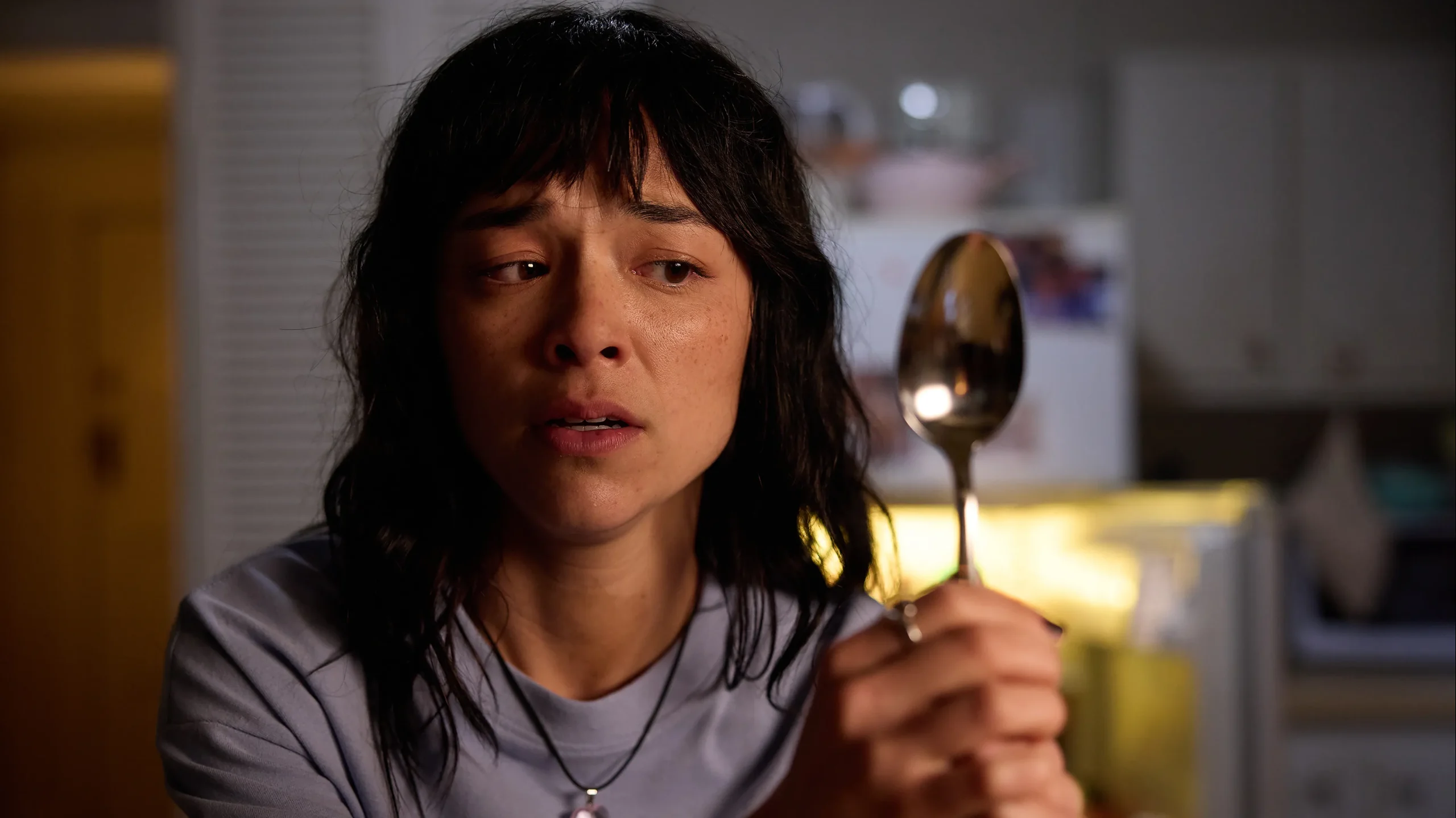
After tackling the Rosemary’s Baby prequel Apartment 7A for Paramount Plus (in which Weapons’ Julia Garner gives full life to a minor character from the 1968 classic), James is back in original territory with Saccharine. Midori Francis stars as Hana, a medical student struggling with food addiction, a dysfunctional set of parents, and complicated romantic feelings toward her trainer, while also attempting to get through medical school. After stumbling onto an underground weight loss craze — eating human ashes — Hana begins helping herself to bits of her lab group’s cadaver. Weight loss ensues… but so too does the angry, insatiably ravenous ghost of the donor.
As James states in Saccharine’s press materials, “This film is not about judging bodies or appearances. It’s about examining the inner forces — shame, pain, avoidance — that drive compulsive behavior, and the societal and personal pressures that deepen them.”
James talked to FANGORIA about the film’s tricky themes, hungry ghosts, and the wave of “self-image” horror she’s found herself part of.
FANGORIA: Don’t judge me for this — decades ago, I used to smoke weed with a friend of mine, this Buddhist bodybuilder. We would get super high, hit a diner and absolutely indulge ourselves. And he once told me with a completely straight face that he believed that, when he was high, his munchies were him channeling spirits from another realm and, as he saw it, that he was honored to indulge in that craving on their behalf.
Natalie Erika James: So, the notion of the Hungry Ghost in Buddhism is the idea that someone who’s died in a very extreme circumstance or in extreme loneliness or anger or emotion, or is neglected by their families. They live on in the afterlife, but they’re cursed with an insatiable thirst or hunger. And so, the film definitely draws on that mythology peripherally, but obviously with this ancestor worship, that’s all tied into that.
But I think the idea that something like an addiction or a compulsion is so much about things feeling outside of your control, and maybe that it’s coming from a different place or there’s some power over you, that feels supernatural, right? And that’s where I guess the idea came from that Hana’s eating would be linked to this supernatural force and there’s a kind of a power that this force has over her, and she’s in the grips of that.
As you did in Relic, you’re juxtaposing something very fantastical, very supernatural with some very authentic emotions. You’ve talked in our magazine about Relic’s themes of elder care and grief. Where did the authenticity come from here? It’s a terrifying ghost setup, but the core themes of weight fixation, disordered eating… those are all very real and relatable.
It has really come from a personal place. And specifically, I grew up with parents who really sat on opposite ends of the spectrum in terms of their relationship to food and eating and their bodies. My dad really had this very long struggle with food addiction for decades. And almost in reaction to that, my mom was the opposite. She was very strict with her health and her diet. But I think diet culture so permeates every corner of our society, it’s really hard to escape. So, even though I had a very extreme version of that at home, I feel like most people can relate to some degree to what the film’s exploring.
Saccharine is really the film I wish I’d watched growing up in that, while I was developing these very warped ideas about body image and body dysmorphia and all that kind of thing. A lot of writing this film has been very healing in that way and has come from a lot of recovery from those inherited beliefs.
And the way that you articulate it feels so lived, it’s coming from a real place. As someone who has struggled with some manner of food addiction for most of my adult life, I was really taken with the way you were able to portray the disgust and the shame of binge-eating, but also there were moments that were really euphoric that also rang true.
I think that’s the emotional truth of disordered eating in a way. There is that duality of there’s this sense that it’s too much, but it’s also never enough, you know? And so, that drive is something that we try to convey through that euphoria. And it’s also… I guess it’s desire, right? Desire for food, desire for Alanya, the love interest. So, that plays out in this, it’s all part of the high that Hana experiences, and she does go through these extreme highs and sugar crashes. And yeah, I think it’s important to convey both sides of that.
So there are these autobiographical elements, but at same time the film needs Hana to have these scientific detective skills to navigate this thing once she’s in the throes of it. Those skills mean she would almost have to be a medical student or a doctor. What was the chicken/egg of developing that part of her character, of setting it in the medical world?
I was really obsessed with the idea of the body and its inherent worth. And obviously there’s your own body, but then I wanted to explore that through the idea of a cadaver because the value of a cadaver is… I guess at the basis level, we’re all just skin and bones, right? And these bodies teach the next generation of medical doctors. And so, I was interested in the value in that as well, and that being a very sacred thing. So she always was a medical student because I knew I always wanted to have her examining the human body, and that was a theme that had been there from the start.
But in an early draft, I had her steal an urn from someone; she didn’t actually steal the bones from school because I was like, ‘Oh, I don’t know if this is realistic.’ Turns out, a lot of body parts are stolen from medical schools! [laughs] So, yeah, I weaved it in. And it’s nicer to understand who that character is, to know the ghost who’s haunting her as an actual person, not some anonymous donor.
And that really is what made that scene showing the memorial service for the donors land so emotionally for me. Hana’s cadaver is a piece of meat on a slab, but she still gets an emotional arc. I found that so novel.
It was so important to me not to make her this faceless person, because she becomes, via the hungry ghost mythology, the antagonist. But actually, a lot of that is so much of Hana’s projection of what she’s going through herself. So, it was important to really humanize her as well.
People are going to fling the word ‘Cronenbergian’ around here and, sure. But one thing I always think about when I think of Cronenberg, which nobody really talks about, is his visual attention to architecture; buildings and spaces. Between Relic, Apartment 7A and this one, I see that same level of attention in your work. It’s rare in contemporary horror, because filmmakers often don’t have a lot of resources — ‘this is the room we got, there’s three people in our room, and we’ll figure it out.’ But you’ve got such a command of your architectural spaces.
In this film in particular, we were always really aware of Hana within the spaces and how that shifts, and then things like lens choices in order to reflect a claustrophobia or an evolution in the way that she’s perceived on camera as her perception of herself starts to change. So, it was definitely something that we mapped in the making of it.
I think as well, her apartment is very womb-like in the way that it almost mirrors her internal state. In the euphoric highs, there’s a lot of this freewheeling messiness that occurs and everything’s very textural, whereas it’s paired with this very ordered side of her as well, which her mother obviously is the driving force of. I think our production designer, Josie Wagstaff, did an incredible job conveying those two sides of her.
I want to talk about the prosthetics and the bodysuits, because I think we’re in a really reductive period in terms of how audiences receive that sort of thing, and there’s this mindset of ‘bodysuit = bad’ that’s going to feed some hot takes about this aspect of the film. Obviously with Hana, she’s on a journey and that has to be part of that process.
With Hana, her transformation happens within a seven-week shoot. So, it’s not really feasible to expect an actor to do that, nor is it healthy. It’s like the antithesis of what the film is saying. But I get it; I feel like there’s such a long history of bodysuits being used almost as punchlines for comedy, right? And the character in that state is always ridiculed, or there’s a grotesqueness to the way that they’re portrayed. It’s absolutely something we discussed in length and that we were really conscious and mindful of.
Hana’s transformation requires it, but I found it curious that you also went that way with Hana’s dad. He’s in the scenes he’s in; there’s no transformation needed.
With Travis, Hana’s dad, we certainly initially set out to cast someone who was more similar to the size of the character, but ultimately, we ended up going with Rob Taylor because we just really did think he was the best for the role. And yeah, I imagine, of course, some people will be critical of that, but I think what he brought to it was worth that choice.
Maybe I’m reading too much into it, but I have relatives who’ve had weight issues. And I feel like burying Hana’s dad under that makeup was almost… Hana had such disappointment in him, and his health was such a source of friction for them that, to me, seeing him in the bodysuit was like, does Hana feel like she’s seeing him in a bodysuit, too? ‘You’re in there somewhere, Dad, but why are you under all that?’ And I think that was cool.
Maybe I’ll steal that, Phil. [laughs]
It’s yours. Finesse it, though. I know we’re just on a first draft here. The film feels like part of a self-image moment happening right now in horror. Of course, The Substance is going to come up for people. I don’t know if you saw The Ugly Stepsister.
Loved The Ugly Stepsister. That was great.
Right? I’m curious if you have theories about why that’s a moment right now, or your place in it.
I feel like maybe it’s something to do with social media and how much we are exposed to certain images, and how often we’re exposed to certain images. I think we are pattern-seeking creatures. If you’re constantly looking at images of a certain body type, then you of course look at your own and find something wrong, right? So, I think maybe this moment must be borne out of that phenomenon where someone who feels perfectly fine starts scrolling and then you find flaws in yourself, and we’re all really susceptible to all of that.
And I love that unlike those films, when Hana gets on the other side of her transformation, it’s not exactly a glow-up. She looks happier before the transformation, and she looks like something’s sucking the life out of her when she’s reached her goal.
Yes. And actually reaching her goal drives a wedge between her and her object of desire, right? So, it has the opposite effect. Someone’s internal struggle doesn’t necessarily translate to how they look at all, right? This film for me is really much more about that internal journey of Hana going from self-destruction to self-compassion, and how she looks is irrelevant. You can be unhappy at any size or you can be happy at any size. Your worth isn’t related to that.