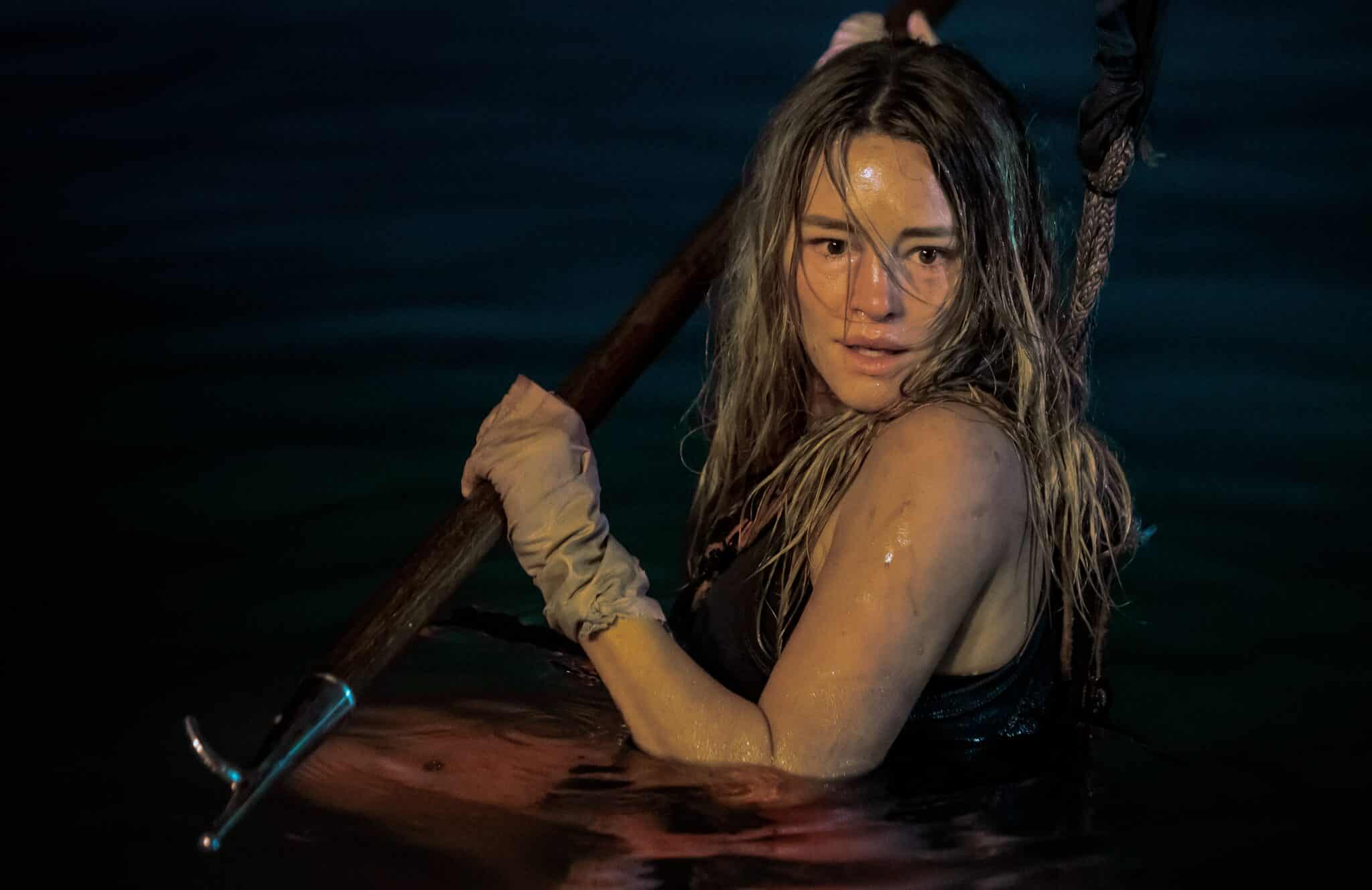
The third feature from Australian frightmaster Sean Byrne (The Loved Ones, The Devil's Candy), Dangerous Animals is a shark movie built to remind us that man is crueler than nature could ever be. The film stars Yellowstone's Hassie Harrison as Zephyr, a surfer with a dark past who runs afoul of a shark-obsessed serial killer named Tucker (Jai Courtney), who abducts her in order to ritualistically feed her to his favorite apex predator.
The film also stars up-and-comer Josh Heuston as Zephyr's romantic interest, Moses, who she'll need to lean on if she wants to escape Tucker's floating death trap with her life. FANGORIA sat down with the main cast and director to discuss the difficulties of shooting on open water, the importance of thematically relevant needle drops, and how Dangerous Animals isn't your grandaddy's shark attack movie.
Jai, this is such a showcase for you. Were you at all daunted by taking on this role?
Jai Courtney: Daunted? I was daunted by shooting a movie almost entirely on a boat out at sea, that's for sure. But the role felt like a lot of fun for me on the page. When I read the script, I saw the potential to do something very playful, and he was a character that I, aside from the serial killer part, felt like I knew.
He reminded me of that cab driver who doesn't shut up, the guy in the bar that you sit next to who won't stop talking about politics, [or] your uncle who's an expert on all things. There was just kind of an archetype there that I wanted to bring to life, and Nick Lepard, our writer, gave me such great material to work with. I was just excited to take the plunge, honestly!

Was Tucker all on the page? Or were you able to bring a bit of your own spin to him?
JC: I think with a role like Tucker, you need to inject it with a certain amount of spontaneity, and I got to jump in and have fun with it. Sean and I had a great collaboration from the outset: he knew to kind of just let me do what I wanted and he'd take care of the fine tuning of it. There was just a lot of trust both ways, and I knew I had to go big in order for it to work. That was my instinct on it.
Obviously, Tucker presents a threat for the whole film but I always feel like there's a responsibility to have fun with it and hope that audiences do the same because it gives it more dimension. I want people to feel somewhat conflicted. I mean, if they're rooting for him at some point in the movie, it's tough, but I'm definitely doing my job.
The character is very fun, but there's a dark determination to what he's doing and some really striking quieter moments. What is the emotional core of the character for you and how did you find it?
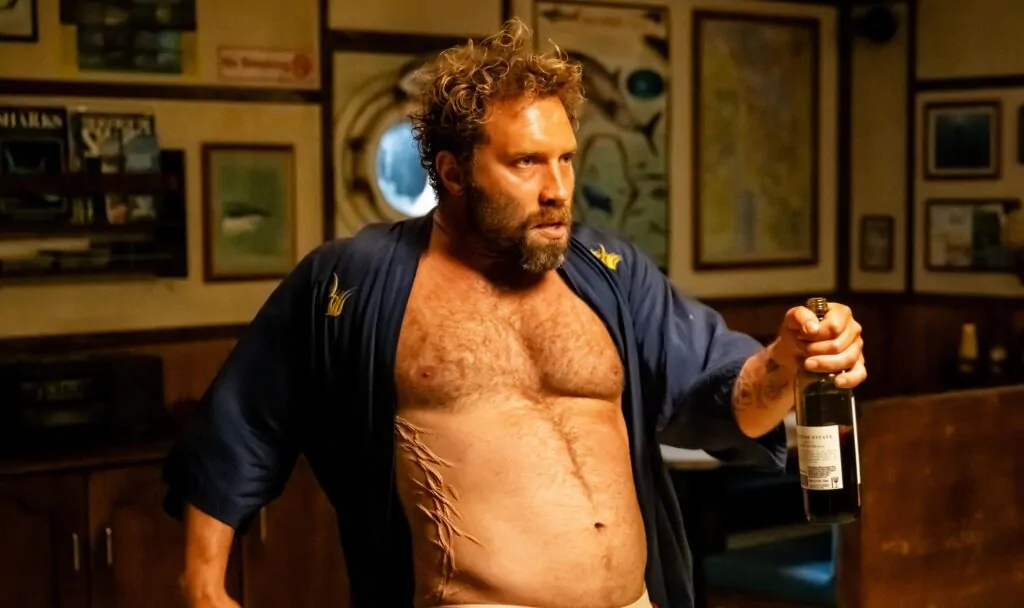
JC: I think it's all got to come from a place of vulnerability and finding his wound, you know? It's touched on earlier in the film that he was the victim of a shark attack in his youth, and I feel that we get a slight glimpse into the fact that he was probably spending a lot of time on his own as a kid and maybe didn't have people looking out for him.
You get those clues, but I get to make some decisions around that stuff about who that kid was and who his family was or who they weren't and who was around and who was setting an example for him. Was he being nurtured? Was he not? How did he fill those gaps in his life as he grew up? How did he alienate himself from society?
And then it kind of grows into a commitment to something where he feels like he's on this crusade. I think it's pointless to play something with a wash of evil: it has to come from a tender place and something that he hasn't healed within himself. It's deranged, but I think he truly believes he's connected to this apex predator and that it's his role to help restore order within his own kind of controlled animal kingdom.
What do you think is his ultimate tragic flaw as a character?
JC: He feels connected to the beast, but that's not like really reciprocal. Sharks are seen in most films as these kind of indiscriminate killers, and in this we examine the fact that it's not their fault. We're operating in their environment. But I think he puts himself on this kind of pedestal, [and believes he has] a language with them that others may not. And it's not necessarily true.
You mentioned the difficulties of shooting on the open sea. What was the biggest challenge for you on this shoot?
JC: I was honestly terrified that I would spend six weeks with incurable seasickness. I've been on boats before, and I don't know if you've ever been seasick, but it's one of the most horrific feelings on earth because you can't get to land, which is exactly what your body needs. It's just waves of nausea, and I was like, man, I'm taking this on, and it could be hell. But I managed to escape that.
It did present some interesting challenges because we were shooting in open water where there is marine life. I don't know if I've been getting in trouble for saying this or not, but we had a shark incident on the film, which was quite ironic and kind of wild, but things got a little too close for comfort at one point.
No one got hurt, but a shark did turn up one day, and that was enough to change the way we were shooting those sequences. One of our safety divers was visited by a bull shark so we had to create a much larger marine life barrier so we could get in the water and hopefully have no more encounters. But it gave [the shoot] a certain life. We were like, like, “Holy shit.” I mean, you know they're out there, but you kind of hope that by the numbers, by the odds, you won't actually have any incidents. But we did!
What do you hope viewers take away from the film?
JC: I hope they're just wildly entertained. I hope it scares the shit out of them, and I hope they have a lot of fun at the same time.
Josh and Hassie, this is your first time working in horror. Are you fans of the genre?
Josh Heuston: Yeah, I love the genre. I love getting scared, but I feel like I need someone to watch it with, otherwise I freak out!
Hassie Harrison: Yeah, I love the thrill of it for sure, but I get a little scared! I think that Dangerous Animals is great because there's comedic relief, there's a love story…it kind of hits all these different elements. It's a survival thriller.
Hassie, you're so damn scrappy in this and your character is really put through the wringer. Was this a challenging shoot for you?
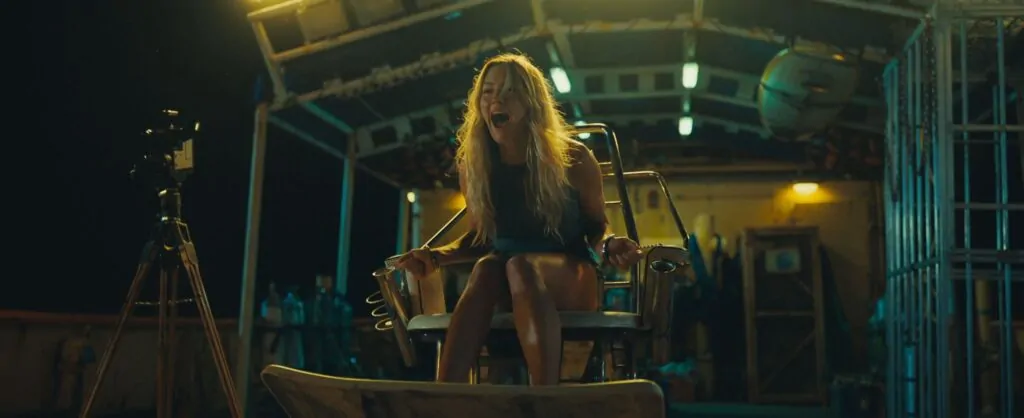
HH: I mean, physically, I had to be in the water, it was cold, it was winter, I'm in shorts and a T-shirt. But [overall] it was easy! All my co-stars are so cool and fun, and we had such a fun time doing it. I think all the places that required me to be scrappy only served the performance.
How about you, Josh?
JH: It was quite physically demanding being on that harness and stuff. [But] we were super supported the entire time, so you're kind of free to go to those places and try and push the envelope. It was definitely the most stunt work I've done before. We all learned a lot, and Jai's got an insane amount of experience in fight choreography and all that sort of stuff.
HH: He's basically a stuntman. There's a a fight scene that he and I have where I'm hitting him with a frying pan. He sold it so well I thought that I had knocked him out. I was like, “Oh, my God!” and the fall and everything…he makes it fun to do the stunt scenes!
JH: Yeah, 100%.
He talked a bit about seasickness. Did either of you struggle with that?
JH: I was okay, personally, thankfully.
HH: I have pretty good sea legs. Yeah, but there were days, like after a long day at sea, you come home, and you feel like you're still rocking, you know?
Are either of you afraid of sharks, and did Dangerous Animals challenge your preconceived notions of them?
JH: Growing up in Australia, you're very aware that they're there, and you try not to think about it because we're surrounded by ocean. It's a big part of Australian culture, but I think I'm as afraid of them as any average person would be [laughs].
HH: You have to compartmentalize, for sure. Anybody who enjoys the ocean, which I do, you just put that thought somewhere else. I love sharks, and I live for Shark Week. It's been a big part of my life since I was a young girl. You have a reverence for them.
Your chemistry together is really fantastic and adds a lot of heart and emotional investment to the film. How do you go about building that relationship?
HH: I think it was pretty easy. We filmed all the love story stuff the first week of shooting, so, we just jumped right into it. I call him Angel Boy. He's the sweetest guy in the world and makes it so fun and easy. It's one of those things you didn't have to fake, thank goodness!
JH: It was super easy, and it came organically. Even from our chemistry read on Zoom, I dropped a line in the audition, and Hassie pretended that it was her fault. So, from day one, we kind of had each other's back.
HH: I've been that actor a million times over, where it's like you're so nervous, and it is harder to create chemistry via Zoom on the other side of the world. But it all worked out!
What did Sean Byrne bring to the table that's different than other directors you've worked with?
JH: Sean knows everything about horror. It's his bread and butter. You could reference almost any horror film, and he knows every single beat and every single moment in it. He storyboards the entire film. Every single scene and moment, he's already hand drawn how he visualizes it. You go in knowing exactly what he wants, and then you build from there. It was nice because I hadn't worked with someone that has built it out visually like that before.
HH: I think the reason Sean was in Directors' Fortnight, and we got to premiere the movie at Cannes, is his love and passion for all movies and all genres. He's one of those people that's so inspiring, who makes you realize, God, I need to watch more movies. You know what I mean? He loves it, and you feel it in his work. The day I landed in Australia, we sat down and read the script together for four hours and just talked through every moment, every beat. I was so in awe of how much thoughtfulness he puts into every moment. I think that's why the movie stays so fun and every moment is so tight.

Was there any room for improvisation, or was everything you needed on the page?
JH: I think it's definitely a combination. There's so much to draw from on the page and Sean's vision, but on set, there are moments where we're bouncing off each other. You can only script fighting sharks and screaming [so much]. There's definitely space for both.
HH: I was just having this conversation with Sean the other day, he was like, “Yeah. I would storyboard everything, but then sometimes there is the moment.” Specifically, the scene when I'm helping Josh's character with his car took such a different turn than what was originally on the page. That was our chance to make the audience care about the characters with that vulnerability. You see why my character has those walls up, and you can see that she's more scared in that moment than she is being on a boat with a serial killer.
What do you hope viewers take away from the film?
HH: I hope viewers have the fun experience I did when I got to watch it. You get laughs, you get scares, you just want them to enjoy the ride.
JH: Just get ready to not know where you're going. It's funny, it's scary, it's sad. It's kind of got…
HH: All the beats!
JH: Exactly.
Sean, Dangerous Animals feels like a bit of an unexpected turn into eco-horror for your third feature. What made this the right project for you now?
Sean Byrne: I think it's as attacking as my previous two films, and I'm an attacking kind of horror filmmaker, but the whole of the eco-horror angle that you mention, that's what I found so exciting about it. This is the first shark film where the shark's not the monster – man is the monster.
We've seen a lot of shark films, and in pretty much all of them, the shark is just an indiscriminate killer. I felt like the audience was ready for a different type of shark film. I found that incredibly exciting, along with the blending of serial killer and shark film — the crossing of two very popular horror sub-genres. Instantly, I was like, “I've just got to do this.”
The cast has spoken a bit about the difficulties of shooting on a boat. Did this stretch you as a filmmaker?
SB: Oh man, I'm still recovering from that. I think it's kind of a rite of passage for a filmmaker, shooting on water for real. It was a struggle, but I'm glad we did it. To begin with, there's a certain practical reality: tanks to fit a boat of the size that's featured in the film would have cost up to $80,000 a day.
But also, they're really quite sterile. To me, sometimes I feel like it's just a big tub of bath water, and then you've got to recreate Mother Nature with the wind and the salt. Whereas with this, they're out there for real, they're on the crane. When Jai's in the dinghy, he's got wind and salt whipping at his face. You can't buy that type of authenticity. It's more of a ride when you feel like it's genuinely dangerous.
As you mentioned, this film directly confronts people's misconceptions about sharks. Did you have to bolster that message at all, or was it already loud and clear in the screenplay?
SB: That was already there. The writer, Nick Lepard, is married to a marine biologist. That was really the template for the film. Jaws is one of my favorite films. It's an absolute masterpiece, but it did a real disservice to sharks because a film that popular is slavishly imitated. Even documentaries can't get the money unless you see a shark breaching.
It's still in our top three fears [culturally], and it's all so untrue. We hunt sharks more than sharks hunt us. They kill less than 10 humans a year, and it's an accident. To point the finger at the real monster, man, felt incredibly exciting. We don't shirk on shark carnage because there are a lot of exciting shark scenes, but they only turn up at the manipulation of man. Sharks don't hunt indiscriminately in real life, and they don't in the film either.
What makes shark movies such great fodder for character drama?
SB: I think it's a confrontation with our primal selves and our primal fears. Again, Jaws changed everything culturally. I think without that film, people wouldn't be as scared of sharks. It was the start of the blockbuster era along with Star Wars. Jaws was so seismic, it gets in your brain, and these creatures seem so fearsome. Just coming face to face with that, with being eaten alive, is incredibly primal. But in this instance, that's not as dangerous as actually facing Captain Tucker on the boat. You're safer in the water in Dangerous Animals than you are on the boat.
Was Jai Courtney always your first pick for the role?
SB: He was! I didn't think we were going to get him because there are a lot of shark films, so I was worried about how he would perceive it. But straight away, he understood there was a real opportunity here. Antagonists can really own the stage in a horror film, and we talked about Kathy Bates' performance in Misery, Christian Bale in American Psycho and Nicholson in The Shining and about how much fun you can have while still being terrifying and nuanced.
I just knew he had that. He's got that Captain Boomerang, wild, unhinged Australian charisma, but he's also a really fine character actor with a great warped sense of humor, and he's a real team player. Physically, he's so intimidating! The first time I met him, I tried to give him a hug, and I felt like I was hugging Mike Tyson or something. I couldn't even get my arms around him. It's like you're facing a bear, you know?
He obviously has a lot of fun with the role but he also delivers many effective, quiet moments. Did you have to pull him back at all?
SB: We talked a lot about the character and the building blocks of what makes Tucker Tucker. His damaged childhood, being attacked by a shark, parental neglect, and a warped socialization. He had no trouble finding the damaged child inside the man, but he's also been in massive Hollywood films and franchises, and he knows the difference between a movie line and a personal line.
So, he can turn to the camera and say, “Welcome aboard,” and Jai would recognize, “This is for the audience, isn't it?” And then, other times, he knew exactly when it was meant to be looking more inward. As our producer Pete always says, we were making an overtly commercial film, but with a dark indie heart. Jai just understood it. He knew who the guy was.
During rehearsal, he's not someone who likes to go through the script and break it down into objectives. You talk about it, but he would stalk the space. We would go to the boat, and he would walk around the boat, and the more that he would walk, he would just start finding this guy. It was great to watch.
Michael Yezerski scored the film, but there's very prominent use of popular music throughout. What was your approach there?
SB: I'm a huge fan of needle drop films because I think it's extra propulsive and it gives films a certain kind of candy element. I'm also a massive Tarantino fan. But you can't just throw them in there; every single one has to have thematic relevance. I can take you through all of them, but it would take a long time.
Take “Ooby Dooby” by Creedence Clearwater Revival: on one hand, they represent political awareness and the voice of the disenfranchised, on the other hand, that song just represents fun and letting go and letting love in. That's the actual crux of the whole relationship between Zephyr and Moses and this kind of battle she's had with a troubled past. What she needs is to allow light into her life, and that song and the whole debate [the characters have] about Creedence represents what's missing from her life.
It's the same with Moses – it's like the complexity of Zephyr can complete him. So, it's sort of narrowing [the themes] down into a song choice. We also use Stevie Wright's “Evie,“ which is all about letting your hair hang down, and we know what happens with hair in this film: it's a part of Tucker's trophies. Even the use of Crowded House, “She came all the way from America. She had a blind date with destiny.“ It all ties back into the narrative.
What do you hope viewers take away from the film?
I just hope they have a great time! It's designed to be seen on the big screen. I'm a huge fan of elevated horror and think this is a golden age in horror filmmaking, but Dangerous Animals is like pure, scary, extreme escapism. That's why we make films, so the audience can have a great time.
Dangerous Animals is in theaters June 6.