When Blumhouse announced they'd be doing an American remake of Christian Tafdrup's Speak No Evil, we were curious as to what that might entail. The original Danish movie is bleak as hell, not the sort of thing most mainstream audiences seem to be able to stomach. A family in peril and no Hollywood endings in sight. The original and the remake both center on two families who befriend each other on vacation. James Watkins' remake changes the setting and the family's backgrounds a bit to lend some new elements to the story. We still get a cautionary tale of the dangers of politeness and false prophets and what those elements can lead to in the most extreme of circumstances.
Watkins joined us to chat about the upcoming remake, how far to push a mainstream audience, and playing in the same sandbox Tafdrup created. Read our full interview below.
[Warning: What some may consider mild spoilers follow.]
The tagline for the original Speak No Evil is basically, “We're all too fucking polite.'” You actually had one of your characters say the line out loud. When you're approaching a remake, how do you decide how faithful you will be to the source material and where it makes sense to deviate and take it in another direction?
It's interesting because I've been sent remakes in the past and haven't been interested. With this one, I loved the original and what Christian [Tafdrup] did — the bleakness of it, the theme of it, and the character. I loved everything about it, actually. But I also saw a way to reimagine it or make it slightly different in my own way. There's no point in me engaging with something if I can't do that. If it's just a carbon copy, people should just watch Christian's movie, and they still can. In a way, I think the two films can now have a conversation with each other.

There was the setup, and then I thought, “Okay, I can relocate the setup.” That was the first conversation I had, “Can I relocate it to the UK?” I'm passionate about trying to make films in the UK, and also, the cultural specificity of the characters suddenly changes the DNA once you have Brits there. The humor, how they react, how they respond. And then Americans. Americans definitely change things. Europeans and Americans have a slightly different world view, and I thought it would definitely change the third act.
We're playing in the same sandpit as Christian's movie, although in a different musical key. But we are playing the same notion of how politeness can be a shackle. For me, once it hit that point of, “We're beyond politeness. The cat's out the bag,” it's overt rather than covert confrontation, and you're facing mortal danger.
I thought my American characters should have a different energy. There was no way they were not going to at least try, whether to run, to hide, to fight. I didn't want them suddenly to become these militarized Navy SEALs. Ben, particularly, has thought that if he followed this outdoorsy mentor, a toxic, masculine figure, he could be that guy. He discovers he really isn't. It's Louise who is actually better able to fight back. I just thought there was an interesting way to further explore the movie, but in a way where I can get my fingers a bit dirty.
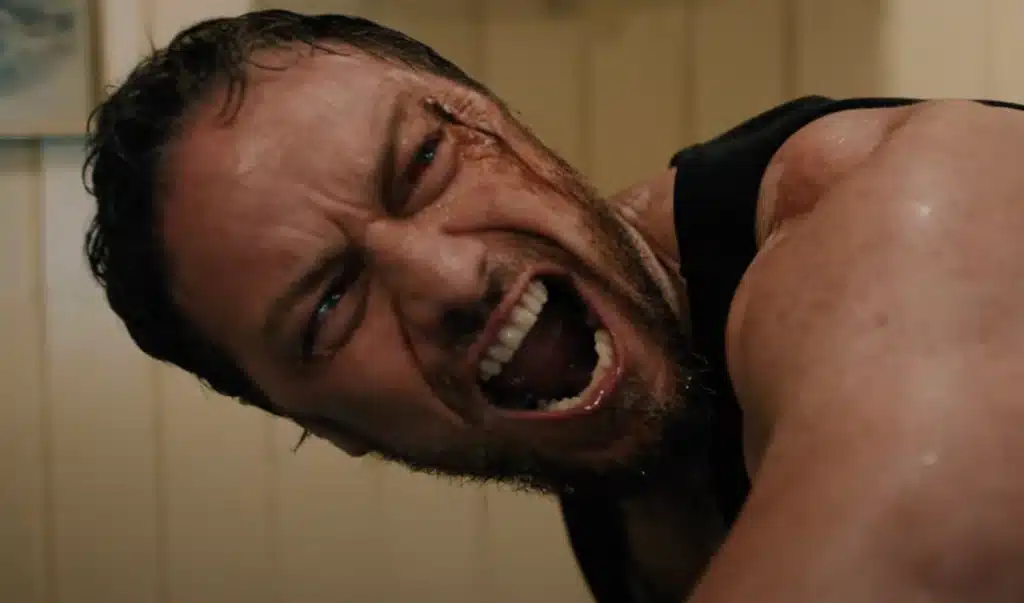
Since you touched upon that, Christian's has the social satire with a slow-burn vibe to it. You keep the social satire, dealing with different cultures, but instead of the slow-burn horror, you go with more of an action-horror element. Did you always know that was going to be your approach?
The gear shift into the third act, I suppose is more Straw Dogsy sort of territory with the siege of the farmhouse. Yeah, I thought it was an interesting place to go to explore those characters.
As a whole, I'd say independent and foreign horror tend to go much more brutal than American mainstream horror. What were those early discussions like, and how did you decide how far you wanted to push the mainstream audience?
I think the mainstream audience is pretty pushed by this movie. It's not like it's a Hollywood ending. However, I've sat with a lot of audiences, and I can't give any spoilers, but the final shot of the movie is in no way a simplistic, triumphant “all's well with the world” shot.
It's the themes of the movie about how man hands misery to man, the Larkin poem “This Be The Verse,” cycles of violence, and all of that. They're pretty in there. I think it gives an emotional release, but I also think there's a sort of note on the end of the movie that is very… As a friend of mine said, “It's pretty fucking European for a Hollywood ending.”
That's a great way to describe it. Is there anything you wanted to include that didn't make the final cut?
It's all there. There is some stuff that we cut just to keep it moving forward. For example, after they've been at Mike's cottage for that awkward dinner and “Black Velvet” comes on, they go up to dance. There was a whole brilliant sequence of them dancing a really raunchy dance with Paddy and Ciara, bringing Ben into their embrace with Louise watching, and it being super awkward. I loved the scene, but in a way, we already watched it.
The scene before had already done what that scene was doing in a different way. There's another bit after they'd been screaming on the hillside, where Ben and Paddy go in the car in a field, and they're driving the car doing donuts. They were screaming, and we were going to play Spandau Ballet, they were having a real roaring time, and it's great. I mean, they were absolutely loving it. But again, we kind of got that energy already. It's just stuff like that.
I'm curious: why were you going to use Spandau Ballet, and why did you use The Bangles' “Eternal Flame”? Those are very specific musical choices.
Yeah, there's a sort of ‘80s/'90s theme, I suppose. You go back to a clip of Chuck Norris at the beginning, which Ant is watching on a VHS. It's a throwback to Paddy's “When Men Were Men” type earthiness and “Oh, The Modern Rules, I just want the simple life, and the countryfied rural values,” and all of that.
Musically, in my head, it's almost like Paddy would have the radio tuned to, I don't know, Absolute '80s or whatever. That's what he likes. There are more specific reasons for each particular song, but that was the overarching philosophy.
He's got good taste. You're not going to tell us the more specific reasons, the secrets?
Oh, yeah, when he's singing “Eternal Flame” to Ben, I mean, it's a beautiful song. It's an incredibly well-constructed song. But in my head, when I was writing it, I thought the energy would be so weird when he was singing it to him. There's a real kind of bromance going on, and he's serenading him. Ben's like, “Am I enjoying this? Is this awkward?”
Then I thought that song could then be reprised later in a really interesting, fun way. Also, stuff like Def Leppard's “Animal” is very much almost speaking a theme. Paddy is an animal, here we are. It's all kind of subtly in your audience's face, I suppose.
The whole cast is brilliant. But James McAvoy is unleashed, and he's so good. He's absolute batshit. This guy is insane but so, so good at reeling you back in. “But I'm cool. I'm the cool guy, I'm fun, I'm charming.'” Part of us is attracted to that, the average person doesn't do that kind of stuff.
I completely agree. Most of us live by the rules, and we're attracted to people who are mavericks. I talked about it when I first met James. We talked about it in terms of politics. Both in England and here, you have these demagogic figures. They tend to be men, and they tend to say, “I'm the rule breaker. I'm the anti-establishment guy.”
It's that sense of people looking at these figures in life and in politics, and they're very seductive but dangerously seductive. Often, what they're prescribing is dangerous, and you follow them, and they turn out to be false gods. So there was a lot of that in Paddy, and I think James and I enjoyed leaning into that.
Speak No Evil is in theaters Friday, September 13.