
Last Updated on October 4, 2024 by Angel Melanson
Today marks the 50th anniversary of the release of Tobe Hooper’s The Texas Chain Saw Massacre. Produced for $140,000, the film is loosely based on the crimes of serial killer Ed Gein and follows a group of friends as they travel through Texas and encounter a family of grave robbers who also happen to slaughter humans for food. The clan’s main muscle is referred to only as Leatherface, a hulking man who wears the skin of others over his own.
A key film in the genre’s transition to contemporary horror, Tobe Hooper’s film has a fraught yet unique legacy due to its graphic content and extreme violence. But there’s an element that is rarely discussed when talking about the film: the way it navigates disability.
When it comes to exploring disability in the horror realm, Chain Saw sees disability manifesting both literally and symbolically, with a disabled killer and victim. The film’s most overt use of disability is found in the character of Franklin Hardesty (Paul A. Partain), the wheelchair-using brother of the film’s hero/final girl, Sally (Marilyn Burns). If you Google the movie’s title and “Franklin” you’ll see a litany of articles ranging from “8 Horror Characters We Were Happy to See Killed” to a Reddit thread asking “Did anyone else cheer when Franklin died in The Texas Chain Saw Massacre?”

Back in August I asked a similar question on social media: Is Franklin the worst disabled character in film? I wasn’t surprised that it got a lot of traction. What did surprise me was how many people came to the character’s defense and said Franklin was remarkably sympathetic and illustrated the ableism of Sally and her friends. It’s a concept I hadn’t initially considered, but there is merit to it.
Disability in film has a fraught history, with rampant ableism and stereotypes crafting a legacy of questionable portrayals that is slowly, ever so slowly, changing. But the world of horror has offered a unique landscape for characters with disabilities, offering up a variety of different roles, from victims to monsters, going all the way back to the silent era. The sheer abundance of characters, either coded as disabled or possessing them literally, is astounding and makes horror the place where the disabled come to play.
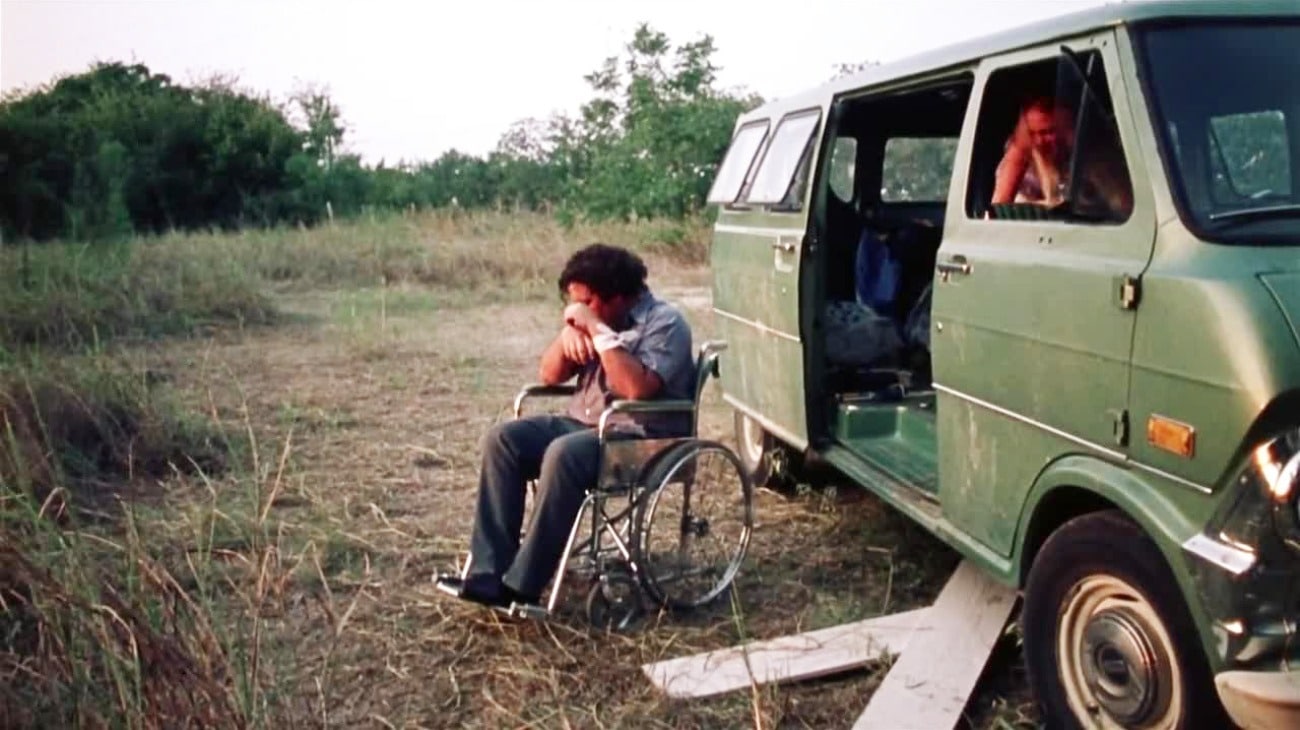
There is a heavy amount of evidence that works against Franklin as a character, much of it fueled by Partain’s performance. Described as an “invalid” in the opening narration, he is introduced to the audience as a highly infantilized man-child cared for by his sister/mother Sally and her friends. Much of his performance vacillates between whining, crying or pleading. When a hitchhiker they pick up pulls out a knife and cuts Franklin, he starts wailing like a baby, holding up his arm for Sally to inspect. He also has a propensity for talking in wide-eyed wonderment, like a child. Several lines of his dialogue are just overt questions. “I got no gas,” the gas station attendant they meet says, to which Franklin replies, “What? You’re all out of gas?”
There is a sense of obligation to the group bringing Franklin along, felt in characters treating being near him as punishment. When the group decides to pick up the hitchhiker they complain about him smelling like the slaughterhouse they’ve passed. Sally says, “He can sit by Franklin.” There’s two ways to take this: Franklin’s past upbringing around slaughterhouses means he can endure the new hitchhiker, or – and more cruelly – that Franklin and he are both unpleasant and… birds of a feather.
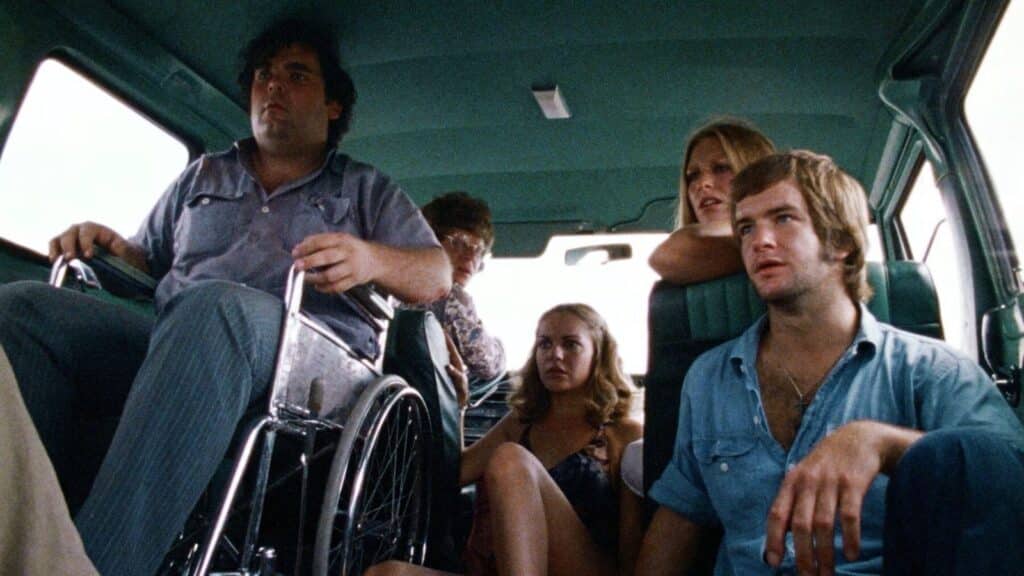
Partain’s performance and the aesthetic of the movie enhances the unattractiveness of Franklin as a person. He’s slovenly dressed, perpetually sweating and making exaggerated facial expressions to create a grotesqueness to him akin to a pig. This is coupled with a heavy level of fatphobia to further punctuate the fact that he, and his friends, are pigs for the slaughter. When Pam (Teri McMinn) mentions that Franklin swam in a local pond when he was little, Kirk (William Vail) replies, “Franklin never was little.”
Franklin definitely sets himself up as a character you’re hoping is the first to go, and yet it is the script and performance that makes the character so unappealing. Every character exhibits some form of ableism against Franklin that, coupled with how he’s written to be so child-like, feels like the character is set up to fail. There is a flipside to the character I hadn’t previously considered: maybe he’s justified? Make no mistake, Franklin plays up the waterworks and acts very extra, but he also is surrounded by some equally terrible friends and family. He’s stuck in an unsupportive hospital wheelchair (there’s zero back support) in a moving van. How he’s not sliding around back there is movie magic. Instead of his friends stopping to let him pee somewhere civilized, he’s forced to pee in a coffee can on the side of the road where he’s accidentally thrown down a steep hill and flips out of his chair.
(A very brief aside, something you’ll see in this movie that you should take with you whenever you watch movies with disabled characters: Franklin’s hospital wheelchair is not one that actual people with disabilities use. They’re unsupportive, they’re big and they are incredibly hard to navigate. I’ll applaud Franklin any day for being able to push that massive thing around a wooded area where any large rock could have spelled doom for him.)
Director Tobe Hooper and screenwriter Kim Henkel give the Hardestys little backstory – short of Franklin explaining that his family owns a slaughterhouse – but the post-Vietnam landscape of the story is felt, and this includes Franklin’s presence in the film. Franklin is akin to Vietnam veteran characters seen in movies that would debut later and focus on the war, most specifically Tom Cruise’s portrayal of Ron Kovic in Oliver Stone’s Born on the Fourth of July. Franklin’s “woe is me” attitude and general antipathy towards life sets up the grizzled, combative, surly vets from ‘Nam that came back in janky hospital wheelchairs in more prestigious films.
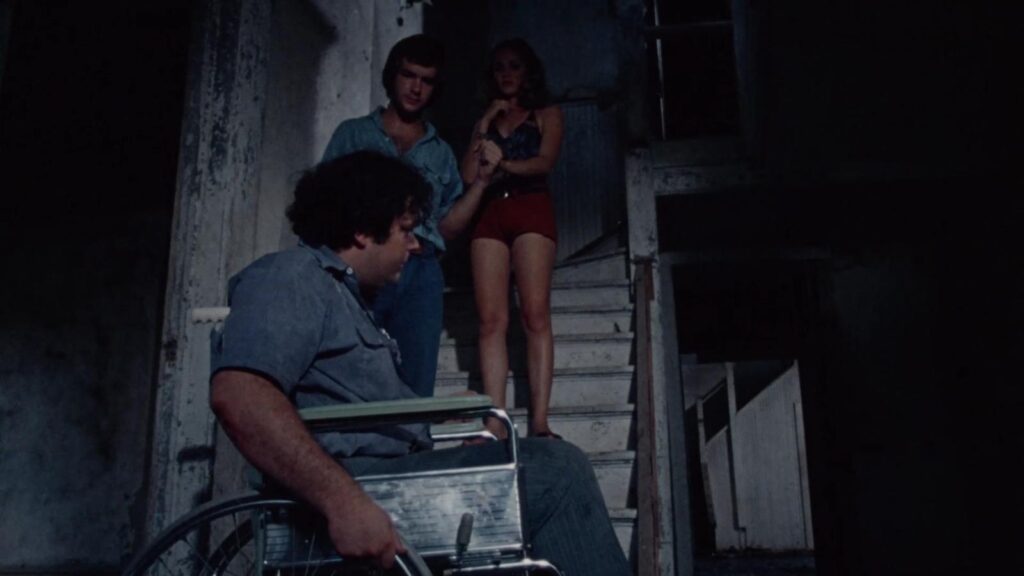
Once Sally and her friends discover a house where they can hang out while searching for gas, Franklin is pulled into all manner of situations that, in any other horror film, would leave him in a victim position. Because the house has stairs Franklin wanders over dirt floors screaming for Sally (or anyone, really) to at least keep him company. He’s a whiner, for sure, but as a disabled person who has been left outside while my friends go off and have fun – sans chainsaw killing, of course – it’s hard not to empathize with him. Franklin is left alone with no one caring what happens to him. Once the youths start disappearing, Sally decides to search for them and Franklin, understandably, doesn’t want to be left in the dark and begs Sally to take him with her. She cries that she can’t push Franklin’s wheelchair and wants to leave him.
What’s fascinating is how audiences respond to Sally’s crying and pleading, which ramps up in the third act when Leatherface and his family abduct and torment her, yet they find Franklin insufferable. Again, this is partly performance-based, but it’s hard not to feel there’s a double standard. Disability narratives in film often illustrate disabled characters as afraid to be a burden to family. To have Sally callously say she can’t push Franklin and want to leave him with the equivalent of a “good luck”… she’s outright stating he’s a burden. Franklin may be the most unsympathetic disabled character portrayed on-screen, but he’s worth sympathizing with in some way.
As many people said in response to my thread, “Don’t we want to see unlikable disabled characters?” The answer is yes. Released four years before the groundbreaking disabled feature Coming Home and three years before the 504 Sit-In, a disability rights protest that saw activists, including the late Judith Heumann, occupying federal buildings, disabled characters in film were finally starting to leave behind the stereotype that they were saints. Historically, disabled characters have fallen into two tropes: kindhearted saints, and horrific monsters. One could argue that Leatherface, who is presumed to have a disability, falls into the latter category, but that’s another story. In this case, Franklin is able to leave aside the peppiness and goodness of a character like Charles Dickens’ Tiny Tim and present as something close to human. What balances Franklin out is his mistreatment by his abled friends, illustrating that when ableism is present in society, everyone defaults to being kind of a jerk. (That includes folks on both sides of the screen: When Franklin meets his eventual end, it’s often greeted by cheers from an audience, a phenomenon worth reflecting on. He’s ostensibly the lead of the film for the entire first hour, yet his chainsaw-fueled exit from the film is met with applause.)
Still, for all his suffering and indignities, Franklin remains a pioneer in disabled representation. It’s nice, too, that Franklin doesn’t die first, upending another stereotype somewhat common to disability narratives. (The 1981 film Friday the 13th Part 2, while possessing a superior disabled character, also does this skillfully.) Franklin is the only character in a movie called “The Texas Chain Saw Massacre” to die by said chainsaw, but he doesn’t go first! Progress.

