Last Updated on October 4, 2024 by Angel Melanson
Anecdotal: the concept of one’s own death loiters in the brain of a middle-aged man a lot more frequently than that of his twenty- or thirty-something counterparts. Once you hit 40 there are, statistically speaking, more days behind you than in front of you, and as much as you try to run in the opposite direction, your mind will always eventually face front to ponder (or dwell) on the non-negotiable black nothingness of oblivion waiting for you at the end.
Not surprisingly, this mindset changes the way one watches the beloved horror classics of one’s youth. In middle age, moments of cinematic carnage take on a gravitas that the 18-year-old version of you couldn’t possibly have absorbed. When we’re young, death is scary but abstract; a dark unknown. In our 40s and 50s, death is a fact. It has by now reached out from the shadows and taken a few of our group. It surrounds us, moving toward us as we move toward it. Our youth behind us, we’re always painfully aware that death is always just around the corner, the one true certainty in life.
Death's bleak inevitability is sitting right there in the title of The Texas Chain Saw Massacre. There's no ambiguous “haunting” or “legend” in that title. Right there on your admission ticket, it’s printed in black and white: Death is coming. With that one title, you’ve been told the what, the where, and the how. (An opening dateline provides the when; you will never really get the why.) The film that follows is not an escapist, spooky funhouse ride. It’s a funeral dirge. And no one gets more existentially fucked up by a funeral than the middle-aged.

That’s an interesting wrinkle, as The Texas Chain Saw Massacre is, through and through, a young people’s movie about death. It stars and was made by people mostly under 30, and was ingested primarily by a young audience who, in 1974, recognized it as the primal fairy tale it was. “What happened to them was all the more tragic in that they were young,” John Larroquette's voice tells us in the opening narration, and a young, draft-age audience likely nodded in agreement. Certainly that was my take on my first viewing, at age 12. In the VHS heyday of the early ‘80s, I found The Texas Chain Saw Massacre to be unnerving in its visual and aural assault, altogether different from the other genre offerings in my rental pile.
Of the many films that sparked an early interest in the craft of filmmaking, Tobe Hooper’s 1974 masterpiece was likely in my top three, though I struggled back then to articulate what was so special about it. It wasn’t exactly fun, or heightened, or overly stylized with the kind of polish that telegraphed “film production” to the viewer. It felt like you were seeing genuine homicidal insanity onscreen. There were no safe, cathartic thrills to be found. It made me feel small and helpless. That’s probably why it wasn’t on rotation in my VCR the way, say, the Friday the 13th movies were.
But as the power (and appeal) of other slasher franchises faded with my adolescence, The Texas Chain Saw Massacre continued to cast a spell. Time did not render any of its moments cheesy or hokey for me; the film’s unblinking lack of sentiment served it well in that regard. While more advanced moviemaking technology started to throw the rough edges of my other horror favorites into sharp relief, here was a film that never stopped feeling real. With each new video format, its deceptively primitive visual style was revealed to be more detailed and sophisticated than we assumed, VHS “purists” be damned.
Its hellish soundscape never became dated, because it is singular in the history of the genre; nothing has sounded like it before or since. The sound design is near-flawless, impregnating even the quiet moments with a droning sense of doom. It’s the heavy silence of a funeral director’s office, or an oncologist’s waiting room. It’s the noisy quiet of blood pounding in your ears during a panic attack.
The Texas Chain Saw Massacre is the one film that never became “just a movie” to me, but not for my lack of trying. I’ve attended multiple Q&As with the makers of the film. I’ve watched at least four documentaries (and appeared in one), and I’ve read numerous books on its making. I’ve digested all the outtakes, and I’ve met every living principal cast member. I’ve had three meals in the relocated farmhouse and wandered both floors. Despite my many attempts at demystification, its hold on me remains.
In 2024, I now find the film resonates most powerfully in the moments leading up to the characters’ deaths. Pondering your own end; that terrible awareness that you’re rushing toward a point in the future where you will no longer exist. Unease, quiet dread, guilt, confusion, panic, abject terror: The Texas Chain Saw Massacre has become, for me, a mosaic of the feelings the idea of oblivion stirs within me. These days, those feelings are where I experience true horror, and I find that the film still delivers on that front.
Make no mistake: the movie still offers plenty of straight-up terror for all age groups. Unpredictable, unknowable chaos reigns in Hooper’s film, a marked contrast from the subgenre it helped birth. Later slasher films would evolve into a more-or-less rigid set of rules by which characters would live or die; abstinence was rewarded, vice and promiscuity were punished. In a way, many slashers came to really epitomize the ‘80s mindset, nearly right-wing in their code of conformity. They reassure a status quo; they're downright comforting in their predictability.
This is not the case with The Texas Chain Saw Massacre. There are no ground rules as laid out in Wes Craven’s Scream; no one is safe. Our heroes don’t fit the stereotypes of slasher victims, and aside from Franklin (Paul Partain) and his wheelchair-bound whining, the characters are fairly nondescript. Its “final girl” Sally (Marilyn Burns) barely rates a close-up for the film’s first hour. But even more unsettling is that these are good kids. They’ve heard reports of grave-robbing in the area, and they’ve gone out of their way to make sure their grandfather’s remains are undisturbed. Think about that: they are driving all day in the Texas heat to check on their dead grandpa. It’s a sweet, human, honorable goal. The film — the universe — does not care. 84 minutes later, they’re all just so much fodder for a saw that’s still swinging when the screen cuts to black.
This is a horrifying notion in more ways than one. These characters — good, bad, indifferent, pretty, annoying, carefree — are all going into the sausage grinder. WE’RE all going into the sausage grinder. Like dumb cattle, oblivious to the signs all around us, one by one we willingly march toward our own screaming, bloody ends, slaughtered without ever really understanding what’s happening to us.
But part of The Texas Chain Saw Massacre’s enduring power is its juxtaposition of obliviousness and a kind of horrible omniscience, and in that clarity is revealed a universe prodding us down the cattle chute from day one.
Right from the opening frames, the protagonists’ deaths have been set in motion. In the first moments of the film, the Hitchhiker (Ed Neal) rattles those bones and displays that skeleton in the cemetery. It’s not just grisly folk art; it’s a beacon. Relatives from miles away descend on the graveyard to check on their loved ones’ remains (who knows how many of these well-meaning people ended up as furniture in that house, their cars piled up under that tarp in the backyard). With his cemetery display, the Hitchhiker has summoned Sally and her friends to their doom. Later, Franklin tells the group that his and Sally’s grandpa sold cattle to the slaughterhouse where Leatherface (Gunnar Hansen) and his family worked, and eventually we come to find out that the two families were essentially next door neighbors.
On recent viewings, that last detail chills me the most. The film is rife with omens — the astrology readings in the van, the ramblings of the graveyard drunk, the radio station that broadcasts literally nothing but reports of apocalyptic carnage and mayhem. But more than anything I can't shake the weird angle of these characters dying horribly simply because of where their grandfather happened to buy a home. That vanload of victims were fated to meet their cannibalistic murderers decades before August 18, 1973. Whatever it is that’s gonna kill you, the film reminds us, has probably happened already, and there’s nothing you can do about it. You were always going to end up on that meat hook.
Movies, we like to tell ourselves, are a kind of immortality. Films last forever, and sequels and reboots keep things alive long after the end credits. In the world of cinema, we're seldom asked to confront the actual end of anything. But discarding all the sequels, the remakes, the sequels to remakes and remakes of sequels, The Texas Chain Saw Massacre remains one of the most confrontational films about death ever made. 50 years on, the movie offers no comfort in its bleak message: you might live or die at any given moment, and when you finally take the long dirt nap it will likely be an unsentimental, arbitrary bit of happenstance.
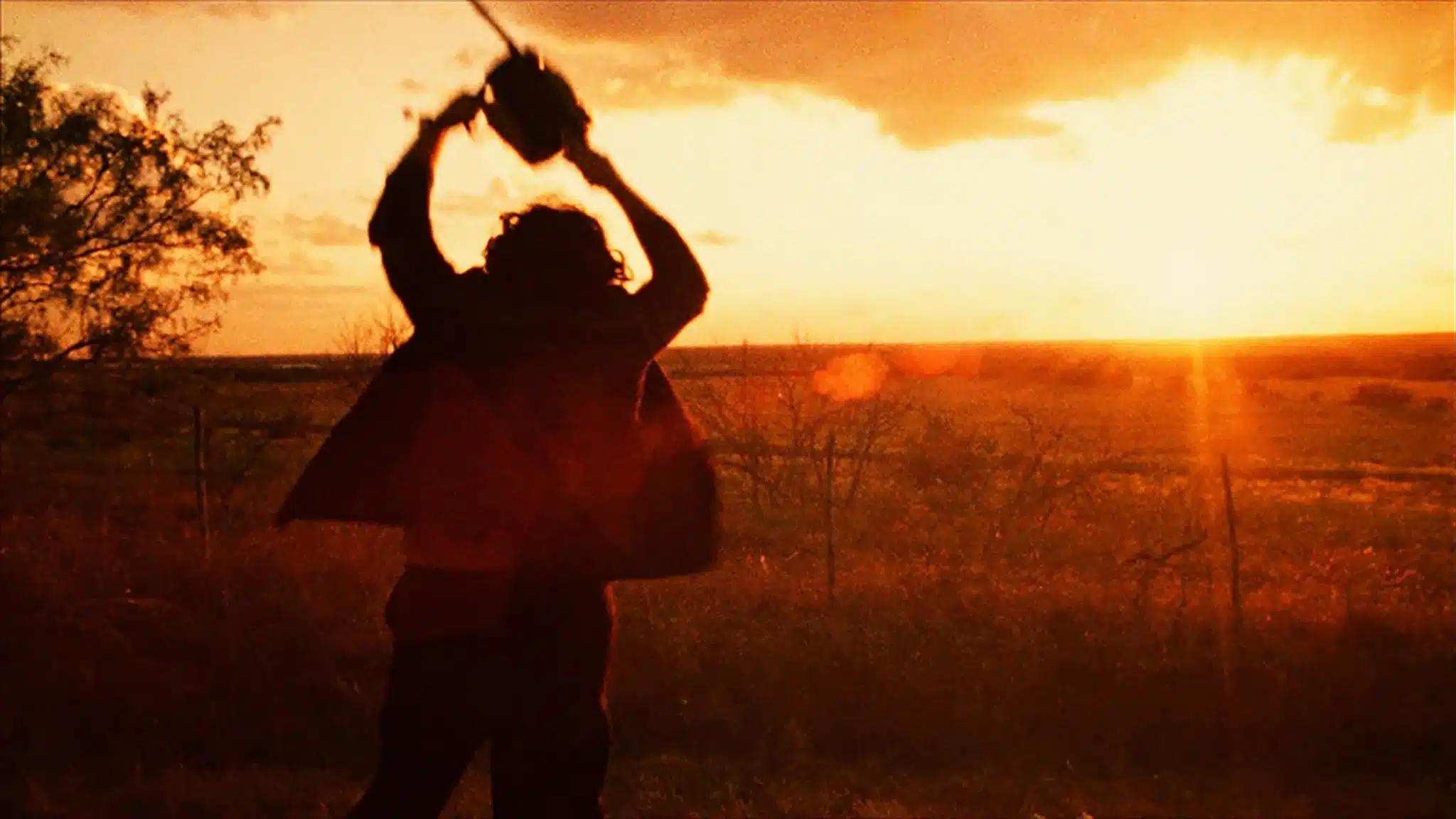
This is the message sun-bleached into the viewer’s brain: Sooner or later you will end. Once you are dead you will no longer matter to the world at large, and odds are most people on Earth will never know about your experiences. Moreover, the film stealthily reminds us, this horrifying proposition will one day be everyone’s reality. Time will eventually claim not only you and everyone you love, but the entire planet. The whole of human existence will become nothing, as our tiny blue marble of cruelty and chaos is one day swallowed by the angry sun we see erupting in the movie’s opening credits, and in whose rays the film’s unknowable killer dances as the film ends.
(A version of this article was originally published by the author in 2014.)