Editor's Note: This was originally published for FANGORIA on December 20, 2000, and we're proud to share it as part of The Gingold Files.
I really, really wanted to love The Gift. It seemed to have all the right elements: Sam Raimi, applying the dark dramatic abilities he demonstrated with A Simple Plan to genre material; a sterling cast led by Oscar nominee Cate Blanchett; and a script by Billy Bob Thornton and Tom Epperson, who previously collaborated on the superb One False Move. But while it’s true that two out of three ain’t bad, the corollary is that one bad apple can spoil the bunch, and Raimi and the actors’ significant contributions are blunted by the underdeveloped screenplay.
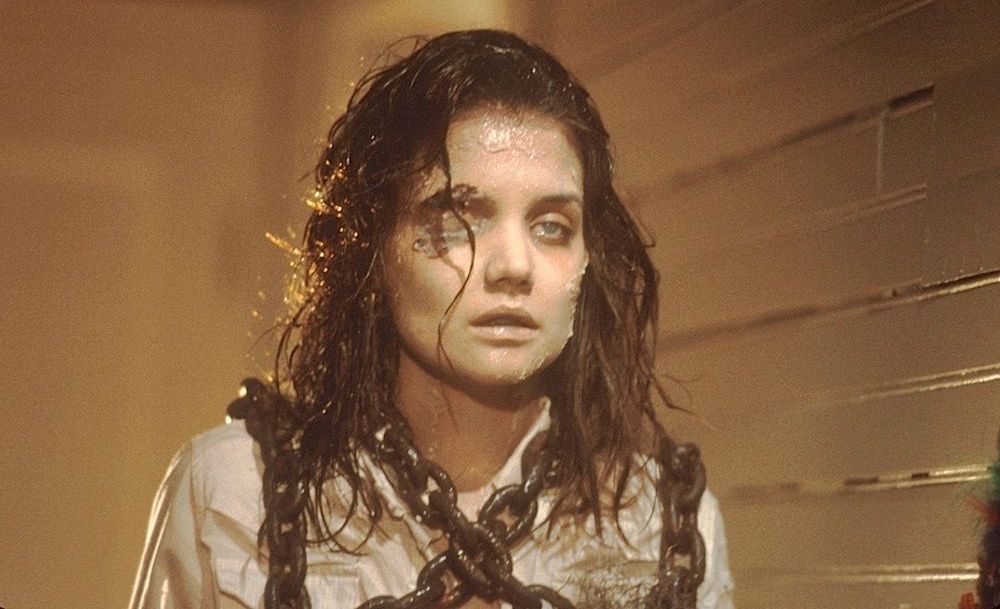
Raimi certainly sets up the right Southern Gothic tone as he introduces us to the world of psychic Annie Wilson (Blanchett), who has been making a living as a fortune teller in the small Georgia town where she’s raising three kids after the death of their father. Trouble brews when she advises battered wife Valerie (Hilary Swank) to leave her husband Donnie (Keanu Reeves), a suggestion the violent Donnie doesn’t like one bit. Then the police, having exhausted their other leads, come to Annie for help in finding vanished rich girl Jessica (Katie Holmes)—and in the process, Annie begins having increasingly frightening visions and finds her own life at risk.
If you think that sounds like basic TV-thriller stuff, you’re right, but Raimi and the cast manage to disguise the thinness of the material for a while. The director vividly evokes the Deep South environment without condescending to his characters or turning them into caricatured hicks, and the actors follow suit with generally solid performances. Blanchett unerringly evokes a woman trying to eke out a living through a “gift” that not everyone trusts, while Swank makes the most of her limited role and Reeves, in a surprisingly strong against-type turn, is convincingly threatening as abusive redneck Donnie. Offering varyingly effective levels of support are Holmes, making a believable 180-degree turn from her Dawson’s Creek good girl to play the hot-to-trot Jessica; Greg Kinnear as her fiancé, whose attentions turn to Annie in Jessica’s absence; and Giovanni Ribisi as Buddy, a disturbed young man Annie tries to help.
The nature of what’s troubling Buddy is one of the script’s more conventional and predictable elements, and unfortunately, it’s not the only one. While the basic story certainly holds the interest, it hasn’t been embellished with the surprises or depth that this kind of material needs to stand out. Annie’s relationship with her town in general, and her continued grieving over the loss of her husband (about which she had a vision that could have allowed her to prevent it) are suggested but only sketchily developed; the former extends mostly to people shouting “Witch!” at Annie from offscreen. Once Jessica’s killer appears to have been arrested, the movie seems to be onto something when it raises the question of how solid a case can be made when the only “witness” is a clairvoyant. And the courtroom scenes, in which Annie is grilled by a weasely defense attorney (vividly enacted by Michael Jeter), are the film’s highlight.
Then the movie falls apart. It’s not giving away much to an alert viewer to say that the apparent villain may not be the true bad guy after all, and just speaking for myself, I had the entire climax figured out about 15 minutes before it arrived. The concluding moments feature a revelation about one of the characters that is supposed to add an extra mythic level to the story—but in the realistic context of what has gone before, the twist comes off as simply puzzling and opaque. And to be brutally honest, the horror elements collapse into cliché: shock cuts of scary faces, hazy flashbacks, people suddenly bumping into other characters that they should have logically seen standing there. This kind of stuff would be understandable, if not forgivable, from a director who hadn’t made a horror film before (Blair Witch 2’s Joe Berlinger, for handy example), but it’s especially disappointing coming from Raimi, particularly given the genuine frissons he works up in The Gift’s first half.
One could venture that these tricks are simply Raimi’s way of juicing up the script’s lackluster final act; certainly, the movie overall demonstrates that he maintains a respect for the genre, even as he has toned down his approach from the beloved camera kinetics of his Evil Dead films. It will be interesting to see what he brings to Spider-Man, and one hopes he will continue to explore supernatural territory—but also that he does so with stronger material than he’s been given here.