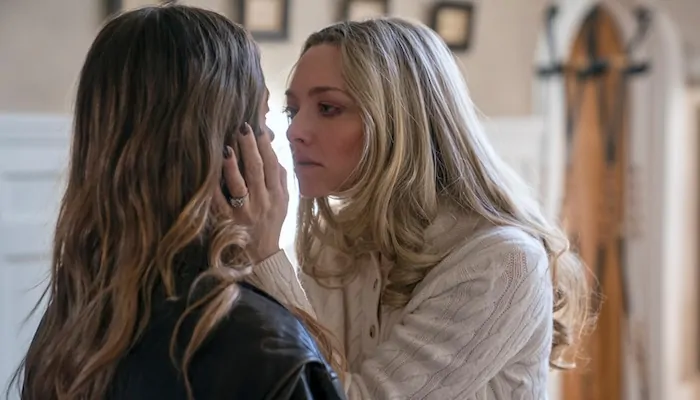
Paul Feig’s The Housemaid is one of those movies where you can’t really say anything about the plot without spoiling an aspect of what makes the movie both trashy and thoughtful at once. What can be said, though, is that Amanda Seyfried and Sydney Sweeney are both at the top of their game and that the film might be Paul Feig in his final form. It also might be the closest to the horror genre that the director has ever gotten. Ghostbusters (2016) was good spooky fun, of course, but I don’t recall anyone ripping out their own teeth in that bad boy.
Rebecca Sonnenshine’s screenplay of Freida McFadden’s book is deliciously trashy right up until the third act when everything spins out to become petty, poignant and horrific in the messiest way possible. “Mess” is, of course, used in both the literal and figurative here. Fans of the novel that became a global phenomenon need to be prepared for some changes, but most of those shifts are beneficial to the new medium and, in some cases, overall improvements to the story as a whole.
Delightfully, The Housemaid heard the younger generations’ cry for less sex in film and elected to tell them ‘no’ with its entire chest. Erotic thrillers are back, baby! However, it’s worth noting that there doesn’t seem to have been an intimacy coordinator on the project (or, if there was, they can’t be found in the credits or the press notes). What shows up on screen doesn’t suffer for it, but it’s the year of our lady 2025, and anything with a sex scene should have one on staff at this point.

Throughout the story, we follow Millie (Sweeney), who is chasing a new start after over a decade of bad luck and Nina (Seyfried), a socialite housewife who needs help keeping things spick-and-span for her tech bro husband Andy (Brandon Sklenar). Millie believes she’s gotten her big break and that her life is finally turning around for the better, but the Nina that hired her and the Nina who becomes her boss seem like completely separate people. The tension is intentionally erratic throughout the film, with no day playing out the same as the last. This ensures that Millie never finds her footing as things get more and more tense before finally spiraling into violence. Before the story reaches its final descent into wonderful madness, though, the audience is in for an assortment of shriek-worthy “omg” moments. Each auditorium is different from the last but, as far as my theater was concerned, everyone was hooting and hollering until the bitter end.
The Housemaid uses some of its “faults” to its advantage (like the aforementioned trashiness), but there are a couple of aspects of the film that end up grating in a way that wasn’t intended. The novel is told from the perspectives of the two leads, leaving the book dialogue heavy in a way that is beneficial to the reader’s understanding of the characters. Though that’s not necessary for a visual medium, Feig relies on voiceover narration at several key points of the film.
With the exception of Nina’s letter to her daughter Cecilia (Indiana Elle), all of these voiceovers feel out of place. Aside from that, this film is too damn long. The film drastically shifts tone in the third act (this is intentional, and not a detriment to Sonnenshine’s screenplay), and a lot of the discomfort and levity of the first two acts help soften the two hour and eleven minute runtime, but that is still far too many minutes for what a film like The Housemaid is trying to do.
What the film doesn’t fail at are its horror elements. Make no mistake, this is a thriller through and through, but there are plenty of blood-soaked moments to leave fans satisfied. Want to see a rapist meet the business end of a glass orb? How about a terrible person trying to rip out their own teeth? The Housemaid might not start there and it takes a good long while for things to escalate but we definitely end up in gore town before it’s all said and done and, if you watch closely throughout the film, you’ll see hints at the violence happening just off screen as well.
In the end, The Housemaid is kind of a delicious conundrum. It’s messy, but never sloppy; unhinged while also thoughtful; and always a good time. Amidst all of that chaos are several compelling conversations about power dynamics, consent, how money buys narratives and who gets to be the good guy vs. who gets written off as insane by society. The whole film is in juxtaposition of itself, operating as a constant conundrum even when everything becomes violently clear. Which is to say that whether or not you as a viewer end up loving or hating it you will never, ever be bored.
The Housemaid hits theaters on December 19 via Lionsgate.