Like many film fans of a certain age, my love of cinema grew in the video store. Sure, going to the movies was – and remains – an incomparable experience. But, as a horror fan in particular, it was at my local rental store that my love of spooky stuff was nurtured. I might not have been able to see Critters 2 at the pictures, but I could sure rent it – along with a stack of other monster movies – for a sleepover with my friends.
And I'm not alone. The rental store was a cultural cornerstone for a generation, forever changing how films were viewed: previously, you'd have to wait for movies to screen theatrically or come on TV, but now? You could watch them at home, repeatedly, with your friends, for just a few bucks, and – with small distributors releasing titles off the mainstream – you could see flicks that would otherwise remain inaccessible.
It was not to last, however. After a Golden Age in the '80s and '90s the rental market began to implode. Huge chains such as Blockbuster made it harder for small indies to compete, and a few years later, even they succumbed to the onslaught of mail-order rentals and, finally, streaming. It seemed as if rental stores were a thing of the past, consigned forever to the history books.
Except, they weren't. Though far less common, a handful of stores still remain today. And, what's more, they're thriving.
In the small town of Bebington, England, Snips Movies is open for business. Trading since 1995 and now stocking over 17,000 titles (more than Amazon, Netflix and Disney+ combined), it's a veritable Aladdin's cave of cinematic delights. And business is booming.
“I had a customer recently who, as he walked through the rental section, smirked and said, ‘It's so great to see people going back to the old way of doing things,'” says Dave Wain, owner of Snips. “I said, ‘Yes, but for most of my customers, it's not the ‘old' way. They're kids, teenagers, Gen Z and Y. This is the ‘new' way of doing things. All they've known is streaming.'”

Snips was founded by Dave's father at the height of the rental boom, a decision based on business acumen (“emotion never played a part”). But now on other side of the streaming revolution, Dave acknowledges that a well-stocked rental store has a wider role to play.
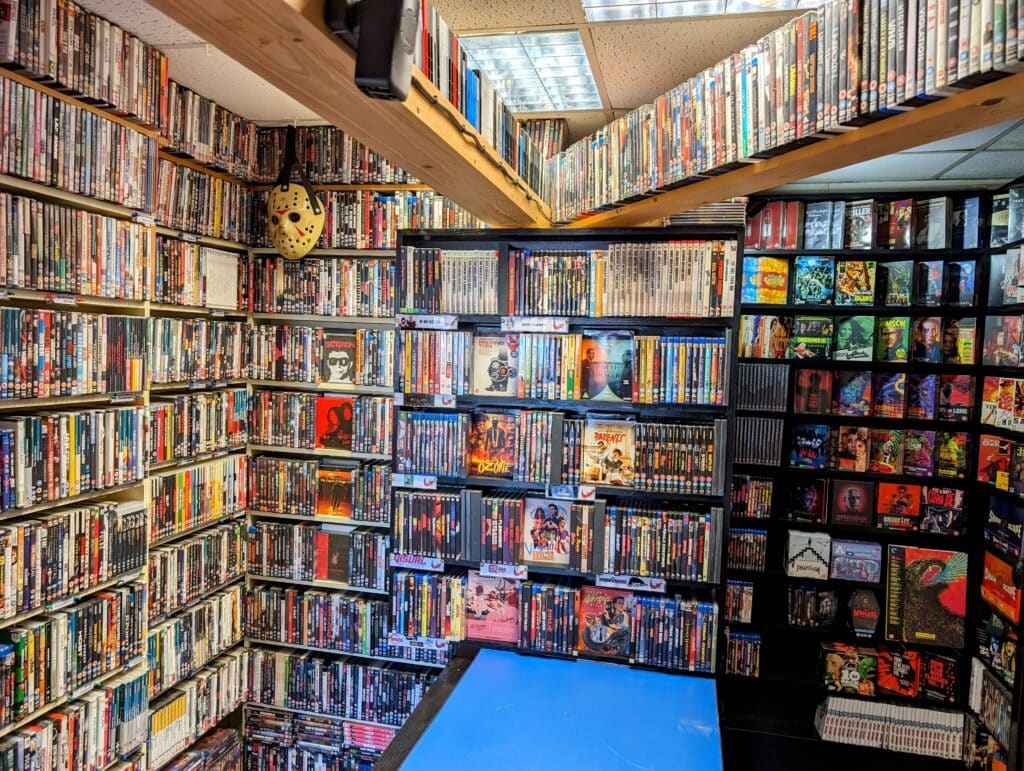
“Preservation is key,” he reflects. “I have a young guy here every week who's studying film at Liverpool University, and he raised the issue that he had access to every facet of film history at Snips, but his fellow students were stuck sifting through whatever the streamers dictated. It's a terrifying situation. The lack of availability not only stifles the passion of so many young film obsessives, but when titles are available the cost of having to subscribe to multiple streamers is hugely prohibitive for students and the working class. Film is slowly becoming an elitist pastime.”
A well-curated selection is one thing, though physical media is something Dave believes in more widely. Along with long-time collaborator Matty Budrewicz, he's contributed numerous commentary tracks and essays to Blu-ray releases for Arrow Video and 88 Films. “It's impossible to replicate these releases in a streaming capacity,” he muses. “If you consider the thrill of that tangible product, and the sheer volume of special features that comes with it… physical is the only true means of appreciation.”

And given the price tag for buying Blu, Dave feels making these releases available to rent is all the more essential. “The boutique market is thriving, but as a consumer buying the core releases from Arrow, Eureka, Indicator, 88 Films and Second Sight would cost you in the region of £400 to £500 ($500-$650) each month. That's far beyond the dreams of most people, so by offering these titles [to rent] it gives the opportunity to watch these great releases against the stress of rising costs.”
This idea of the important physicality of cinema is echoed Stateside at Movie Madness. Based in Portland, Oregon, the store boasts over 90,000 titles to rent: and that's not all.
Following the retirement of original owner Mike Clark, Madness was bought by local cinema the Hollywood Theatre in 2018, and since then the store has diversified to include a screening room (dubbed the MiniPlex) and a film appreciation program (the Movie Madness University). And that's before you even mention the Movie Madness Museum of film props and costumes.

“Over the years we've viewed ourselves as less of a retail business and more of an archive and resource for the film loving community,” says Matt Parnell (Managing Director and Head Curator). “We recognize the importance of preservation and keeping these films available for people to appreciate for years to come.” And whilst “the rise of streaming has certainly had an impact on our business,” Matt is keen to point to Madness's unique place in the community.
“I think that the enormity of [our] collection, the way we categorize films to encourage cinematic discovery, our one-of-a-kind museum, and our expert staff knowledge is what really sets us apart from anything that streaming could ever hope to match. There's something to be said about having a face-to-face interaction with someone who really understands your tastes and wants you to have a good time, as opposed to a faceless algorithm that always seems to give the same recommendations.”
And with Madness now also adding beer and wine to their concessions, the focus is very much on fostering a community space for people to build relationships. “We have worked hard to make Movie Madness a destination to come and hang out!” says Matt. “There's always something happening here.”
Back in Bebington, it's an idea that resonates with Dave Wain, too. “I try my best to create an air of collaboration at Snips. We're knee-deep in a mental health crisis, and all this solitary behavior as we stare at the same four walls is doing us very few favors. If I can lure one new person in per week, and away from that lifestyle, then I'm doing my job.”
So what's next for rental stores? Could we be seeing a resurgence? Dave admits he dreams “of a world with a movie rental store in every town,” but sadly he feels it “impossible,” citing the prohibitive start-up costs of acquiring enough stock to offer a viable alternative to streamers. But back in Portland, Matt is more optimistic.
“I actually believe that the future for video stores is pretty bright,” he beams. “There was definitely a storm to weather, but it seems like the current resurgent interest in physical media and growing dissatisfaction with streaming has driven a lot of success to the remaining video stores and is even encouraging some new shops to open.
“If you have a local video store in your community, it's important to support them because the work they are doing to ensure that cinema remains widely available to the public is urgent and necessary. Long live physical media!”
For cinema, for communities and for people, long live physical media indeed. There's currently no widely used video rental store locator (like the handy comic shop locator) that we know of, but a quick search for “video rental store near me” may turn up some treasures. Seek them out.