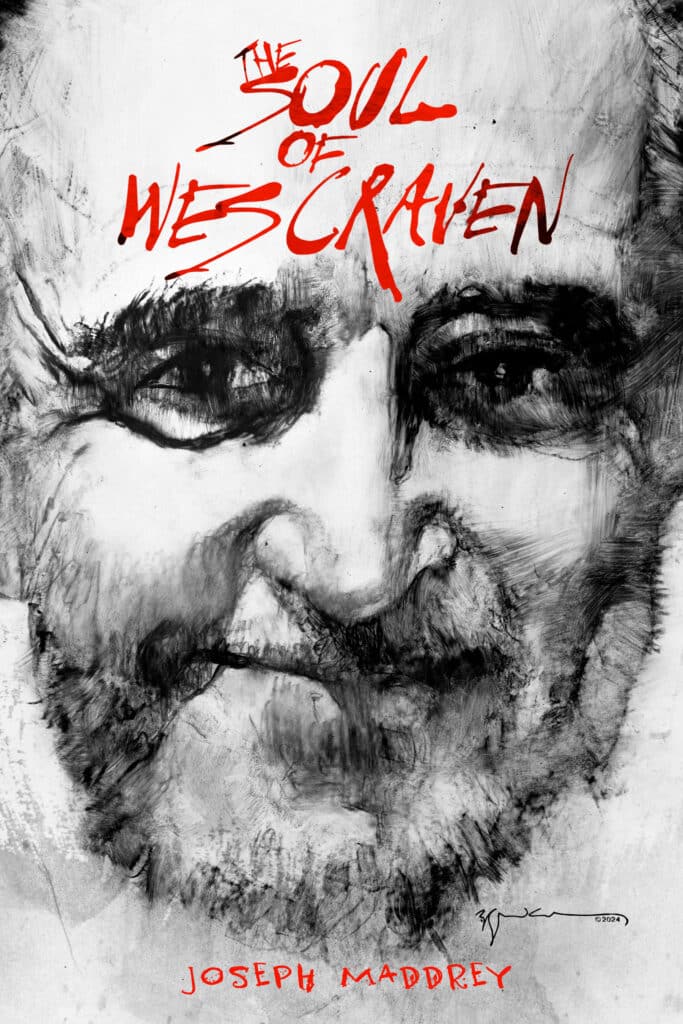
Author Joseph Maddrey's new book, The Soul of Wes Craven, looks to be the definitive text about the filmmaker as a literary, creative force, and such was Maddrey's insight that FANGORIA tapped him to write about Craven's most iconic creation, Freddy Krueger, in our new issue.
But as Maddrey illustrates in his book, Craven was much more than the father of Freddy, and Fango sat down with the author to let readers know what insights await them in this new tome.
Craven’s work has been studied by fans and scholars for years. What can readers expect from your book that will be new territory for them?
The first three chapters of the book will be completely new information for most readers, and what happens in those chapters changes everything that comes after, putting Wes’s work into a new context. In addition to interviewing Wes personally, I spoke to over a hundred people who knew him or collaborated with him at different times in his life. I also found and examined a lot of rare manuscripts and unpublished screenplays by Wes, from a high school newspaper column to a series of essays he wrote in the final year of his life. I feel confident in saying that this is the most intimate and comprehensive study of Wes and his work that has ever been published.
What drew you to Craven, specifically, as a topic for a book? What about his story or body of work compelled you?

When I met Wes in 2010, we had a fascinating dialogue about our early lives. I think the fact that we both grew up in the church (although they were very different churches) made us ask big questions and resist easy answers, which lured us both toward literature and certain types of cinema. Talking to Wes, I realized it was too easy to dismiss him as the “father of Freddy Krueger” or the “master of horror,” and to overlook what was really interesting about him as a literary mind. He consistently asked big questions, but embedded those questions in very accessible genre stories. His films aren’t didactic or preachy; they’re deeply personal—which is why we’re still talking about them.
What were some surprises for you as you researched and wrote the book? What’s the biggest thing YOU learned about Craven?
When I started, I knew only the broad strokes of the first 30 years of Wes’ life: his father died when he was young, he was raised in fundamentalist church, he went to an evangelical college and rebelled, then became a college professor… I knew even less about his secret life and work in the 1970s, between Last House on the Left and The Hills Have Eyes (hint: there’s a sex therapy cult involved)… and almost nothing about his final years. After Wes passed away in 2015, I couldn’t go directly to the source and ask questions, so I went to the people who knew him best. All of the great revelations in the book come from people who trusted me with their memories of Wes. It’s hard to point to one particular detail, but I will say that the college-era chapter is my favorite chapter in the book. It explains how Wes became such a powerful storyteller.

Film illiteracy is gaining traction and fandom seems ever eager to reduce the vast history of film to easily digestible memes and gifs. Is that a deflating thought while writing such a deep text on a filmmaker like Craven? Why is this kind of work important now?
I’m always grateful to anyone who can make me see a beloved film in a new way, or make me think of it in a deeper way. When that happens, a particular world or worldview that I’m already invested in has been enlarged and expanded and renewed. That’s what this is all about. You can only get so much satisfaction out of simply remembering and re-watching your favorite films, but a great film with multiple layers can be endlessly mined for overlooked nuances. If we’re not doing that work—as viewers, as critics, and as potential filmmakers—then we’re stuck in a nostalgia loop. I don’t have a problem with nostalgia, but at a certain point it’s boring and we become boring too. I hope The Soul of Wes Craven gets past the familiar perception of Wes, and prompts people to view his films—or maybe films in general—in a slightly different way.
What other genre figures would you be interested in tackling in such a manner?
I would only want to write another book like this if I felt that I was in a unique position to write it. That’s what happened when I wrote Lance Henriksen’s biography Not Bad for a Human. I had access to Lance, and he trusted me, and I really wanted to hear his story. Similarly, a few years ago, I helped screenwriter Bruce Joel Rubin write his autobiography, It’s Only a Movie! Befriending Bruce, and having access to his manuscripts (including the unproduced work), was the reason to continue. And again, I just really wanted to read that book. I’d also love to see a comprehensive biography of George A. Romero, something that builds on Adam Charles Hart’s new book Raising the Dead, which has set the table, so to speak.
Maddrey’s book, The Soul of Wes Craven, is available now.