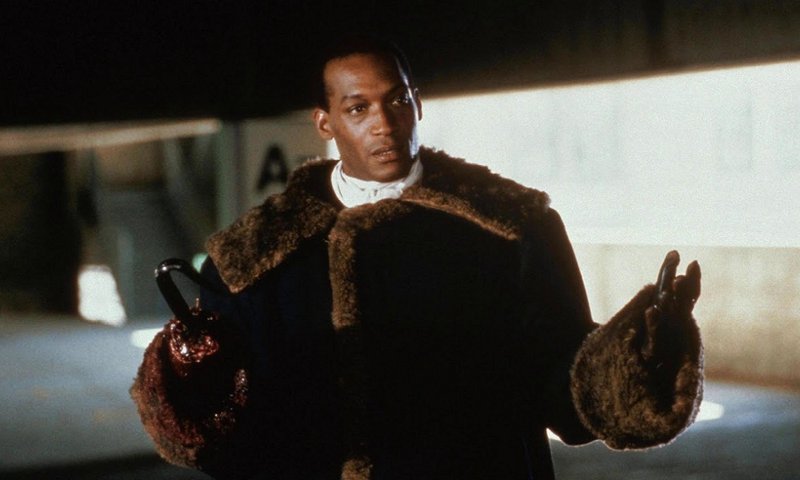
I met Tony Todd through the late, great playwright August Wilson. In 2000, Wilson invited me and my husband, Steven Barnes, to see the premiere of his newest play, King Hedley II, by the Seattle Rep Theater. The actor in the titular role was – surprise, surprise! – Tony Todd.
For us, it was a thrilling opportunity to see an actor we knew only from his iconic role as Candyman only seven years previously. On stage, he captivated a live audience with his deep baritone and striking presence.
Seventeen years later, Todd was vibrating with excitement as he recalled that play when we interviewed him for our online Black Horror class, The Sunken Place. He spoke to us for more than thirty minutes about the impact of Candyman on his career – but also his love for the theater, the aunt who raised him, his love for writing (he had an MFA in creative writing before he was known as an actor!) and the power of horror.
I recently unearthed that interview, and we're featuring Todd in a special tribute episode of our Lifewriting Podcast. www.lifewritingpodcast.com
Monkeypaw Productions updated the original Candyman, with Jordan Peele co-penning a 2021 film directed by Nia DaCosta. The update confronts Black trauma and the legacy of Cabrini Green through a more nuanced Black lens, but as I said in Horror Noire: A History of Black Horror, “To a lot of us, Candyman is Tony Todd and Tony Todd is Candyman.” Tony Todd appears at the end of the new film reimagined as an avenging angel.

While he was thrilled to have a cameo in the updated Candyman, Todd himself never had anything but good things to say about the original film and its director, Bernard Rose, who became a lifelong friend. Of course, Candyman wasn't Todd's only film – he also had more than 200 credits in films, TV and video games, including the remake of Night of the Living Dead – but he knew almost immediately that Candyman might be his best-known work as an actor.
As he recalled in Horror Noire, actor/producer Vondie Curtis Hall told him after the film premiere, “You're going to be Candyman forever.“
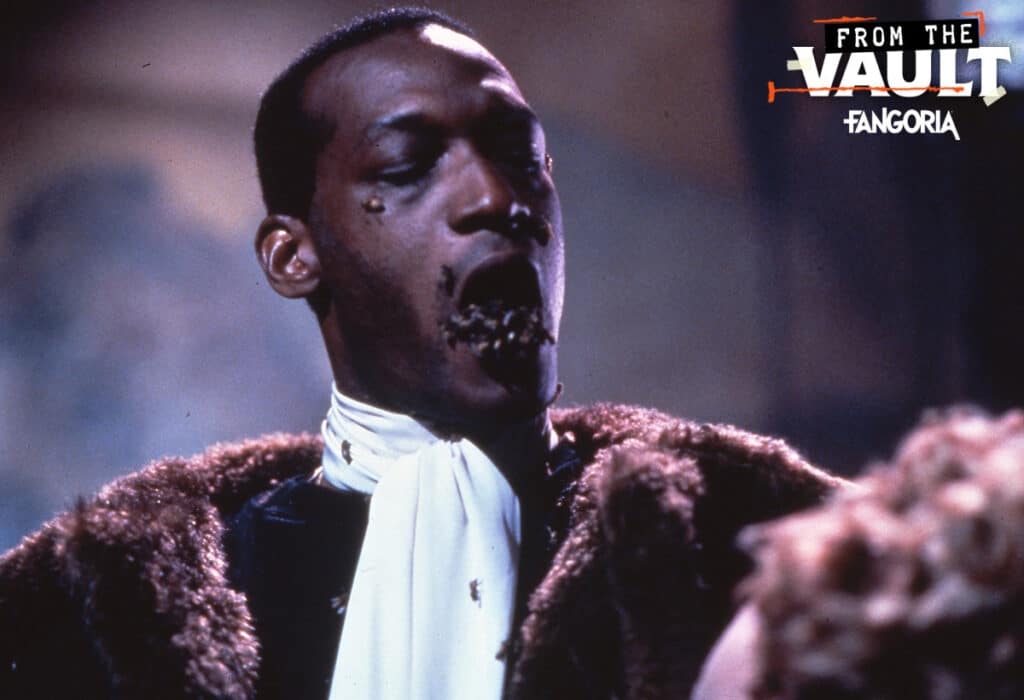
It was 2017, and Jordan Peele's Get Out had just swept the world. I was teaching a Black Horror class at UCLA called The Sunken Place, which Peele visited (I still do), and we wanted another special guest for the digital course Steve and I began offering online.
We invited Tony Todd. I couldn't have known then that I would be working on the Horror Noire documentary, which would bring us together again – or that Todd would be a part of our dream casting when Steve and I would adapt a story called “Fugue State“ for Shudder/AMC+ anthology film Horror Noire, where Todd plays a deranged cult leader with telepathic abilities.
Below are excerpts from our conversation with the prolific Tony Todd:
On his role in Candyman:
I got a call. It was one of the first gigs I ever got where I actually didn't have to audition. I was on a roll at the time because of my work in Star Trek and I had already done Living Dead. I get a call out of the blue from my manager at the time saying a director wanted to meet me to discuss a project called Candyman. I thought he was joking. I thought it was a history of Sammy Davis Jr. …
And [I met] Bernard Rose, a mad, maniacal Englishman who's become a great friend of mine. Shout out to a lot of aspiring actors out there: One of the keys to success is repeated business. So unless somebody gives you a reason to curse them out or call them out, make friends with the people that you collaborate with. Hollywood is a very small circle of workmanship, so you must keep that in mind and just, you know, be prepared, come in there and do your best work.
The only hurdle to me having the character was meeting with the studio at the time. They wanted a personality test. I didn't know what that was. I didn't know whether I was supposed to sing and dance, put my best foot forward…, I don't know. So it happened to be at 8 in the morning, and it was a bunch of executives, and they were pouring fresh squeezed orange juice from their carafes and buttering their bagels. It looked very expensive and nothing was being said.
So I said, “So okay, what am I?“ I felt like an animal in the zoo kind of, right? So that ended, took about 45 minutes of complete torture. I asked, “How did I do?“ And they said they thought I had zero personality. But Bernard fought for me. I guess I didn't do the shuffling and jiving part well. Then, it became just me meeting with Virginia Madsen, who was also a producer at the time. And we clicked, and that was it.

Bernard claims that I was the only one for the role, but I've heard later that the studio was fighting and insisting on Eddie Murphy at one point.
Bernard has this habit of twirling his brown hair with his fingers and he's saying, “This movie is going to change your life.“ And I said, “Bernard, whatever project I do, I do it 100%. I hope it doesn't change my life because I don't want to be locked in or stigmatized by any one role.“ So we fought through that. And years later, I've had a lot of fans at conventions come up to me and say, you know, “That movie terrified me as a kid, or you scared me as a child.”
I always ask them, “How old were you when you watched it?” And they would always say, 8, 9, 10. These are primarily white fans. And that bothered me for a long time because I didn't think we were making a film for babysitting purposes.
I went to Bernard at one point and he says, “Tony, listen, any person that remembers a film when they were a child will remember it forever.“ So that calmed me down…and I've come to accept that. But I think a lot of things went into the mythology of that film.
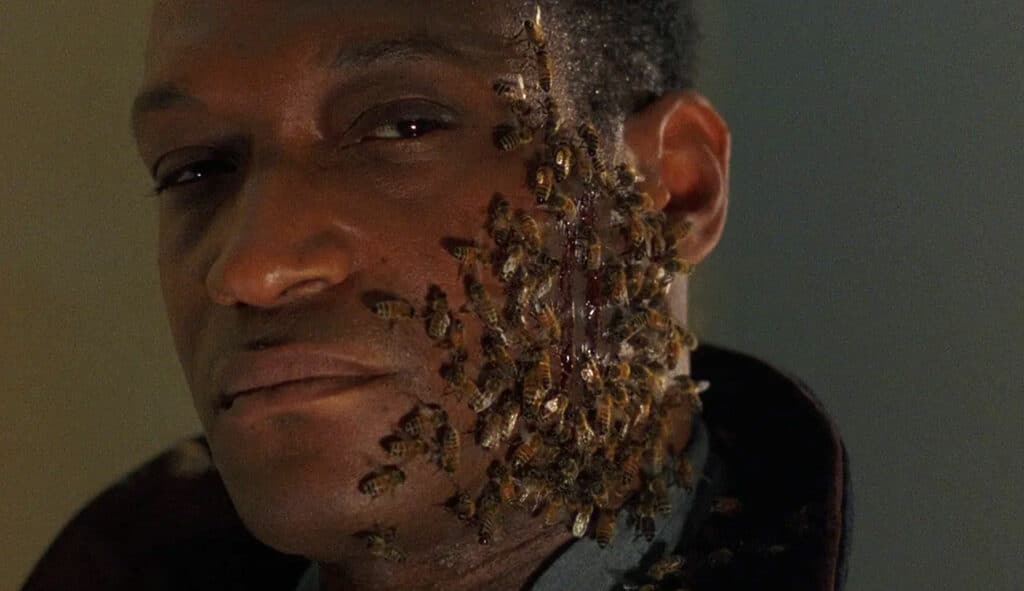
On a scene that didn't make it into Candyman:
There's a 10-minute chunk of the film that was unfortunately removed. The studio was afraid of the interracial love angle because, at the core, that's really what it is. When she finally goes into the lair, and there's a brief moment – we built this elaborate turntable – you see us spinning around in the film. …We shot a 10-minute segment of us just spinning in multiple directions, just psychologically becoming embroiled with each other's passions. And desires and fears.
And they thought that it was too sympathetic to the Candyman character.
On his fans:
I think young Black people are more appreciative because there's an unspoken historical context of the character. They feel that Candyman is someone cinematically who triumphs, if that makes any sense. Aside from the interracial love story, Candyman was a man with his own purpose and his own identity. He was a successful artist. His father was a shoe cobbler. It was the turn of the century, 1800s. He was fine until he fell in love with someone of the opposite race. And that's the genesis of our film.
How did Todd get interested in acting?
Every summer my aunt put me into a different summer program, it ranged from geology, science, public speaking, and most importantly, the Boy Scouts became one. With the Boy Scouts, I got to engage people of other races.
The World Jamboree, which happened to be in Tokyo, [was] my first time on a plane, that changed my life. Flying from Harford, Connecticut to Tokyo. It was around that time that I knew I wanted to be an artist because I knew that art could allow me to see places beyond a street corner. I have people I grew up with who never got off the street corner.
As an actor, how was he able to connect to the character of Candyman?
The first thing that I identified with Candyman was his abject sense of loneliness. Growing up an only child and also I'm a Sagittarian, so I had to deal with birthday and Christmas in the same month. Sometimes, you know, they would combine.
I always felt cheated. But at Christmas…I had my electric football set, I had my road racing set. I had my game of Monopoly. But most of the time, I had to play by myself. So I learned how to corral my schizophrenia and make deals in Monopoly, make sure I had the right hotel in the right place, or do the roll and win with my left hand or win with my right hand.

So I was able to plug into those things for Candyman because also, I mean, I gotta say, I had great training. I got a scholarship to the Eugene O'Neill Theater center, which has won a Tony Award in Connecticut, and then a professor there said he wanted me to be part of his conservatory. I said, “I don't have any money.“ He says, “I just want you to come…“ That was at Trinity [Repertory Company].
So between those two institutions, that was six years of dedicated theater work where we worked from eight in the morning. Well, actually at Eugene O'Neill, we got up at five to do fencing. Just an abundance of riches playing roles that perhaps I would never be considered for, like doing Shakespeare, Moliere and up to Tennessee Williams, Sam Shepard, just doing all the things and having developed no sense of no fear. So when it came time to work professionally in Hollywood, Hollywood is easy. After you've done a great theater work, it really is. You try to elevate it, but at the end of the day, it's easier.
Why do people love horror?
I think people have an intimate desire to be scared and to share that fear with someone they love. All props to Jordan Peele for the phenomenon that has become Get Out. And the fact that Jordan Peele wants to categorize it as a documentary, which I understand completely.
People who watch successful horror go in pairs and they, like some men, go to try to impress women. They can withstand it, and they're there to hold them with a strong hand. I always equate it to going on the world's scariest roller coaster. You slowly creep to the top, you don't know what to expect, and then chaos occurs. But somewhere in the back of your mind, you know, as a spectator, that you're going to be okay.
You can hear the entirety of Tananarive's interview with Tony Todd on the Lifewriting Podcast right here.