The medium of comic books allows for questions that change and reinvigorate familiar horror stories. For instance, “What if there was a zombie story about undead who hungered for their old lives instead of flesh?” And, “What if society were forced to confront and accommodate the reemergence of these revenants instead of collapsing?” Those two questions fueled writer Tim Seeley (Hack/Slash) and artist Mike Norton’s (Battle Pug) Image Comics series, Revival —a horror rural noir that ran for 47 issues, published between 2012 and 2017. The entire series is available in a massive hardbound compendium or several graphic novel collections.
Like many of its characters, Revival returns in a new form, this time as a television adaptation airing on the SyFy network on June 12. The upcoming television series stars Melanie Scrofano (Wynonna Earp, Ready or Not), Romy Weltman (Terror Train [2022]), and David James Elliott (JAG). If that premise and cast intrigue you, read on! We've put together a two-part primer on both the Revival comic series and the new TV show. In this first part, we’ll give you details about the comics series, informed by a chat with Revival comic creator Tim Seeley.
Revival #1 debuted in July 2012, almost nine years after the release of issue #1 of The Walking Dead comic by creators Robert Kirkman and Tony Moore, and almost two years after the debut of AMC’s long-running television adaptation. By that time, the post-apocalyptic zombie tale had become a familiar one.

“The biggest influence on Revival at the time was reacting against things I love, like the Romero films. In those stories, people were on their own, and the system had fallen apart. Our thing was, ‘What if the system has held, but it’s the people who are starting to fall apart?’” Seeley explained. “The zombie story tends to be about survivalism before anything. So, we wanted to see if we could do a zombie story about something other than survivalism. For us, it became a metaphor for the way we deal with grief and move on from losing someone.”
The story that Seeley and Norton devised for Revival centers on a Wisconsin town where, one day, all the recently deceased come back to life and attempt to resume their lives. Then the government steps in, quarantines the town, and tries to uncover what caused “Revival Day,” which ends up being one of the book’s overarching mysteries.
“The series is set in a small town where everyone is stuck together and having to deal with a new set of problems that come from people you already mourned or are glad were gone, returning and being part of your life again,” Seeley remarked.
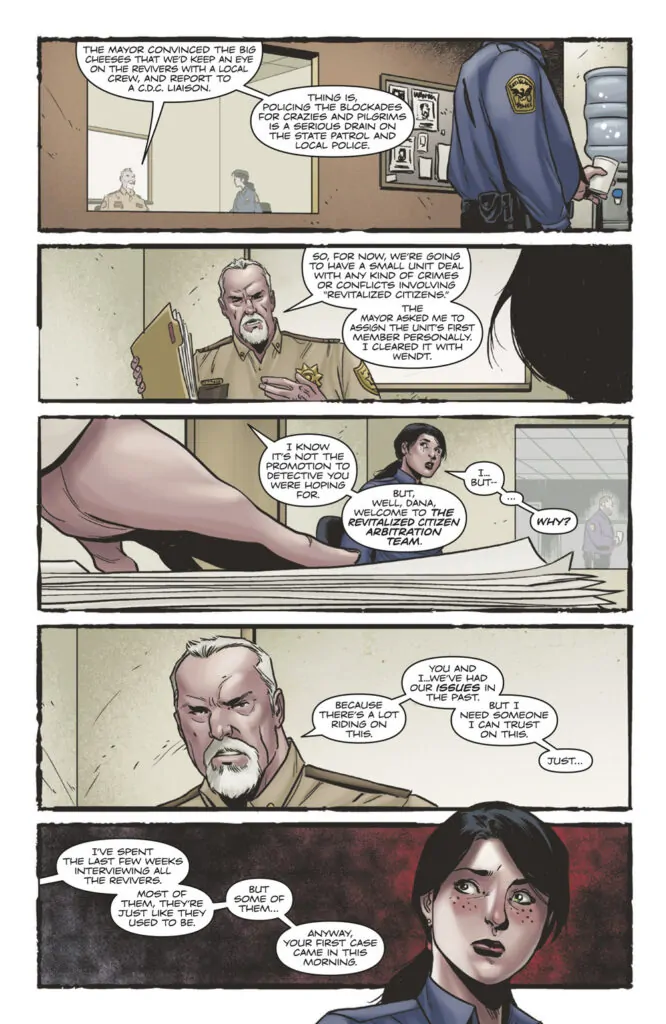
The other major mystery of Revival involves a revived murder victim and how an investigation into what happened to them impacts the town and the book’s central characters, Deputy Sheriff Dana Cypress and her sister Martha, AKA Em, who have a complicated relationship.

“Dana is trying to make up for their childhood,” Seeley said. “They didn’t grow up in the same house for very long because Dana is older than Em. She feels that she wasn’t there for her sister, and now she’s trying to make up for it. The reason she wasn’t there for her, though, was because she had her own life to live.”
Seeley and Norton created the Cypress sisters individually. “Dana is really a Mike Norton creation. He came up with this sarcastic ex-Goth, early to mid-twenties, cop, who had a kid already and wanted something better for herself,” Seeley explained. “I came up with Em, who is this sort of broken person. Creating these separate characters and jamming them together ended up making a lot of the conflict and story.”
The Cypress sisters are the leads of Revival, but the book does feature a very large cast of characters, including their father, Sheriff Wayne Cypress, A CDC doctor who assists Dana in investigating Reviver crimes named Ibrahim Ramin, and many of the colorful, quirky, living and undead residents of the quarantined town, Wausau Wisconsin. The setting is a fictionalized version of the town where Seeley grew up.
“The Wausau I grew up in was a place at a crossroads in a way. It’s very rural. It’s more for hunting and fishing,” Seeley explained. “Also, Wisconsin then, and even more so now, is a place of political equilibrium. There are about as many liberals as there are conservatives, so the state has kind of swung back and forth. That made it a really good setting because you have all these conflicting ways of dealing with a very big, abstract problem.
“I did exaggerate and change certain things about the town in the book, but it’s also accurate in a lot of ways. That led to me learning the lesson of not setting things in the small town I grew up in,” Seeley continued with a laugh. “Because the town was so small, I would occasionally have a character, and people would know who I was basing it on.”

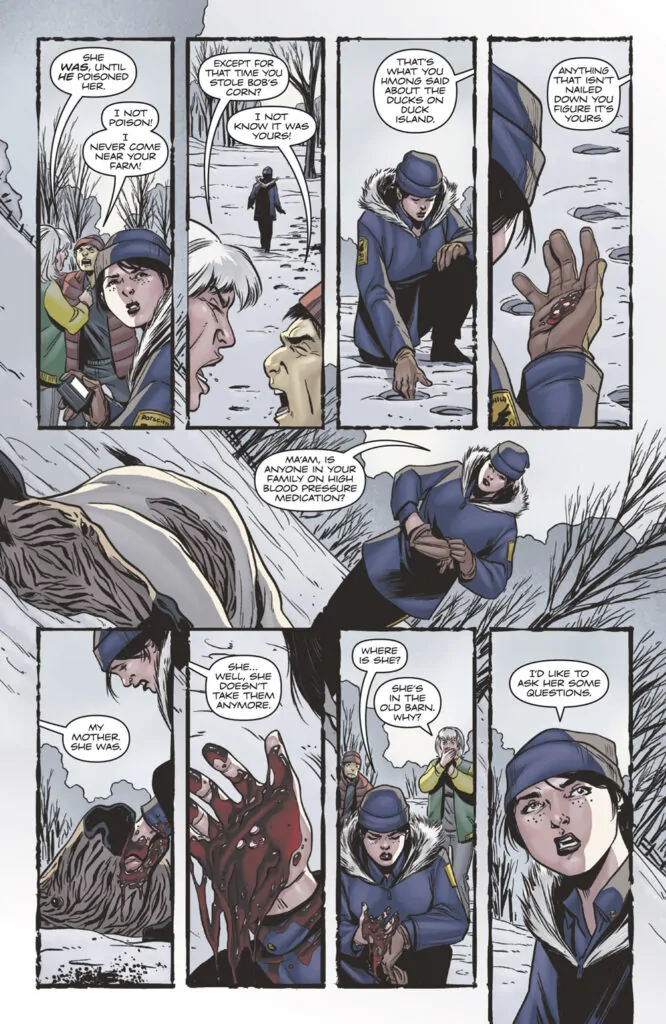
Throughout Revival, Wausau is often rocked by a series of bizarre crimes. Some are perpetrated by seemingly normal individuals, and others are carried out by desperate, small-time career criminals who find themselves with new and lucrative opportunities thanks to the town’s undead citizens.
“In the series, we introduce the idea that the body parts of Revivers are suddenly worth a whole lot,” Seeley said. “They’re a valuable commodity to the medical industry, military, pharmaceuticals, and even cosmetics. It becomes a new crime avenue for small criminals to steal from the Revivers or smuggle them out. We used that as a metaphor for real life stuff, but also to introduce new, horrible things that can happen because of the situation.”
Lots of horrible and often gnarly stuff happens in Revival. Those moments of gore and terror are especially effective thanks to the art style of Mike Norton.
“I think Mike’s greatest skill is drawing regular people and really making you connect to them, which is so necessary in this series,” Seeley stated. “His work lulls you into a false sense of security because it’s so clean. Then something horrible would happen, and I think that’s really the strength of it.
“I remember giving Mike assignments, and he’d be like, ‘I don’t know if I can do that. That’s horrible!’ Then he would do it, and it would work so great because he didn’t want to do it,” Seeley said with a laugh. “It worked because he was making you feel the same way he felt about it.”
Revival came to a close in 2017, and I originally read it month-to-month as it was released. To prepare for this piece, I reread the entire series, and I found that in the aftermath of the 2020 pandemic, Seeley and Norton’s saga about life, undeath, and a town of differing viewpoints in quarantine had taken on a whole new significance.
“The big thing that we talked about when we were making the book was that being out in the country meant that sometimes we’d get a big snowstorm and not be able to go anywhere for like a week,” Seeley explained. “That cabin fever of being trapped inside and not getting to see the world was such a motivating factor in making the series. To have that happen in the real world for a year and a half sucked so bad!
“Also, a big part of what we were writing about was this culture war where people with money and power take advantage of the conflicts of everyday people to keep us fighting so they could rob us blind,” Seeley continued. “You see that in the book with people’s suspicions about each other and people being manipulated to hate each other so that someone else can get what they want. That’s really relevant today.”
If you’re intrigued by the rural horror elements of Revival and want to see what they look like when added to other horror subgenres, Seeley views the series as part of a thematically tied “Forgotten Person Trilogy” of horror comics. The other two books are Dark Red, a series he created with artist Corin Howell for Aftershock comics involving vampires and werewolves, and Hack/Slash, his epic slasher series created in 2004 with artist Stefano Caselli.
“They’re all stories that take place in rural parts of America where people feel forgotten by society at large and now have to deal with some kind of horrific situation. If you like Revival, I’d recommend Dark Red and Hack/Slash,” Seeley said. “And if you’re just checking out horror comics for the first time, there’s some great ones that play with the same small-town crime and horror elements that we do in Revival, like Cullen Bunn and Tyler Crook’s Harrow County and Donny Cates and Lisandro Estherren’s Redneck.”
Seeley has had other comics like Hack/Slash optioned for film and television, but Revival is the first of his comics to make it out of development. It lingered there for a while and was almost adapted several different times. The version that will air on Syfy is especially sweet for him, though, because its co-showrunners, Luke Boyce (Revealer) and Aaron B. Koontz (Scare Package II, The Pale Door), are friends who understand the core elements of the book.
“People have pitched us several versions of live-action Revival stuff that was not the right tone. Luke and Aaron were never going to bend on what it has to feel like, and that comes through. I saw the pilot, and I saw stuff being filmed. It’s the right tone. It’s not too gory. It’s not too funny,” Seeley explained. “A big part of that was that everyone stuck to their guns and got it. It worked. It wasn’t any kind of Hollywood miracle. It was the blood, sweat, and tears of the producers and studios and then, finally, the cast and crew that made this happen.”
What Shudder film led to Seeley working with Boyce and Koontz? What core elements of the comics did they feel had to be preserved for the television adaptation, and what elements did they need to change? For the answers to those questions and more, check out Part Two of our Revival primer, coming tomorrow for a chat with Aaron B Koontz and Luke Boyce, providing more details about the upcoming television show.
Revival premieres on SYFY Thursday, June 12 at 10:00 p.m. ET, with new episodes dropping weekly. All episodes will also be available to stream exclusively on Peacock a week after they air.