Editor's Note: This was originally published for FANGORIA on November 22, 2000, and we're proud to share it as part of The Gingold Files.
For those who admired The Sixth Sense, the question of whether Unbreakable lives up to writer/director M. Night Shyamalan’s 1999 blockbuster will have a lot to do with how much of that admiration resulted from Sixth Sense’s surprise ending. With all of the (justified) praise and attention given Shyamalan’s last-minute pulling of the rug out from under the audience, appreciation of the movie’s other qualities tended to get lost—its emphasis on quiet atmosphere and deliberate building of character and relationships in a movie scene dominated by noise. These pluses are very much in evidence in Unbreakable as well, but its lack of a payoff as potent as Sixth Sense’s may leave some viewers disappointed.
Which is not to say that Unbreakable doesn’t have a significant plot twist at the end—it does—but it doesn’t force you to look at everything that has come before in a fresh light the way Sixth Sense’s did. The new movie’s coda may also strike some as hokey, but those who have bought the story that far will likely find it of a piece with the rest of the film. That acceptance does require something of a suspension of disbelief, as Unbreakable is less the supernatural thriller that Sixth Sense was and more of a superhero origin story told in gritty real-world terms.

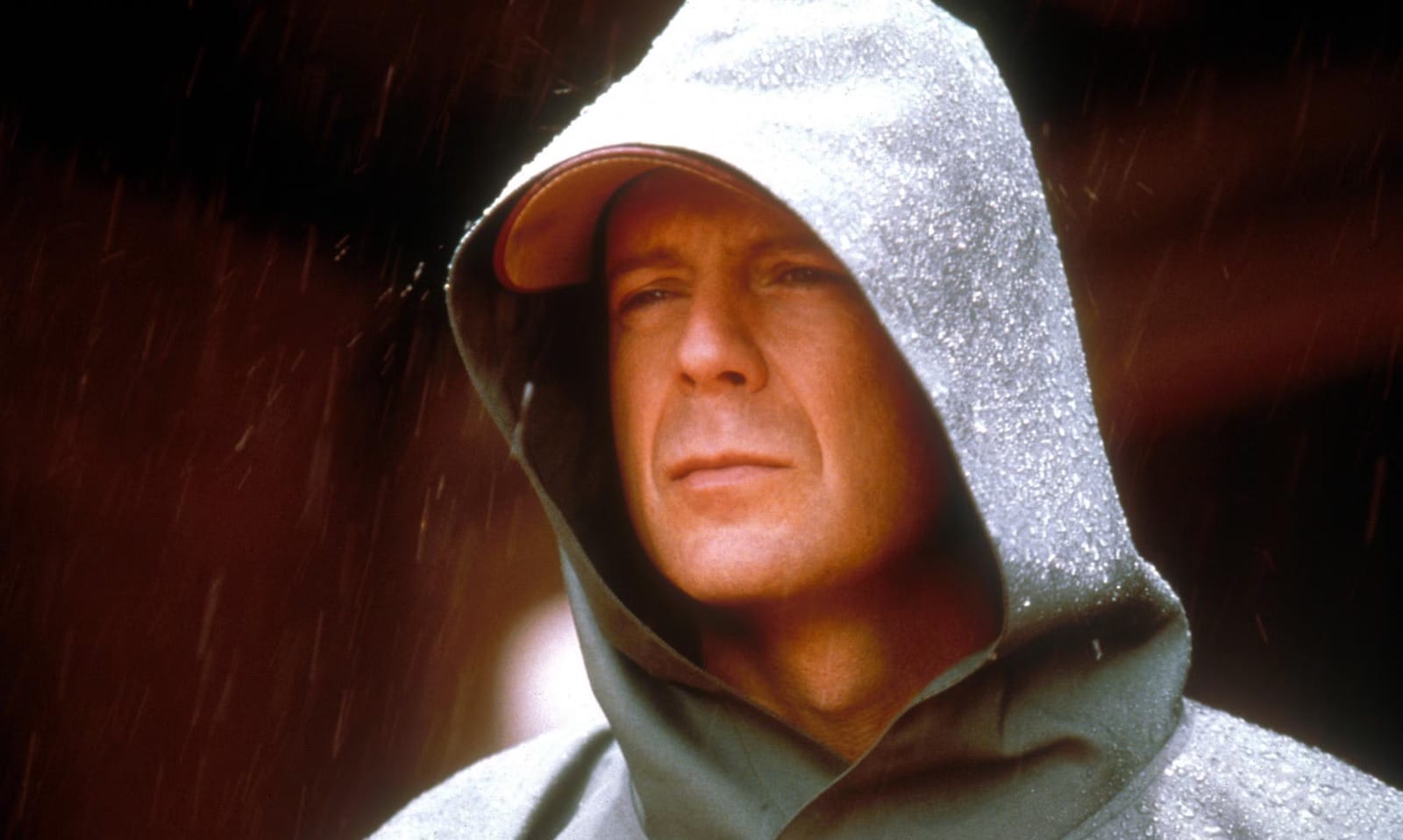
Yes, “it’s not a horror film”—though there’s a lengthy setpiece toward the end that’s as chillingly powerful as anything in this year’s straight genre movies. But most of Unbreakable aims for drama and mystery rather than tingling the spine, and for the most part, Shyamalan succeeds. Once more, he draws a finely tuned, low-key performance from Bruce Willis, again playing a man who suffers a tragedy and finds it leading him into paranormal realms. As his guide, a mysterious man with apparent untapped reserves of anger, Samuel L. Jackson resists the temptation to overplay and makes his character intriguing and compelling.
Complementing the two strong leads is Shyamalan’s absolute control over the visuals and pace, which is deliberate but rarely bogs down. He likes to let scenes play out naturalistically, placing and moving the camera just right to bring out the necessary emotions. This time, though, his script isn’t quite as strong; there are scenes whose purpose in the narrative remain obscure, and the broken relationship between Willis’ character and his wife (Robin Wright Penn) isn’t as convincing as the scenes between Willis and Olivia Williams in Sixth Sense.
On the other hand, there are certain moments here, particularly a confrontation between Willis and his young son (Spencer Treat Clark, facing unenviable but inevitable comparisons with Haley Joel Osment, but carrying himself admirably) that might have been ludicrous or offensive in other hands, but which Shyamalan gets away with through his strong directorial control. Also noteworthy are Eduardo Serra’s photography, which effectively desaturates the images without descending into the arty, monochromatic emptiness of the likes of Get Carter, and the excellent score by James Newton Howard.
You’ll notice that I haven’t said very much about the plot of Unbreakable, but that’s not just because I don’t want to spoil any surprises. Indeed, most of the movie is concerned less with startling the audience than with gradually uncovering new layers and levels of the story and characters, which is something I’m equally loath to give away. Unbreakable is a film that’s just as concerned with the trip as with the surprise destination, and in many ways, the real dramatic climax—as in Sixth Sense—is the next-to-last scene, one not of revelation, or even of catharsis, but of reconciliation.